
Why This Matters
• Italian tennis scores a breakthrough moment: Luciano Darderi advances to his second ATP final of the season—a strong signal that Italy's clay-court talent depth extends well beyond Jannik Sinner.
• Championship pedigree matters: Darderi has won 4 of his 5 career ATP finals, a closing-rate that separates rising prospects from established contenders.
• Career milestone achieved: At age 23, Darderi has reached his sixth career ATP final and holds a world ranking of No. 21, the highest point in his professional trajectory.
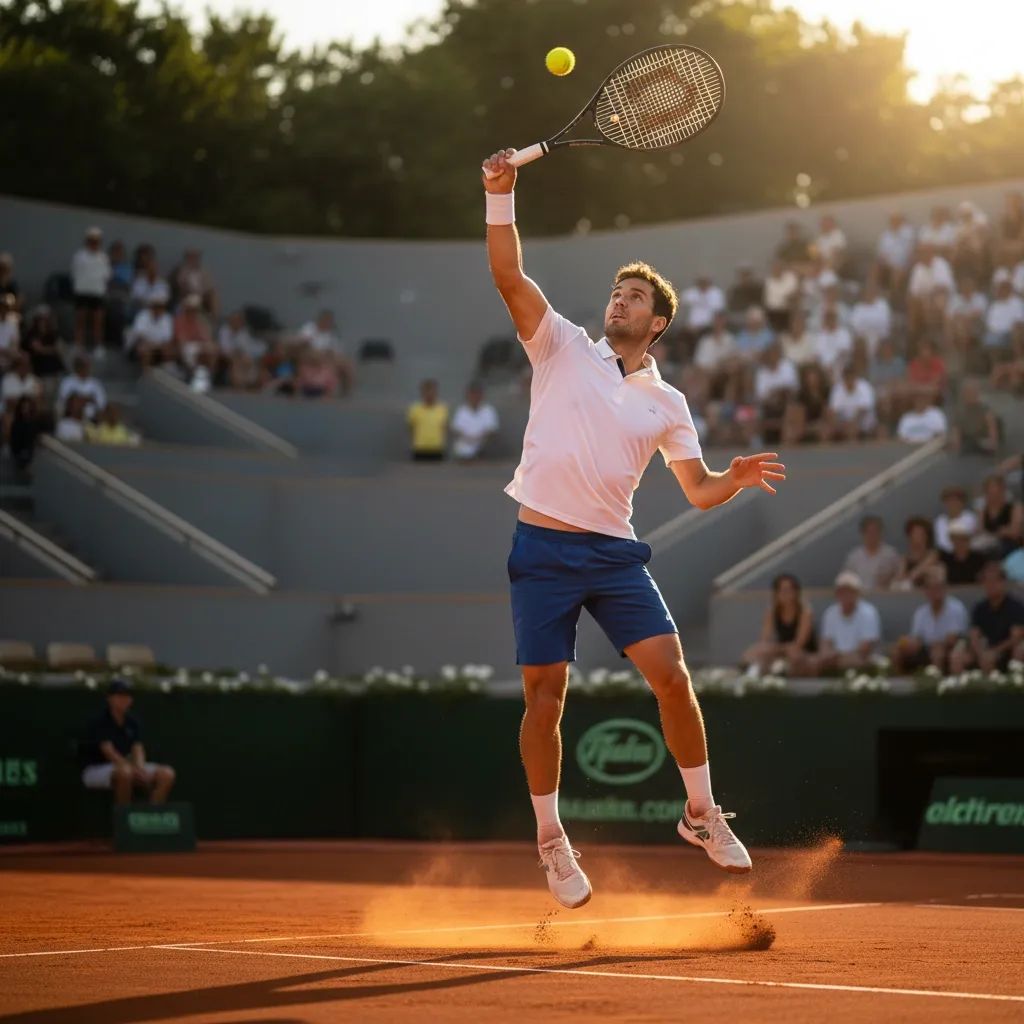
On the clay courts of Santiago, the Italy-based Darderi engineered a convincing dismantling of Argentina's Sebastian Baez, winning 6-4, 6-3 in under 90 minutes to claim his spot in Sunday's championship match. The semifinal performance was emphatic—purposeful serve placement, disciplined baseline exchanges, and timely aggression when the moment demanded it. Waiting on the other side of the net is Germany's Yannick Hanfmann, a 34-year-old veteran ranked 81st globally who pulled off a shock victory over tournament top seed Francisco Cerundolo to earn his first ATP final of 2026.
Darderi enters as the clear favorite. He owns a 2-0 career record against Hanfmann, and his statistics this season paint the portrait of a player operating at a genuinely advanced level. Through early March, his win-loss ledger reads 7-4, representing a 63.6% conversion rate—well above the threshold separating contenders from pretenders. Every match he has played in 2026 has produced at least one service break, a rare consistency that speaks to both his serving reliability and the potency of his return game.
The Baez Roadmap: Efficiency Over Drama
Darderi's path through Santiago's draw resembled a player who had done his homework. He dispatched Mariano Navone in the second round via a tightly contested three-setter (6-3, 3-6, 6-4), then outclassed Andrea Pellegrino in the quarterfinals with a near-identical scoreline (6-3, 3-6, 6-2). The semifinal against Baez—a player renowned for grinding baseline exchanges and relentless court coverage—posed a different question: could Darderi accelerate the rhythm?
The Italian answered decisively. Breaking Baez's serve at pivotal moments, he controlled both sets without ever facing the pressure of a tiebreaker. The performance suggested tactical maturity that typically takes years longer to develop. Rather than engaging Baez in the Argentine's preferred extended rallies, Darderi moved with purpose, ran around his backhand to unleash inside-out forehands that opened the court, and finished points with clinical precision. For an opponent accustomed to opponents matching his patience, Darderi's tempo-shifting proved disorienting.
This particular victory carries symbolic weight within Italian tennis circles. Baez represents the conventional South American clay specialist—a player comfortable in the mud, confident in congested court positioning, and capable of outlasting less disciplined opponents. The Italian's ability to neutralize these attributes without relying on thunderous shot-making demonstrates how thoroughly Darderi has evolved from a promising junior prospect into a legitimate tour competitor.
Hanfmann's Upset and the Veteran's Challenge
Yannick Hanfmann's journey to the final deserves separate consideration, not least because it disrupts the narrative of inevitable youth triumph. Standing 1.93 meters tall and capable of generating serves exceeding 230 km/h, Hanfmann represents a specific archetype: the European hard-court specialist who has gradually adapted his game toward clay surfaces.
His semifinal demolition of Cerundolo—a ranking favorite and home favorite—demonstrates the caliber of tennis Hanfmann produced in Santiago. The German, who turned professional in 2015 and reached a career-high ranking of 45, spent much of his early-to-mid thirties chasing titles that never quite materialized. His ATP Tour singles trophy cabinet remains empty, yet his longevity on the circuit speaks to consistent competence. Over a career spanning a decade, he has accumulated multiple Challenger circuit victories and ITF titles, evidence of sustained competitive ability.
The 2023 Rome Masters provided his breakthrough moment. In a tournament where elite players congregate, Hanfmann defeated two members of the world's top ten, proving that his big serve and aggressive baseline game could trouble even the most accomplished competitors. This year's Australian Open forced him to confront Carlos Alcaraz in the second round—a losing effort, certainly, but one that confirmed Hanfmann remains capable of extending elite talent.
Against Darderi, Hanfmann faces a clear underdog position. His 7-4 record through early March matches Darderi's, but the composition of those wins differs markedly. Hanfmann has survived more difficult draws and tougher conditions, his victories accumulated against journeymen and lower-ranked opponents who lack the Italian's systematic precision.
The Mechanics of Darderi's Excellence
What distinguishes Darderi from the dozens of other ambitious European junior champions is not raw power but rather a calculated, almost mathematical approach to point construction. His forehand delivers respectable speed, but his real weapon is pattern recognition and tactical economy. He identifies which side his opponent prefers to occupy, consciously directs the ball to the opposite flank, and when a defender overcommits, he exploits that overcommitment with precision rather than violence.
The numbers validate this observation. Through 11 matches in 2026, Darderi has averaged 6.14 aces per match—a number that places him in the 84th percentile among professional competitors. More tellingly, he has converted 50% of his break-point opportunities, a ratio typically reserved for top-20 returners. He has forced a service break in 100% of his matches and delivered at least one ace in every contest. These are not outlier performances; they represent his established baseline.
Where Darderi demonstrates particular strength is in consistency across tournament formats. His record in ATP finals reads 4 wins against 1 loss. The loss came relatively recently—a February 2026 Buenos Aires final against Francisco Cerundolo. Rather than allowing that reversal to derail momentum, Darderi traveled directly to Santiago and immediately returned to the final stage, demonstrating sustained competitive drive.
What This Means for Residents
For anyone tracking Italian tennis beyond Sinner's inevitable dominance, this event matters considerably. Darderi represents the depth that separates genuine national strength from one-player reliance. His No. 21 ranking places him fourth among Italian male competitors, a ranking that would have seemed ambitious just 18 months ago. Should he defeat Hanfmann on Sunday, Darderi claims his fifth ATP title before turning 24—an accomplishment that invites serious discussion about where his ceiling might ultimately rest.
More practically, a victory in Santiago positions Darderi favorably for the upcoming European clay season. The spring swing includes tournaments in Barcelona, Madrid, and Rome, each presenting opportunities for a player of his caliber to accumulate ranking points and momentum heading into the French Open. Current trajectory suggests he will arrive at Roland Garros as a genuine contender rather than a curious talent.
For casual observers who follow Italian sports, Darderi's ascent matters in a different register. Italy's dominance in men's tennis—historically confined to rare individuals—now encompasses an emerging cohort capable of competing consistently at tennis's highest level. This reality translates into sponsorship opportunities, media attention, and crucially, investment in tennis infrastructure from the government and private sponsors who recognize that competitive advantage often flows to nations with robust talent pipelines.
Sunday's Equation
The fundamental calculus of the final appears straightforward. Darderi possesses superior ranking, superior championship experience, and superior head-to-head record. Hanfmann enters as an underdog competing in his first ATP final.
The Italian will almost certainly dictate the baseline exchanges. His movement proves superior to Hanfmann's, and his court positioning sense represents years of development on precisely this surface. Should Darderi establish rhythm early and break Hanfmann's serve once in each set, the match likely concludes in two sets. Hanfmann's path to victory requires either unseating Darderi's service games through aggressive returning or generating sufficient aces and winners to prevent the Italian from establishing his preferred tempo.
The most probable outcome favors the higher-ranked player with proven championship experience. But tennis tournaments rarely progress according to probability. Hanfmann's demonstrated ability to execute at high intensity—his victory over Cerundolo the most recent evidence—ensures that Sunday's match will test Darderi's technical abilities under pressure.
That contest is what makes it worth watching.


