
Why Cagliari This Month, Naples Next Summer—And Why Italy Should Care
CAGLIARI, May 15, 2025 — The Italian sailing community is about to experience the busiest year of competitive regattas in a generation. Beginning May 21, Cagliari's waters host the 38th America's Cup preliminary race, with six challenger teams vying for position before the circuit shifts to Naples for the main event in summer 2027. What began as a prestigious sailing contest has become a live infrastructure test, an economic stimulus package, and a referendum on whether Italy can execute at the highest sporting level while regenerating one of its most troubled urban centers.
The catalyst for this momentum is a simple fact: Team Australia has officially entered the competition, completing a challenger field so robust that even seasoned sailing analysts are calling it the deepest pool in two decades. For people living in Italy—particularly in the south—the implications run far deeper than trophy contention. This is about jobs, urban renewal, tourism revenue, and whether the country can leverage sport to fix decades-old problems.
The Competitive Landscape Takes Shape
The Sardinian regatta begins May 21, and it serves as the first real acid test under the new rulebook. Six challenger teams will compete against the defending champion: Luna Rossa Prada Pirelli (Naples-based), Athena Racing (United Kingdom, represented by Sir Ben Ainslie's squad), Tudor Team Alinghi (Switzerland), K-Challenge (France), American Racing (USA, Sail Newport), and the newly confirmed Team Australia. They face Emirates Team New Zealand, the defending champion that has held the trophy since its fifth consecutive victory in October 2024.
Max Sirena, skipper and operations chief of Luna Rossa, framed the significance without hyperbole. "This is the highest technical and sporting level in probably 20 years," he said during a broadcast interview from Luna Rossa's permanent training base in Cagliari. That assessment predated the Australia confirmation, and the addition of a nation with serious sailing pedigree has only intensified the competitive pressure.
Team Australia's roster tells the story. Leading the charge is Tom Slingsby, an Olympic medalist and two-time World Sailor of the Year, as Head of Sailing. Glenn Ashby, a three-time America's Cup winner with New Zealand, oversees performance and design strategy. The team's CEO is Grant Simmer, who crewed on the legendary Australia II boat that snapped the New York Yacht Club's 132-year reign in 1983. That's not nostalgia hiring—that's strategic experience. The squad also includes 21-year-old Tash Bryant, a rising talent who fulfills the sport's historic first: every AC75 crew (the racing yacht class) must now include at least one female sailor.
Grant Dalton, Chairman of the America's Cup Partnership and Emirates Team New Zealand's CEO, acknowledged what this field represents. "We recognize Australia as a formidable opponent and understand the sailing talent they possess," he told organizers. Translation: this won't be easy.
The Technical Battlefield: Where Margins Get Measured in Millimeters
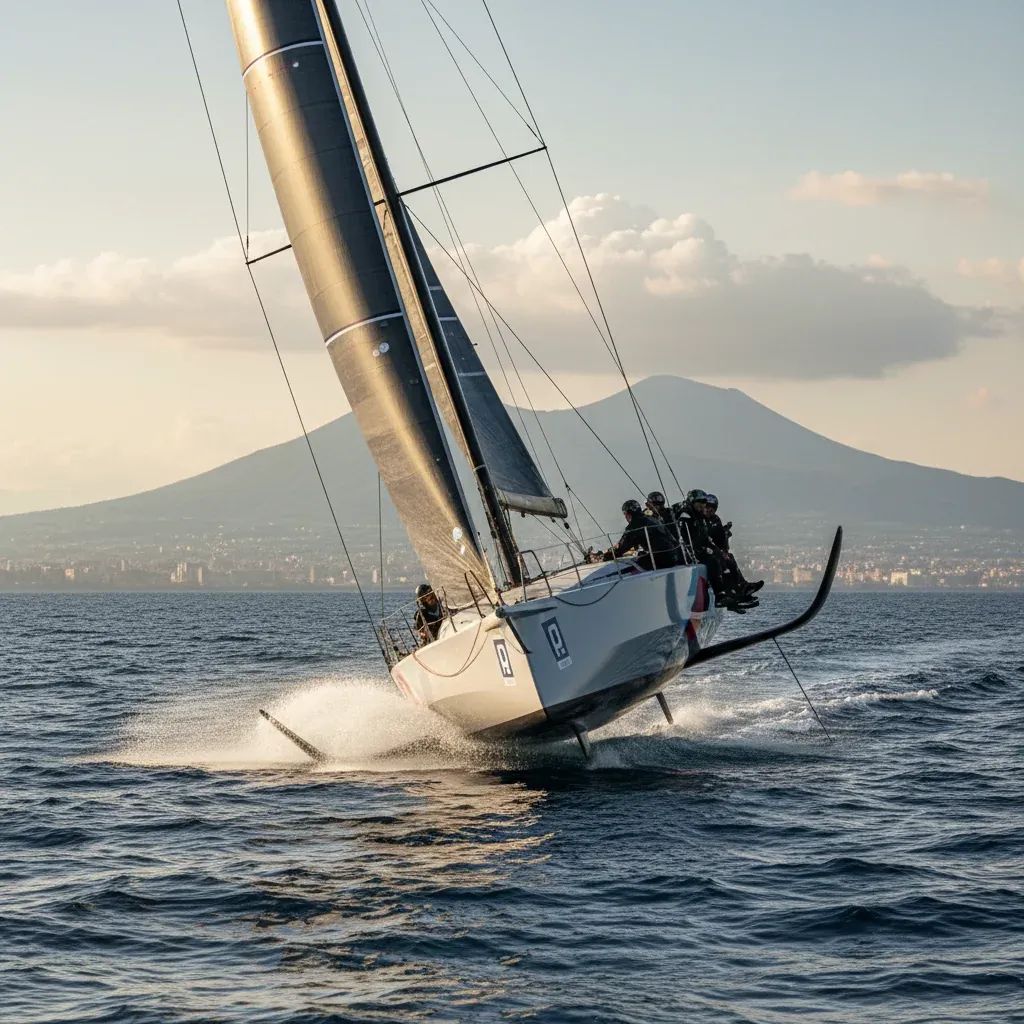
Understanding why this competition matters requires a brief detour into the engineering. The new AC75 rulebook (the one-design yacht class for this Cup) has imposed hard constraints: a €75M spending cap per team, mandatory hull reuse (either AC37 designs or modified AC36 models), and the elimination of cyclors—the grinding crew that powered hydraulic systems. In their place: lithium-ion battery systems that reduce weight and shift the performance advantage to foil design and control precision. Foils are the wing-like appendages that lift the boat onto the water, enabling speeds exceeding 50 knots.
Crews have been trimmed from eight to five sailors, placing enormous pressure on cross-training and tactical coordination. The radical shift means that innovation happens in a narrower window: foil geometry, hydraulic control responsiveness, and crew coordination under high-speed foiling conditions—the phase where the boat lifts onto its foils and loses all contact with water.
For teams based in Europe, Cagliari's preliminary round is also a practical reconnaissance mission. They'll assess weather patterns, understand local maritime conditions, and gather data before the higher-stakes Louis Vuitton Cup (the selection series determining which challenger faces the defender) next spring. For Luna Rossa, competing essentially on home waters, the stakes are inverted—they must perform credibly without the pressure-excuse of early-season learning.
The Cagliari Test and What's at Stake Locally
The May 21-24 preliminary regatta in Sardinia is drawing enormous regional attention, and for good reason. Luna Rossa maintains a permanent base in Cagliari with roughly 140 full-time staff. The preliminary race is expected to inject approximately €50M into the regional economy against a public investment of just €7M. That's a 7-to-1 return on a single week of racing.
Sirena downplayed the pressure of racing at home but acknowledged its reality. "We'll have an entire nation watching. The pressure is part of the sport, and I don't think it will be a problem. We've been preparing for a long time." What he left unsaid: Luna Rossa cannot afford a poor showing. A stumbling performance in Cagliari would feed skepticism about the team's readiness for the main event and complicate the narrative around Italian competitiveness.
The second preliminary regatta was originally proposed for Naples in late June 2026 but remains unconfirmed, with organizers withholding details on revised timing. It is expected to occur in Naples before the Louis Vuitton Cup selection series kicks off in spring 2027.
Why Naples Matters Beyond Sailing
For residents of Naples and the Campania region, the America's Cup is not merely a regatta—it is a development catalyst with concrete, measurable consequences. The Bagnoli district, site of massive industrial decline since the Ilva steel plant closed, has been selected to house team bases and fan zones. It is also the focal point of a broader urban regeneration project that has stalled for decades.
The numbers attached to this event are staggering. A 2024 study by the Ministry of Tourism and Luiss Business School projects long-term economic value of €1.2 billion. Short-term analysis by the Unimpresa Center for Studies estimates €690M for Campania, with an additional €150-250M ripple effect through the rest of southern Italy. Over the five to ten years following the event, potential cumulative benefit reaches €1-2 billion.
Breaking this down: €370M in direct tourist spending on lodging, dining, and transport; €100M in organizational costs (70% spent locally); €165M in induced public and private investment for port upgrades, bonding, and facility work; and €50-100M in private sector spending on maritime technology, shipbuilding, and blue-economy industries.
The visitor projection is bold: 1.5-1.7 million people during the roughly 60-day event window, with 400,000-500,000 international tourists arriving specifically for the races. If realized, this would lift Naples's annual tourism traffic by 5-10% and inject an additional €200-400M annually into the regional economy for the next decade.
Job creation stands at 11,000-12,000 positions, with 1,000-2,000 permanent roles in maritime services, tourism, and hospitality. For a city with persistent unemployment challenges, this is transformational. Officials have committed to announcing formal job application processes by July 2025, with initial infrastructure work beginning in Bagnoli by September 2025. Ticket sales are expected to open by January 2027.
Technical Regulations Level the Playing Field
The technical regulations and spending cap, while not eliminating inequality, have genuinely narrowed the performance gap. Teams cannot simply outspend rivals into dominance. Instead, design ingenuity—particularly in foil efficiency—becomes the differentiator.
Sirena singled out K-Challenge, the French team, as the most visibly reinforced. "They've strengthened not just in sailing talent but in technical and design resources," he noted. Athena Racing, guided by Sir Ben Ainslie after his 2024 loss to Emirates Team New Zealand, enters as Challenger of Record and is formidable. Team USA's American Racing acquired New Zealand's Patriot AC75 and training vessels, meaning they inherit proven hardware while building fresh tactical approaches.
For Luna Rossa, homefield advantage cuts both ways. They operate with internal knowledge of Naples's layout and conditions but under continuous domestic scrutiny. The team has expanded its roster, brought in specialists, and committed to a methodical development timeline. Sirena expressed confidence without arrogance: "We have an excellent foundation, reinforced by new personnel. We have many months and a clearly defined program for technical development and crew training."
Broadcasting, Visibility, and the Home Crowd Factor
Sky Italia has secured exclusive Italian broadcast rights, meaning all events—from preliminary races through the final match on July 10-18, 2027—will be available via Sky and streaming on NOW. This accessibility removes geographic friction. Italians across the country, from Milan to Palermo, can follow their team without cable or paywall barriers.
That visibility is a sword. It means Luna Rossa will operate with unprecedented media attention. Every practice session, every training run, every tactical misstep will be analyzed and second-guessed. Sirena understands this dynamic. He reframed it as opportunity: "An entire nation will follow us. That's the reality of racing at home, and it's not a problem—it's something to embrace."
The Broader European Sailing Story
Australia's return to the America's Cup after 25 years is symbolically important to the southern hemisphere sailing community. Grant Simmer, speaking for the Australian team, called it a homecoming: "Australian talent scattered across teams worldwide has reunited to compete for our country. This challenge has profound meaning."
But Australia's entry also sends a message to every sailing federation watching: the America's Cup is open. If Australia can rally resources and talent, so can others. That competitive dynamic—the sense that victory is possible with strategic investment and smart recruitment—is exactly what rules designers hoped to create.
What's Next: The Timeline
May 21-24: First preliminary regatta, Cagliari.
Spring 2027: Louis Vuitton Cup Challenger Selection Series, with the exact schedule and venues still under finalization.
July 10-18, 2027: 38th America's Cup Match, Naples, under the shadow of Mount Vesuvius.
For people living in Italy, these dates represent more than a sporting calendar. They represent infrastructure deadlines, tourism revenue forecasts, employment projections, and a wager that the country can execute at a world-class level. Whether Luna Rossa wins the trophy matters, but whether Italy successfully hosts, benefits economically, and rebuilds urban spaces matters more—and affects millions of people daily.
The preliminary regatta in Cagliari begins on May 21. The real test begins now.


