
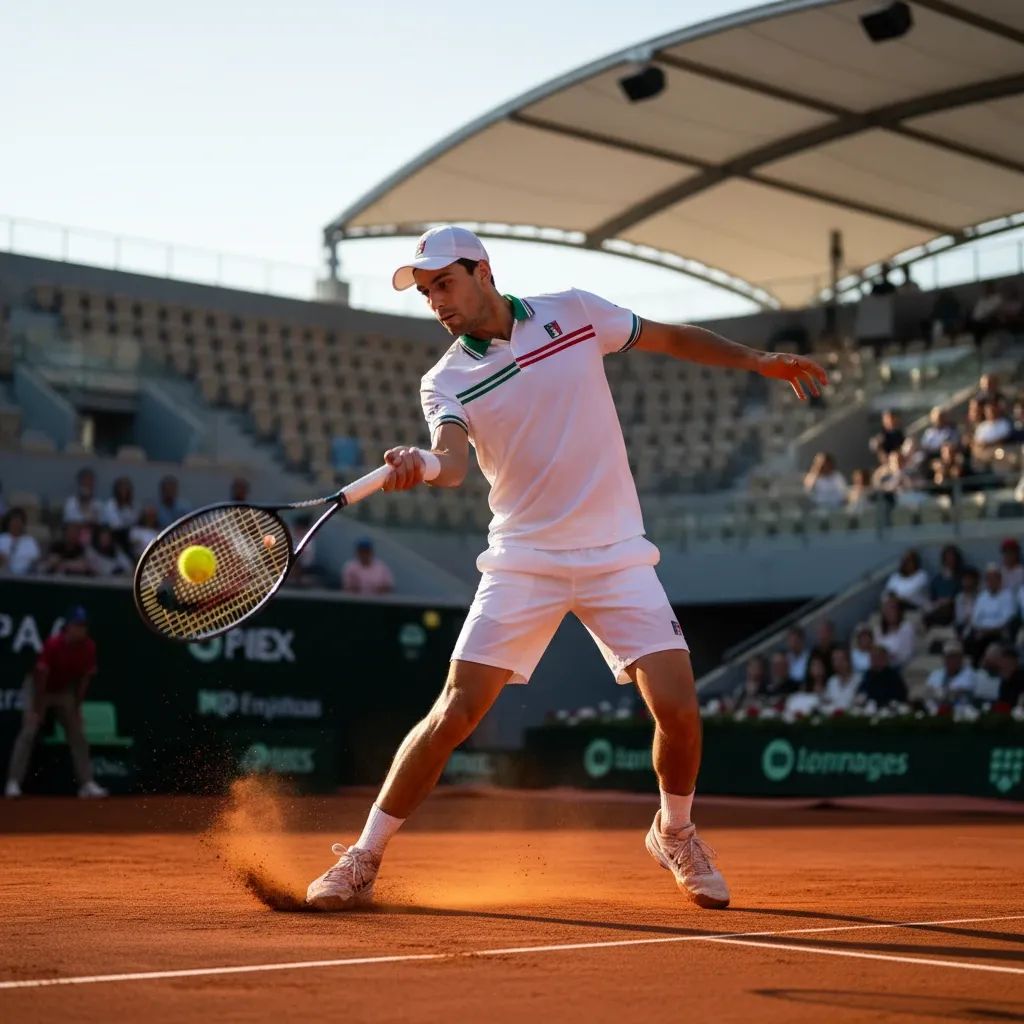
Two Italy tennis stars are battling exhaustion and high expectations at Rome's Foro Italico, as Jannik Sinner and Luciano Darderi prepare for separate semifinal matches that could redefine the nation's sporting identity. The tournament has exposed both the physical toll of an elite tennis season and the structural advantages that have catapulted Italy's racquet sport past its traditional football dominance.
Why This Matters
• Record-breaking streak: Sinner has won 32 consecutive Masters 1000 matches, surpassing Novak Djokovic's previous record while openly admitting fatigue.
• Strategic rest calculation: Both players are managing their Rome performance as preparation for the French Open, which Sinner has declared his primary seasonal objective.
• System vs. talent debate: Football legend Paolo Maldini, attending Sinner's match, credited long-term programming for tennis success—the very element he says Italian football has lacked.
The Physical Price of Dominance
Jannik Sinner's triumph over Andrey Rublev in the quarterfinals came with a candid admission rarely heard from athletes in peak form. "I'm happy about the record, but I'm focused on recovering physically," the South Tyrol-born champion told reporters. "I've been feeling that I've played a lot lately. If tomorrow goes badly, at least I'll have more time to recover for Paris, which is my main goal this season."
The comment reflects a broader pattern emerging in Sinner's 2026 clay season. Despite winning five consecutive Masters 1000 titles and remaining unbeaten on clay this year, he has dealt with a lower back issue requiring medical attention in Monte Carlo in April, a minor shoulder problem during Madrid training sessions, and recent discomfort in his left leg. His semifinal match against the winner of Daniil Medvedev versus Martín Landaluce is scheduled for 7:00 PM at the Foro Italico's Central Court—an evening slot that Sinner noted would be "tougher physically."
Coach Simone Vagnozzi has publicly confirmed that Sinner is recovering well and improving daily, but the player's transparency about fatigue signals a calculated approach to the season. The French Open represents an opportunity to complete the Career Grand Slam, and Rome serves as both a tuning ground and a potential energy drain.
The Argentine-Italian Revelation
While Sinner manages the weight of expectations, Luciano Darderi is rewriting his career trajectory. The 24-year-old from Villa Gesell, Argentina, who gained Italian citizenship through his Fano-born grandfather, reached his first-ever Masters 1000 semifinal by defeating teenage sensation Rafael Jodar in a grueling three-hour quarterfinal that stretched past midnight.
"What I'm living is a dream, and I still can't believe it," Darderi said after the match, which was briefly interrupted when smoke from the Coppa Italia football final drifted across the court, obscuring the electronic line-calling system. He joked that the haze resembled "an asado with the family"—a reference to traditional Argentine barbecues.
Darderi's path to the semifinals included a landmark victory over world number 3 Alexander Zverev, his first-ever win against a top-10 opponent. His semifinal opponent, Casper Ruud, awaits at 3:30 PM on the same Central Court. The winner could potentially face Sinner in a final attended by President Sergio Mattarella, creating the possibility of an all-Italian championship match.
The player known as "Luli" in Argentina and "Lucio" in Rome moved to Italy at age 10 to train under the Federazione Italiana Tennis e Padel (FITP) system, developing through academies in Arezzo and Rome under the guidance of his father and former player, Gino. His recent surge has lifted him to a projected 16th ranking in the ATP standings, a personal best. With five career ATP singles titles—all on clay—he has won three titles during the 2026 season alone, becoming the third Italian to achieve three clay titles in a single season, following Adriano Panatta's 1977 feat and Matteo Berrettini's 2024 achievement.
What This Means for Italian Sport
The tennis renaissance unfolding at the Foro Italico has not escaped the attention of Italy's sporting elite. Paolo Maldini, the former AC Milan and national team captain, was spotted courtside during Sinner's quarterfinal. When asked whether he anticipated tennis overtaking football in national interest, Maldini delivered a pointed critique.
"Having a number 1 in the world increases interest, but having so many players in the top 100 is not a coincidence," he said. "It requires programming—the very thing that has been missing from football. Italy has always been a nation of talents and virtuosos."
Maldini's observation reflects a growing consensus within Italian sport. The FITP (Federazione Italiana Tennis e Padel) invests significantly in talent development through structured programs like the Young Talent Team, which provides scholarships and removes financial barriers for players aged 12 to 18. The federation hosts numerous Challenger and Future tournaments domestically, allowing young players to transition to professional circuits without extensive international travel. A tiered Junior Program with five certification levels ensures methodological consistency across training centers, while support extends to coaches through workshops, data analysis, and access to physiotherapists.
By contrast, Italian football has acknowledged a "talent crisis." The Evolution Programme, active since 2015 through regional development areas and territorial centers, was supplemented in March 2026 by a new youth development project aimed at shifting focus from tactical results to individual technical skills. The initiative represents an effort to emulate the tennis model. Yet cultural obstacles remain: youth coaches often prioritize winning over development, and rising academy costs limit access for many families.
The tennis system's emphasis on merit-based progression, post-18 support, and international exposure has produced not just Sinner, but a cohort of top-100 players including Darderi, Lorenzo Musetti, and Matteo Arnaldi.
Impact on Residents and Fans
For Italians, the semifinal stage at Rome offers a rare spectacle: two homegrown players competing in different brackets with a realistic chance of meeting in the final. The tournament has sold out its premium seating for both semifinal sessions. Residents interested in attending can check the official Foro Italico website for official ticket availability and pricing information, as secondary market tickets are also circulating at varying price points.
Beyond the immediate sporting drama, the success of Italian tennis provides a template for other national federations and youth sports organizations. The FITP model has already been studied by international tennis bodies, and its principles—long-term investment, accessible pathways, and merit-based support—are now being cited as a counter-example to the short-term thinking that has plagued Italian football.
The women's draw has also delivered: Coco Gauff reached her second consecutive Rome final by defeating Sorana Cirstea in straight sets, and will face either Iga Świątek or Elina Svitolina. Gauff's consistency at the Foro Italico mirrors the tournament's growing stature, with attendance and broadcast viewership reflecting increased interest.
Managing Expectations and Energy
Darderi's team has opted for a minimal training schedule before his Ruud semifinal—light movement, massage, ice therapy, and sleep following a near-sleepless night after his late Jodar match. "I won it physically," he reflected. "But I also feel mentally stronger. I've made a quality leap by never giving up, though I still have so much to learn."
Sinner's approach mirrors this caution. Despite his historic win streak, he framed the Rome tournament as both an opportunity and a calculated risk. "The Italian tennis scene keeps producing new phenomena who become potential opponents," he said of Darderi and the emerging cohort. "I know Luciano; we've trained together a couple of times in Dubai. I have a good relationship with everyone, and we're a solid team. Now there are so many of us, and each has his own style of play."
The subtext is clear: the depth of Italian tennis has created internal competition, but also mutual support. Both players understand that their performance in Rome must be balanced against their readiness for the clay-court Grand Slam in Paris, which begins later this month.
Whether exhaustion or adrenaline prevails in the Rome semifinals, the tournament has already demonstrated that Italian tennis is no longer dependent on a single star. The system that Maldini praised—and that football is now attempting to replicate—has produced a generation capable of sustaining success beyond any individual's career. For residents watching at the Foro Italico or on television, the question is no longer whether Italy can compete at the highest level, but how long this golden era can last.


