
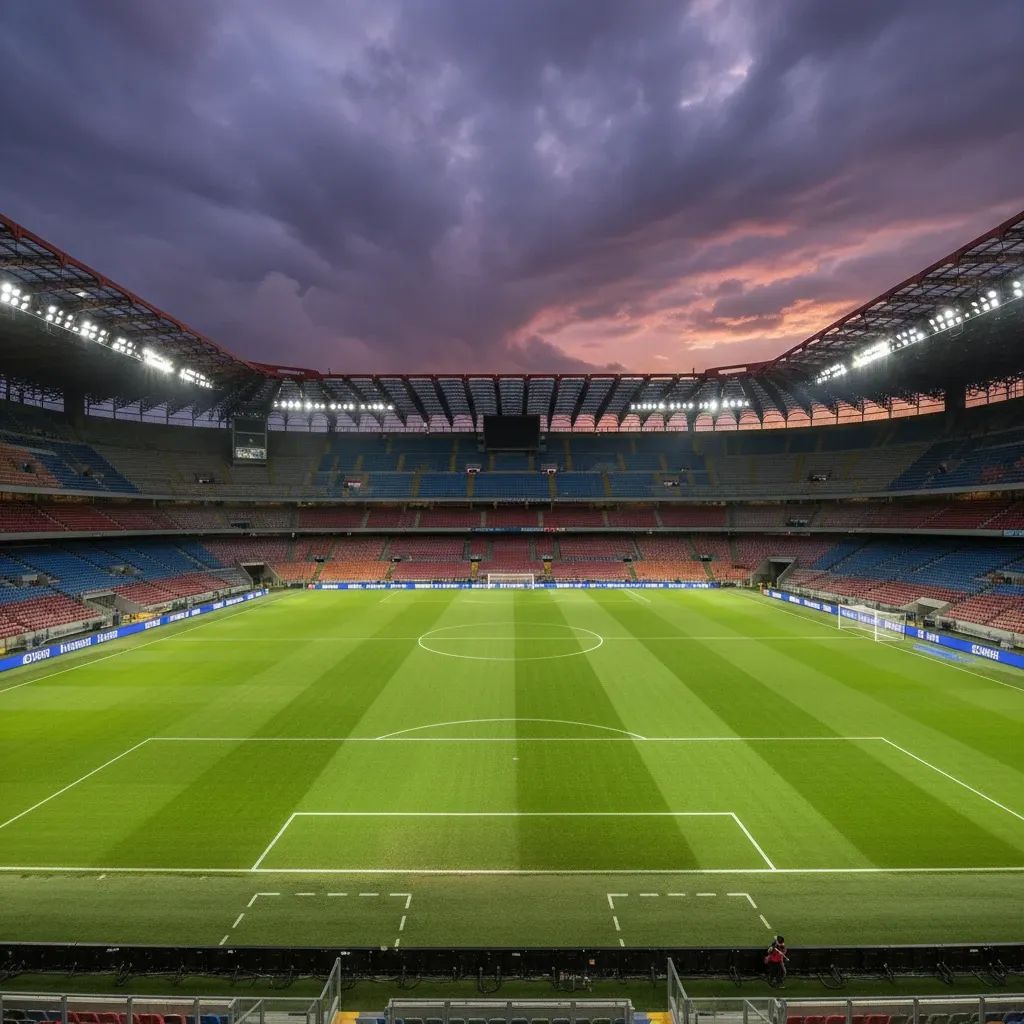
Italian Serie A faces a legal standoff that could upend the final week of its season, as the league challenges a Rome prefect's decision to move the capital's derby to a Monday evening slot—a scheduling shift that threatens the integrity of the final matchday that will determine which clubs qualify for next season's lucrative UEFA Champions League, affecting nearly €80 million in potential revenue and impacting approximately 300,000 fans.
Why This Matters
• Champions League qualification stakes: Five matches involving six clubs competing for spots in next season's Champions League must now be rescheduled, breaking the mandatory simultaneous kick-off rule designed to prevent match-fixing.
• Economic impact: Qualification for the Champions League group stage is worth roughly €80M per club—enough to reshape transfer budgets and wage bills for years.
• Legal deadline: The Regional Administrative Court (TAR) is expected to rule as early as today, Thursday, May 14 (just three days before the original Sunday kickoff), determining whether the Rome-Lazio derby stays on Monday, May 18 at 8:45 PM or reverts to its original Sunday slot.
• Fan disruption: Approximately 300,000 ticket holders across five cities face potential travel chaos, with a national public transport strike also scheduled for Monday, May 18.
The Scheduling Collision
The controversy began when Rome's Prefect Lamberto Giannini issued Ordinance No. 198845 on May 12, postponing the Rome versus Lazio derby from Sunday, May 17 at 12:30 PM to Monday, May 18 at 8:45 PM. The prefect cited public order concerns tied to the overlap with the Internazionali BNL d'Italia tennis finals at the Foro Italico, located just 450 meters from the Stadio Olimpico.
Both venues sit in Rome's northern Flaminio district, and authorities estimated that hosting a high-stakes football derby and a Grand Slam-level tennis final within hours of each other would create unmanageable crowd density and strain public transport. The Stadio Olimpico is accessible via Metro A (Flaminio station) and several bus lines—all potentially affected by the Monday transport strike. With tens of thousands converging on the area simultaneously, the Provincial Committee for Public Order and Security deemed the risk too great.
Serie A had scheduled the derby and four other critical matches—Pisa-Napoli, Juventus-Fiorentina, Genoa-Milan, and Como-Parma—for simultaneous 12:30 PM Sunday kick-offs to preserve competitive fairness. These six clubs are locked in a tight battle for three remaining Champions League berths, and any knowledge of other results before a match begins could distort tactical decisions and create an unlevel playing field.
The League's Counteroffer and Rejection
Rather than accept the prefect's Monday postponement, Ezio Maria Simonelli, president of Serie A, proposed a compromise: move all five matches to Sunday, May 17 at noon, and ask the Italian Tennis Federation (FIT) and Sport e Salute (the state-owned sports infrastructure operator) to delay the tennis final from 3:00 PM to 5:30 PM. Simonelli argued that a 90-minute buffer would allow football crowds to disperse before tennis spectators arrived.
"We are offering flexibility of half an hour on our side, and I hope the tennis federation and Sport e Salute can do the same to shift the final to 5:30 PM and provide an extra hour for people to leave," Simonelli said after an emergency league assembly in Rome. "We believe this timeframe is more than adequate to ensure smooth crowd management. I hope we can find an intelligent solution that allows both events to proceed peacefully and privileges the interests of all the fans."
Sources close to the Interior Ministry swiftly labeled the proposal "not feasible." By evening, the league filed an urgent appeal with the TAR, seeking to overturn the prefect's order. The tribunal is expected to deliver a verdict today, potentially reversing the postponement or upholding the Monday slot.
Coaches, Candidates, and Confusion
The uncertainty has drawn sharp criticism from those directly involved. Maurizio Sarri, head coach of Lazio, launched a scathing attack on the league's handling of the situation, telling Mediaset: "I have the feeling that if we play on Monday, I'll show up. If it's Sunday at 12:30, they can play alone. If I were the club president, I wouldn't even field the team. We'd take a one-point penalty and call it done. The mess comes from a series of errors by the league, and now it has to fix them. Nobody has apologized for the mistake. There are four teams playing for an €80M prize—this isn't football, it's something else."
Sarri's frustration reflects broader anger among clubs that meticulously planned travel, ticket sales, and broadcast logistics around the original schedule, only to see it unravel days before kick-off.
Giovanni Malagò, a candidate for the presidency of the Italian Football Federation (FIGC) and current president of the Italian Olympic Committee, attended part of the league assembly and struck a more diplomatic tone. "I have no role to say anything on this topic," Malagò remarked. "I hope they find a solution that more or less works for everyone. This dispute is certainly not a good look." Malagò had earlier submitted his formal candidacy papers to the FIGC, confirming that all documentation was in order.
What This Means for Residents
For anyone living in Rome, the scheduling chaos translates into concrete logistical headaches. If the TAR upholds the Monday evening slot, expect:
• Transport strain: A general public transport strike is scheduled for Monday, May 18. Check ATAC and Trenitalia websites for exact timing and affected services (strikes typically occur during specific hours such as 8:30 AM-12:30 PM and 5:00 PM-9:00 PM). Reaching the Stadio Olimpico could require hours of planning or expensive taxi fares.
• Security presence: Enhanced police deployments around the Foro Italico and northern Flaminio district throughout the weekend and into Monday, with road closures and restricted parking zones.
• Economic ripple: Hotels, restaurants, and bars had anticipated a Sunday afternoon rush. Shifting the derby to a Monday night changes customer flow patterns, potentially costing hospitality businesses revenue while creating a midweek surge that many establishments are unprepared to handle.
For fans of the six clubs involved, the uncertainty is equally disruptive. Travel packages booked months in advance—flights, trains, hotel rooms—may need last-minute changes. Some supporters face impossible choices: honor existing commitments or forfeit tickets worth hundreds of euros. Broadcast schedules have also been thrown into flux, with international rights holders scrambling to adjust programming lineups.
The Champions League Factor
The financial stakes underscore why Serie A is fighting so hard. Finishing in the top four guarantees entry into the UEFA Champions League group stage, which brings a minimum payout of around €80M when combining participation fees, broadcast revenue, and matchday income. For mid-tier clubs, that windfall can mean the difference between breaking even and posting a loss, or between signing a marquee player and selling one to balance the books.
Simultaneous kick-offs during the final matchday are mandated by UEFA and most domestic leagues precisely to prevent information asymmetry. If one match kicks off hours before another, a trailing team knows exactly what result it needs and can adjust tactics accordingly—potentially opening the door to accusations of collusion or match manipulation. Serie A argues that forcing the derby and the other four matches into a Monday slot while abandoning the Sunday schedule undermines this principle.
The Legal and Political Tangle
Interior Minister Matteo Piantedosi had earlier suggested that "in the end, a way will be found to guarantee both events," but he also pointedly noted that the scheduling conflict "was something people could have thought about earlier." His comment highlights a lack of coordination between Serie A, the Italian Tennis Federation, and municipal authorities. The tennis finals have been held at the Foro Italico for decades, and the football calendar is published months in advance, yet no one flagged the overlap until it became a crisis.
Prefect Giannini defended his decision by emphasizing the "very many contraindications" of allowing the derby to proceed on Sunday, given the growing prestige of the Internazionali and the safety risks posed by massive crowds in a confined area. His ordinance reflects a broader trend in Italian event management: prioritizing public order over sporting tradition when the two collide.
The TAR now holds the ultimate authority. If it sides with the league, the derby and the other four matches revert to Sunday at noon, and tennis officials must scramble to adjust. If it upholds the prefect's order, Serie A will be forced to accept a Monday night finale—and the competitive integrity questions that come with it.
Coordination Failures Exposed
Beyond the legal wrangling, the episode exposes deeper fragilities in Italian football governance. Serie A and local authorities routinely clash over security protocols, scheduling, and revenue sharing. This latest dispute adds another chapter to a long history of bureaucratic friction that frustrates fans, coaches, and administrators alike.
For now, the only certainty is uncertainty. Fans planning to attend the derby or any of the other four crucial matches should monitor official club channels and news outlets closely. The TAR's ruling, expected later today, will finally determine whether Sunday or Monday hosts the conclusion of one of Serie A's tightest qualification races in recent years.


