
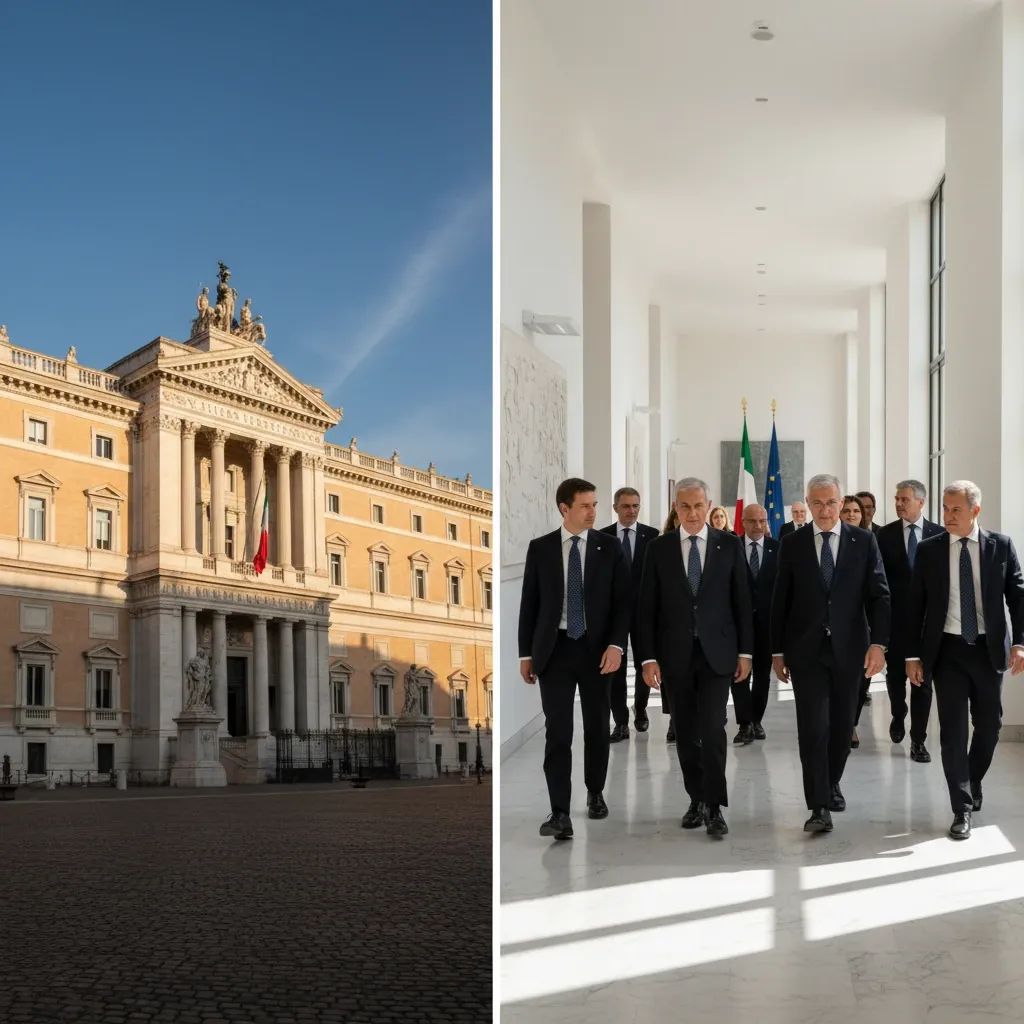
When a government minister openly refuses a direct resignation demand from their Prime Minister, something in the institutional machinery breaks. That's precisely what happened when Tourism Minister Daniela Santanchè walked through her ministry doors on Wednesday morning, arriving at the office as if Premier Giorgia Meloni's public call for her departure 24 hours earlier had never occurred. The standoff exposed not just personal tension between two politicians, but a fracture in the coalition's ability to enforce its own authority—a vulnerability that matters to anyone whose livelihood connects to how Italy manages its government.
Why This Matters
• A minister defying the Prime Minister signals weakening cabinet control ahead of general elections scheduled for 2026 when Italy's parliamentary term concludes, creating uncertainty for long-term planning in sectors dependent on stable government policy.
• The tourism industry faces potential ministerial distraction during crucial investment and promotional planning cycles, though Santanchè has continued organizing scheduled events including May's International Pet Tourism Forum.
• Opposition parties are mobilizing parliamentary removal procedures that will dominate Italian politics for the next two weeks, consuming political energy that should address inflation, energy costs, and infrastructure challenges.
What Triggered This Crisis
The sequence matters. Over the previous weekend, Italy held a referendum on justice-system reform that rejected Meloni's government position convincingly. Voters had spoken against the administration's core judicial proposals—the first significant electoral setback since Meloni took office. The message from voters was blunt: confidence in this government's competence had degraded.
Meloni responded by orchestrating what her coalition calls a "renewal" and critics call a purge. Within 48 hours, two officials from the Italy Ministry of Justice resigned under pressure. Giusi Bartolozzi, serving as Chief of Staff to Justice Minister Carlo Nordio, and Andrea Delmastro Delle Vedove, an Undersecretary, both departed after becoming entangled in separate controversies that opposition parties had weaponized during the referendum campaign. Each scandal carried the potential to damage voter confidence further.
The pattern was clear: when political baggage becomes too visible, the person carrying it steps aside. Meloni believed Santanchè would follow the script.
She didn't.
The Wednesday Morning Theater
Santanchè arrived at her ministry around 10:05 on Wednesday wearing a beige suit and dark sunglasses, flanked by bodyguards. The choice of attire and presentation was deliberate—calculated to project confidence and normalcy despite the political storm. She nodded at waiting journalists without offering any statement. Her silence conveyed the message more effectively than words could: she was continuing as Tourism Minister, period. The resignation demand, in her reading, was negotiable.
This wasn't ignorance of the stakes. Santanchè, a Senator in Meloni's Brothers of Italy party, understands parliamentary procedure and coalition dynamics as well as anyone in Rome. Her background in business gave her experience reading rooms and calculating odds. By simply showing up and conducting ministry business—including strategy meetings for May's International Pet Tourism Forum—she was signaling that she did not accept the Prime Minister's authority to remove her unilaterally.
The defiance was personal but strategic. Several investigations into her business activities prior to entering government had already shadowed her political standing. Those legal questions, which might have remained manageable background noise, had suddenly become central to questions about whether she could continue serving. Santanchè's calculus apparently held that fighting publicly looked better than retreating quietly.
The Parliamentary Mechanics Now in Motion
Opposition parties—emboldened by the referendum result and sensing vulnerability within Meloni's coalition—are preparing a no-confidence motion specifically targeting Santanchè. The procedure is straightforward: a parliamentary vote in the Chamber of Deputies requiring a simple majority for removal. Opposition lawmakers believe they possess the numbers needed to pass such a motion, provided that members of Meloni's own coalition do not defect to defend her.
Historically, this dynamic hinges on a single fact: does the Prime Minister still want the minister in office? When Meloni publicly called for Santanchè's resignation, she essentially signaled no. Parliamentary mathematics then favored removal. Opposition sources suggest the vote could occur within 10 to 14 days, though exact timing depends on coalition coordination.
For Santanchè, the mathematics are unforgiving. She faces a choice between resignation that preserves some dignity and a parliamentary loss broadcast across Italian media—the kind of defeat that permanently complicates career prospects within her own party. A public voting defeat carries consequences beyond mere removal; it becomes a permanent stain.
How This Disrupts Italy's Tourism Sector
Tourism represents one of Italy's most economically vital industries. The sector generates employment throughout regions—Tuscany, Sicily, Veneto, Campania—that depend on international visitor spending to sustain restaurants, hotels, transportation services, and cultural institutions. Without stable tourism revenue, these regional economies contract noticeably.
A Tourism Ministry consumed by internal crisis faces potential complications in executing its core functions. The Pet Tourism Forum planned for May exemplifies this: capturing emerging market segments requires sustained ministerial attention, coordination with regional authorities, and consistent promotional investment. When leadership faces imminent removal through parliamentary procedures, those initiatives could face delays.
The tourism sector also relies on long-term government investment in infrastructure, cultural preservation programs, and international marketing that positions Italy competitively against other Mediterranean destinations. Budget allocations and strategic planning decisions typically depend on political stability. Ministerial transitions can create temporary gaps in sector advocacy during crucial budgetary negotiations scheduled for later in the year.
For businesses in tourism-dependent regions, potential ministerial instability may influence investment decisions. The extent of any practical impact will depend on how rapidly the parliamentary proceedings conclude and whether a successor minister is promptly appointed.
The Coalition's Deeper Problem
This standoff exposes structural vulnerabilities within Italy's ruling coalition that transcend Santanchè's personal legal troubles. Meloni campaigned promising stable, decisive governance as an antidote to years of centrist coalitions criticized as ineffectual. Her administration's early months were marked by confident decision-making and unified messaging across party lines.
That unity now appears conditional. If Meloni cannot enforce resignation requests, observers are already asking, how will she manage more complex policy negotiations involving taxation, energy reform, or European fiscal commitments? These challenges require internal coalition discipline extending across ideological divides and regional interests. The Santanchè episode publicly demonstrates that such discipline is not automatic.
Within the Brothers of Italy party itself, members are calculating implications. If Meloni abandons Santanchè too readily, some party loyalists may question whether leadership commitment runs in both directions. If removal proceeds through parliamentary procedures rather than private persuasion, others may worry their own vulnerabilities could be exploited if political winds shift. The stakes of this standoff extend into party culture and morale.
The Electoral Pressure Mounting
Meloni's political calendar compresses. General elections are scheduled for 2026 when Italy's parliamentary term concludes, though earlier elections could occur if coalition fractures or if strategic considerations favor early campaigns. The government must enter that electoral contest from a position projecting competence and stability, not internal discord.
Opposition researchers have already weaponized Santanchè's legal entanglements in preliminary campaign messaging and social platforms. Allowing her to remain in office during an election campaign would provide months of ammunition for attack advertising and debate coverage. Removing her now, Meloni's team calculated, represented necessary housekeeping before political conflict intensifies.
Yet the strategy has generated exactly the dysfunction that opposition parties most want highlighted when campaigning accelerates. A graceful resignation coordinated privately and announced with unified messaging would have reset the narrative quickly. A public standoff followed by parliamentary removal creates the spectacle of governmental challenge that opposition campaigns are built to exploit.
What Happens Next
Santanchè's official status remained technically unchanged as of Wednesday: she retained her ministerial office and title, though everyone in Italian politics understood her position had become untenable. The no-confidence motion would proceed unless she resigned voluntarily. The parliamentary vote would almost certainly result in her removal.
The next 10 to 14 days determine whether she exits through negotiated arrangement with Meloni's office—preserving some face-saving arrangement—or forces a parliamentary showdown generating additional media coverage and internal coalition tensions. Either way, Italy's tourism policy operations will undergo ministerial transition during months when strategic planning and investment coordination should be occurring.
For residents whose businesses depend on government support or whose employment connects to tourism, the political dynamics in Rome have practical implications. Ministerial transitions can create temporary gaps in permit processing, budget allocation, and promotional campaigns. That's the real impact of institutional friction in a government that promised decisiveness.


