
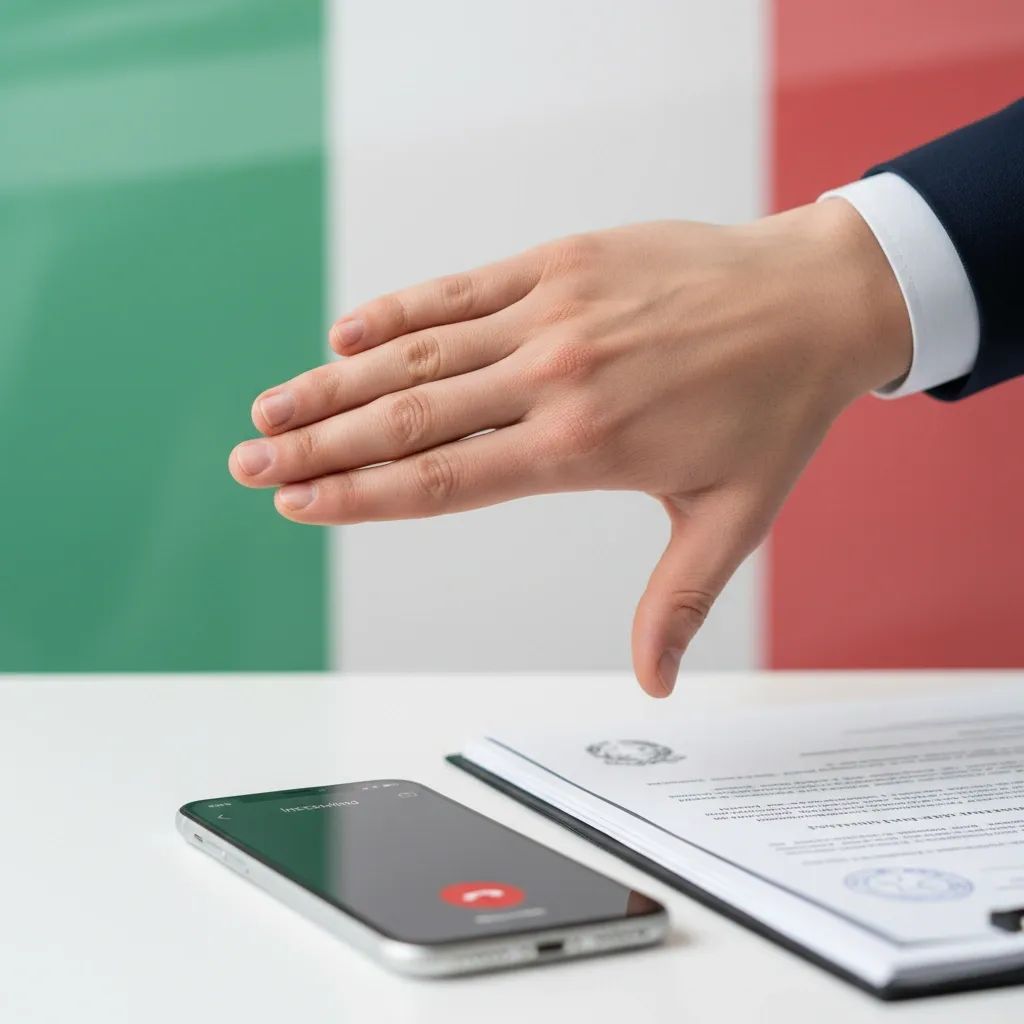
The Italian Parliament has delivered a decisive blow to unsolicited energy contract sales, with legislation that will render all telephone-based electricity and gas agreements legally void unless consumers explicitly consent in advance to commercial contact. Starting June 19, 2026, energy suppliers face automatic contract nullification and multimillion-euro fines for violations.
Timeline Note: This law takes effect June 19, 2026. If you're reading this before that date, contracts signed before then follow different (but still protective) rules explained in the "For Pre-June 19 Contracts" section below.
Why This Matters
• Contract protection: Any electricity or gas contract signed via phone without your prior written consent will be automatically null and void after June 19—no legal challenges required.
• Burden of proof shifts: Energy companies must now prove they obtained your consent, not the other way around.
• Real enforcement: Italy's communications authority (AGCOM) gains power to immediately block phone lines used for illegal sales calls.
• Historic penalties: Violators face fines reaching €10M under consumer protection statutes already used against major suppliers.
What This Means for Residents
If you've been hounded by aggressive telesales agents offering "special rates" or received unexpected bills from suppliers you never knowingly chose, June 19 marks a turning point. Any contract signed without your documented pre-approval becomes invalid from inception—as if it never existed.
The law's most radical feature is nullity, not mere voidability. That distinction matters: you don't need to file a lawsuit or prove harm. The contract simply has no legal standing, and you owe nothing. Consumer advocacy group Consumerismo emphasizes that the energy company must produce material evidence proving you authorized the contact. Missing that proof, the agreement collapses.
Practically, this means if a new supplier starts billing you after June 19 for a service you never consciously signed up for, you can reject those invoices outright. The provider cannot mark you as delinquent, cannot threaten disconnection, and must restore your previous supply arrangement at no cost.
Immediate Action Steps
Check any recent energy bills for suppliers you don't recognize. If you spot a new name, contact the company immediately in writing—preferably via PEC (certified email) or registered mail—and demand proof of your consent to be contacted and to sign a contract. Request a copy of any recorded consent and the full contract with your signature.
You have expanded withdrawal rights even for legitimate contacts. Contracts signed after unsolicited doorstep visits carry a 30-day cooling-off period (extended from 14 days as of January 1, 2025). Telephone contracts require written confirmation on durable media—an email or signed document—before becoming binding. If the salesperson never informed you of your cancellation rights, the window extends to 1 year and 14 days.
File complaints with both your previous supplier (to block the unauthorized switch) and the new one (to demand cancellation). Italy's energy regulator ARERA offers free conciliation services through its Sportello del Consumatore, which can mediate disputes and order suppliers to reverse improper activations.
For contracts signed before June 19 but under similar circumstances—no real consent—you can still invoke pre-existing consumer protection rules. The nullity provision in the new law reinforces existing case law holding that contracts formed without genuine agreement lack legal effect. The difference is that post-June 19, the nullity is statutory and automatic, removing any grey area.
The Legal Framework Behind the Ban
Law 49/2026, the legislative conversion of Decreto Legge 21/2026 (the so-called "Decreto Bollette"), amends Article 51 of Italy's Consumer Code and establishes what consumer advocates are calling the most stringent telemarketing restriction in Europe's energy sector. The Senate approved the conversion on April 8, with the measure published in the Gazzetta Ufficiale shortly thereafter, triggering a 60-day implementation window.
The core prohibition is unambiguous: energy suppliers and their sales agents cannot initiate telephone calls or text messages to propose or finalize electricity and gas contracts unless one of two conditions is met. Either the consumer must have actively requested contact through the company's digital platforms—such as filling out an online form or using a mobile app—or the consumer must have provided explicit, specific consent to receive commercial offers.
For existing customers, the rule is slightly different but equally protective. Companies may contact current clients only if those individuals have separately agreed to receive new sales pitches, a consent that must be distinct from the general terms of service they signed when becoming customers.
How the Industry Got Here
Italy's energy market has been plagued by what regulators describe as "teleselling selvaggio"—wild telemarketing—for years. AGCM, the Italian Competition Authority, has levied over €20M in combined fines since 2023 against household names including Enel Energia, Eni Plenitude, Acea Energia, and Iberdrola Clienti Italia. Violations ranged from activating contracts without any customer consent to impersonating government agencies to mislead people into switching suppliers.
One particularly egregious case involved Enel and Eni unilaterally raising prices for more than 4 million customers in defiance of a government decree that temporarily froze rate hikes. Another saw Facile Energy fined €1.2M for systematic no-consent activations. In multiple instances, call center operators falsely claimed to represent Italy's energy regulator or "bill assistance centers" to extract signatures.
The abuses intensified as the government prepared to phase out the mercato tutelato—the regulated tariff market—for small businesses and eventually households. Sales agents exploited consumer confusion, falsely suggesting the transition was immediate and mandatory, pushing people into unfavorable long-term contracts on the mercato libero (free market).
Enforcement Mechanisms and Penalties
AGCOM, Italy's telecommunications watchdog, emerges as the frontline enforcer. Under the new statute, the authority can order telecom carriers to immediately suspend phone lines used by energy companies for illicit sales calls. That power activates on consumer complaint: if you report an unsolicited energy sales call and provide the originating number, AGCOM can move to shut it down without waiting for lengthy administrative proceedings.
The Garante per la Protezione dei Dati Personali (Italy's privacy regulator) also gains jurisdiction, particularly when companies misuse personal data to generate call lists. Coordinated complaints to both agencies can trigger dual investigations.
Financial penalties follow the Consumer Code's general framework for unfair commercial practices, with maximum fines of €10M per violation. Given that single campaigns often involve hundreds of thousands of calls, the cumulative exposure is substantial. AGCM has already demonstrated willingness to use the upper ranges: Enel's €3.5M penalty for deceptive SMS campaigns and the €15M collective sanction against six major suppliers for aggressive pricing tactics set clear precedents.
Additional Protections and Rights
Energy suppliers will need to overhaul their sales strategies before the June 19 deadline. Legitimate customer acquisition will shift heavily toward digital channels—websites, comparison portals, and apps—where consumers initiate the process. Some analysts predict consolidation among smaller suppliers that relied exclusively on call centers and door-to-door agents, business models now largely unviable.
The law's success will depend on enforcement consistency. AGCM and AGCOM must demonstrate swift action against violators to deter the inevitable attempts to circumvent the rules. Early test cases will establish whether the agencies treat technical breaches—such as unclear consent forms—with the same severity as outright fraud.
For residents, the practical takeaway is straightforward: after June 19, any unsolicited energy sales call you receive is illegal. You owe the caller nothing—not politeness, not a hearing, not a callback. Hang up, note the number, and report it. The era of "teleselling selvaggio" in Italy's energy market, if not entirely over, has at least entered its terminal phase.
The Broader Context
Italy is not alone in wrestling with energy telesales abuses, but its legislative response is among Europe's most aggressive. The measure arrives as household energy costs remain elevated compared to pre-2022 levels, making consumers particularly vulnerable to high-pressure sales tactics promising savings that rarely materialize.
The mercato libero transition, originally intended to foster competition and lower prices through market forces, instead created an information asymmetry that predatory sellers exploited. Many Italians, especially older citizens in smaller towns, lack the financial literacy to compare complex tariff structures, making them easy targets for misleading pitches.
Consumer groups had been demanding action since 2023, when complaint volumes to ARERA and AGCM surged. The Decreto Bollette initially focused on price caps and social tariffs, but parliamentary amendments during the conversion process inserted the telemarketing ban after intense lobbying by organizations like Consumerismo and Altroconsumo.


