
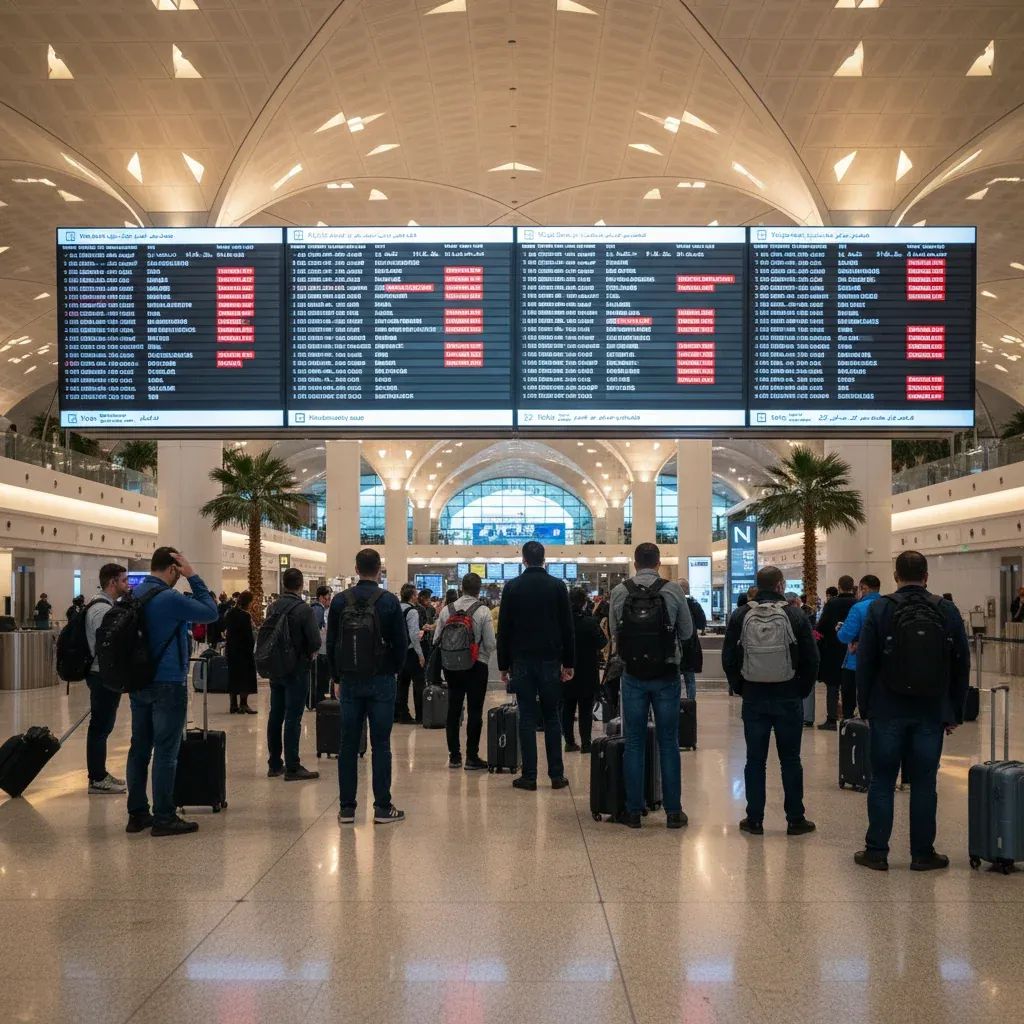
The Italy Ministry of Foreign Affairs has launched a dedicated emergency operation to support thousands of Italian nationals trapped in Gulf countries after the largest military escalation in the region since the Iran-Iraq war forced the closure of airspace across the Middle East. The move comes as airports in Dubai, Doha, Abu Dhabi, and Kuwait City remain shuttered with no estimated reopening dates, leaving thousands of Italians across the broader Middle East region facing an indefinite wait to return home.
Foreign Minister Antonio Tajani convened an emergency meeting at the Farnesina headquarters on March 1 with ambassadors posted in Iran and across the Gulf to assess the fallout from coordinated U.S.-Israeli military strikes that began on February 28. The operation, dubbed "Task Force Golfo," will reinforce the ministry's existing Crisis Unit and provide direct support to Italian embassies and consulates as they field thousands of assistance requests from stranded citizens.
Why This Matters:
• Significant Italian communities live in the United Arab Emirates, with thousands more visiting on business or tourism when airspace closed
• Defense Minister Guido Crosetto and his family are among high-profile Italians stranded in Dubai
• No timeline exists for airport reopenings—this is the worst global aviation disruption since COVID-19
• Gulf governments are providing emergency hotel accommodation at local expense to clear airport terminals
Military Operations Behind the Shutdown
The closure stems from "Operation Epic Fury," a joint U.S.-Israeli campaign targeting Iran's nuclear program and military infrastructure. Launched on February 28, the operation included strikes on command centers, air defense systems, and strategic facilities across Iran. Iran responded with waves of missiles and drones that hit not only Israeli territory but also struck civilian infrastructure in Kuwait, Dubai, Abu Dhabi, Bahrain, Jordan, and Qatar, as well as the U.S. naval base at Juffair in Bahrain.
The counter-strikes forced an immediate region-wide airspace shutdown. Iran, Iraq, Israel, Syria, Kuwait, and the UAE all closed their skies to civilian traffic. Flight tracking data shows the region's airspace nearly empty of commercial traffic, with airlines diverting routes thousands of kilometers to avoid the conflict zone. Major carriers including Emirates, Etihad, ITA Airways, British Airways, Air France, and Lufthansa have suspended service to Gulf destinations, with some cancellations extending through March 7.
What This Means for Stranded Italians
Embassy staff in the UAE and Qatar have successfully relocated all waiting passengers from airport terminals to hotels, according to the Farnesina. The Italian government has publicly praised Gulf governments and their national airlines for absorbing the cost of emergency accommodation—a gesture that relieves immediate pressure on travelers but does nothing to resolve the underlying problem of closed airspace.
Among those stuck are approximately 204 Italian students participating in the "Dubai UN & Abu Dhabi Emirates 2026 - L'Ambasciatore del futuro" program, a diplomatic education initiative. The presence of Defense Minister Guido Crosetto in Dubai underscores that the disruption affects all levels of Italian society. Two professional volleyball teams from Cuneo and Cisterna di Latina, as well as rapper BigMama, are also reported among those stranded.
The Farnesina has deployed emergency assistance desks inside Gulf airports to provide on-site support. The ministry is advising Italians in the region to check flight status constantly, maintain close contact with airlines or travel agencies, and explore alternative routing through European carriers. Citizens are urged to register via the "Viaggiare Sicuri" app, activate geolocation, and monitor official government channels for updates.
Scale of the Crisis Across the Region
Beyond the Gulf states, Italy maintains a significant diaspora and temporary presence across the Middle East. Approximately 20,800 Italians reside in Israel, and around 470 are currently in Iran. Minister Tajani has stated that the government is prepared to evacuate Italians from Iran via Azerbaijan if the security situation deteriorates further. Italy reduced its diplomatic footprint in Iran at the outset of the crisis, a precautionary move that complicates direct assistance.
Italy also has roughly 1,000 military personnel stationed between Iraq and Kuwait as part of international coalition operations. Troops at the Al Salem air base in Kuwait took shelter in bunkers during the Iranian missile barrage and emerged unharmed, according to defense sources.
Aviation Industry Paralysis
The suspension of flights represents the most severe disruption to global air travel since pandemic-era lockdowns. ITA Airways, Italy's flag carrier, has suspended all service to Tel Aviv through March 7 and grounded Dubai flights through at least March 1. The airline is also avoiding airspace over Israel, Lebanon, Jordan, Iraq, and Iran for the same period. Passengers are being offered rebooking on alternative routes or full refunds.
Low-cost carrier Wizz Air canceled all Saudi Arabia service through March 2 and suspended flights to Israel, Dubai, Abu Dhabi, and Amman through March 7. British Airways pulled service to Tel Aviv and Bahrain through March 3, and Air France expanded its list of canceled destinations as the crisis deepened.
The cumulative effect is a near-total blackout of direct European service to the Gulf. Travelers seeking to leave the region face either indefinite hotel stays or circuitous routing through secondary hubs in Central Asia or North Africa—options complicated by surging demand and limited seat availability.
Diplomatic Scramble and Regional Coordination
Prime Minister Giorgia Meloni has conducted a series of phone calls with Gulf leaders, including the King of Bahrain, the Emir of Kuwait, the President of the UAE, the Emir of Qatar, and Saudi Arabia's Crown Prince and Prime Minister. While no formal evacuation agreements have been publicly announced, the high-level engagement signals Italy's dependence on Gulf cooperation to protect its nationals.
The Task Force Golfo structure is designed to streamline communication between Rome and field missions. Ambassadors and consular officers are now operating under a unified command framework, allowing the ministry to coordinate responses across multiple countries simultaneously. The model borrows from Italy's crisis response playbook used during natural disasters and terrorist incidents, adapted here to a regional military conflict.
Uncertain Timeline and Resident Anxiety
The central question—when airports will reopen—remains unanswered. Military operations are ongoing, and neither the U.S. nor Israel has announced a ceasefire or operational pause. Iranian officials have vowed further retaliation, and Houthi forces in Yemen have threatened continued attacks on Israeli and American vessels in the Red Sea and Gulf of Aden.
For Italians living in the UAE, the disruption affects not just travel but daily life. Schools are closed, businesses are operating on skeleton staff, and expatriates are grappling with questions about whether to remain or attempt evacuation through overland routes to Oman or Saudi Arabia—a journey that carries its own risks given the fluid security environment.
Tourists and business travelers face immediate financial strain. Hotels are full, and even with Gulf government subsidies, costs are mounting. Travel insurance policies vary widely in their coverage of military conflict, leaving many to negotiate directly with airlines for refunds or rebooking—a process complicated by the sheer volume of disrupted passengers.
What to Do If You're Affected
The Farnesina's advice is clear: do not travel to the region if your trip is not essential, and if you are already there, stay indoors or in your hotel until the situation stabilizes. The ministry's Crisis Unit is operating around the clock and can be reached through the official "Viaggiare Sicuri" portal. Italians are strongly encouraged to register their presence in the system, which allows embassy staff to send targeted alerts and coordinate potential evacuations.
For those holding tickets on suspended routes, airlines are legally required to offer rebooking or refunds, but processing times are extending as carriers deal with unprecedented claim volumes. Travelers should document all communication with airlines and consider filing claims with credit card companies if refunds are delayed beyond reasonable periods.
The diplomatic outreach and emergency infrastructure Italy has deployed demonstrate the scale of the challenge. With no end in sight to the military operations and no clarity on airspace reopening, the thousands of Italians in the Gulf are facing what could stretch from days into weeks of uncertainty.


