
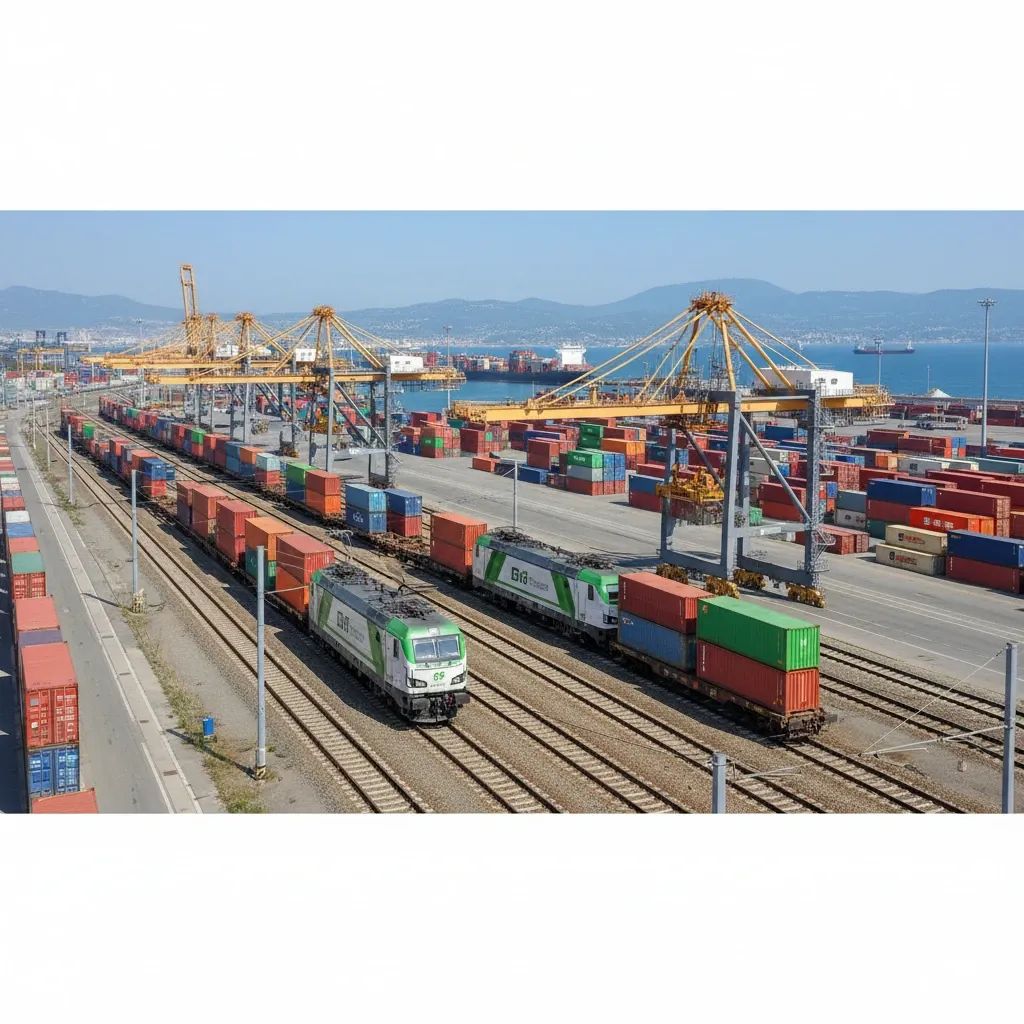
The Campania Region is advancing plans for a regional rail freight subsidy scheme designed to shift cargo from highways to trains, a move that could reposition southern Italy as a gateway for Mediterranean-Europe trade flows while slashing logistics costs for exporters and meeting EU carbon targets.
Why This Matters
• Competitive edge for Campania exporters: Lower freight costs along TEN-T corridors mean Made in Campania goods reach Northern Europe cheaper and with a smaller carbon footprint.
• Infrastructure utilization: The incentive aims to fill underused rail capacity at Nola and Marcianise interports and the new Napoli-Bari high-speed/high-capacity line funded by PNRR.
• EU alignment: The initiative targets the European Green Deal's goal of moving 30% of freight to rail by 2030, up from the current 8% in Campania for the first half of 2026.
• Strategic investment, not subsidy: Funds come from the PR Campania FESR 2021-2027, linking regional economic development directly to decarbonization mandates.
The Congestion Problem Driving the Push
Road and port congestion around Naples and Salerno has reached saturation levels, creating a logistics bottleneck that threatens the region's competitiveness in international markets. Heavy truck traffic clogs highways, while port terminals struggle to handle surging volumes efficiently. The proposed Ferrobonus regionale emerges as a strategic response to this infrastructure strain, incentivizing companies to move containers and cargo by rail instead of road.
Unlike a simple cash handout, the regional scheme is structured as an investment lever to unlock EU structural funds from the Campania FESR 2021-2027 program. The logic is straightforward: build the rail freight volume necessary to justify—and fully utilize—major infrastructure projects already underway or recently completed with PNRR national recovery funds.
The timing is critical. The Napoli-Bari AV/AC line, a high-speed and high-capacity rail corridor forming part of the TEN-T Scandinavia-Mediterranean Corridor, is nearing completion in phases throughout 2026. The Napoli-Cancello section opens in July, with full double-track operation between Frasso Telesino and Vitulano expected before year-end. This new line is engineered to handle 10 freight trains per hour per direction, accommodate 740-meter-long trains carrying semi-trailers with axle loads up to 22.5 tons, and directly link Campania's industrial heartland to northern Italy and beyond.
Yet infrastructure alone does not guarantee usage. Without sufficient freight volume—what industry officials call "critical mass"—these multimillion-euro rail investments risk becoming underutilized, or in the words of industry association Assoferr, "cathedrals in the desert."
Interports Poised for Growth
Nola and Marcianise, two major intermodal hubs located roughly 30 km from the Port of Naples, sit at the center of this modal-shift strategy. Both facilities function as natural hinterland terminals for the port, equipped with extensive rail sidings, container-handling cranes, and direct connections to the national rail network managed by RFI.
Nola has emerged as the busier of the two in recent years. The interport's private rail station can handle up to 30 trains per day and features 13 pairs of sidings each 1 km long, allowing standard European freight trains to enter "in block" for rapid loading and unloading. In 2025, the terminal processed 2,000 trains, a 50% increase over the previous year, and moved 52% more intermodal transport units (UTIs). Projections for 2026 estimate 3,000 trains and 100,000 UTIs, positioning Nola among Italy's top five interports by train volume.
Major operators including MSC, CFI, GTS, FHP Group, Multilog, and Stante use Nola as a base for daily connections to Milan, Segrate, Piacenza, Zeebrugge, and even Poland. GTS shifted its Milan-Segrate service from Marcianise to Nola in 2023 citing less congestion and better infrastructure, and launched a new Nola-Piacenza route with onward connections to Belgium and the UK.
Marcianise remains strategically important, handling approximately 50,000 UTIs and 6,000 trains annually. The Maddaloni-Marcianise terminal offers 8 intermodal tracks, a 16-track arrival yard, and a Mercitalia-run maintenance workshop for freight wagons. It serves as a marshalling hub for trains moving to Rome, Turin, Bologna, Ravenna, Padua, and Catania, and maintains links to Piacenza via Pomezia despite losing some traffic to Nola.
Both interports are benefiting from ongoing PNRR-funded RFI upgrades aimed at removing infrastructure bottlenecks by the end of 2026, improving track capacity, signaling systems, and yard layout to accommodate longer, heavier trains and higher frequencies.
What This Means for Campania Businesses
For companies based in Campania—particularly manufacturers in the agro-food, automotive, textile, and industrial machinery sectors—the regional Ferrobonus could translate into tangible cost savings on export shipments. Shifting cargo to rail reduces per-unit transport expenses along the TEN-T corridors that run north through Italy and into France, Germany, and the Benelux countries.
Lower logistics costs improve price competitiveness in foreign markets, especially for goods heading to Northern Europe where road haulage rates are high and carbon pricing is increasingly factored into supply chain decisions. The ability to advertise a reduced carbon footprint also appeals to buyers under pressure to meet their own sustainability commitments.
Beyond individual company benefits, the initiative aims to prevent the entire Campania logistics sector from slipping into marginality. Simona Ceci, an institutional relations councilor at Assoferr, framed the stakes bluntly: without the incentive, the region risks losing its role as a natural European gateway to the Mediterranean, ceding ground to competitors in other southern European ports and hinterlands.
The regional Ferrobonus complements the existing national Ferrobonus scheme, which already subsidizes rail freight from interports and logistics nodes, with a specific focus on the South. The national program for 2025-2026 closed applications in October 2025; the regional version discussed in May 2026 represents an additional layer of support tailored to Campania's specific infrastructure and trade patterns.
Aligning with European Decarbonization Goals
The proposal arrives at a moment when the European Union is tightening emissions standards and pushing member states to accelerate the modal shift from road to rail. The Green Deal mandates that 30% of freight over 300 km be moved by rail or inland waterway by 2030, rising to 50% by 2050. Currently, Campania's rail freight share stands at just 8% in the first half of 2026—a figure that underscores both the challenge and the opportunity.
Other European countries have implemented similar incentive mechanisms with measurable results. Switzerland already moves more than 72% of transalpine freight by rail, thanks to decades of investment and policy support. The Netherlands recently secured EU approval for a €22.5 M subsidy offering €20 per container or bulk load shifted from road to rail or inland waterway. Italy's own Ferrobonus portuale, approved by the European Commission, allocates up to €500,000 annually per port authority over five years—€30 M total—to cut rail shunting costs and encourage port-to-rail integration.
Campania's regional scheme would tap PR Campania FESR 2021-2027 funds, linking economic development to environmental objectives and ensuring that regional money flows are consistent with EU cohesion policy and climate commitments. By framing the Ferrobonus as a strategic investment rather than a simple subsidy, regional officials position the program as a catalyst for long-term structural change rather than short-term relief.
Political Momentum and Next Steps
The initiative gained traction following a meeting convened by Assoferr and Conftrasporto with Mario Casillo, Vice President of the Campania Region and Councillor for Transport, Mobility, and Maritime Affairs. Industry representatives described the session as productive, with Casillo expressing openness to the proposal.
Pasquale Russo, president of Conftrasporto and vice president of Confcommercio, thanked Casillo for his willingness to engage on the Ferrobonus concept and expressed hope that the meeting would form the foundation for eventual implementation. The goal, Russo noted, is a Campania logistics network fully integrated with national and European transport corridors.
Formal adoption of the regional Ferrobonus would require approval from the regional council and coordination with national authorities to ensure compatibility with existing state aid rules and EU competition law. The European Commission's revised transport state aid guidelines (LMTG and TBER) simplify the process for member states to grant subsidies for rail and inland waterway freight, but compliance with notification and reporting obligations remains necessary.
Funding availability from the PR Campania FESR 2021-2027 envelope is another practical consideration. Regional officials must balance competing priorities—urban transit, port development, road maintenance, digital infrastructure—against the modal-shift incentive, all within a fixed multi-year budget.
Broader Context: Italy's Rail Freight Challenge
Italy lags behind northern European peers in rail freight utilization, despite having a dense network and several major intermodal terminals. Historical underinvestment, insufficient electrification, border crossing delays, and regulatory complexity have all contributed to the dominance of road haulage. Truck transport accounts for more than 75% of domestic freight, well above the European average.
The PNRR, Italy's €191.5 B recovery and resilience plan, dedicates significant resources to rail infrastructure, including the Napoli-Bari line, bottleneck removal, and interport upgrades. But infrastructure investment alone does not guarantee modal shift. Behavioral change among shippers and logistics providers requires economic incentives that make rail financially attractive compared to the flexibility and speed of road transport.
The Campania regional Ferrobonus is designed to bridge that gap, creating a financial trigger that encourages companies to test rail services, build up volumes, and ultimately establish rail as a routine mode for medium- and long-distance shipments.
The Road Ahead
Campania's proposed rail freight incentive represents a calculated bet on infrastructure-led growth and environmental compliance. If implemented effectively, the Ferrobonus could transform the region's logistics profile, reduce highway congestion, lower export costs, and position Naples and Salerno as competitive Mediterranean hubs within the TEN-T network.
Success hinges on several factors: timely completion of the Napoli-Bari line upgrades, effective coordination between RFI, interport operators, and rail freight companies, robust monitoring to ensure incentive funds translate into real modal shift, and political will to sustain the program beyond initial pilot phases.
For Campania businesses, the incentive offers a tangible pathway to lower costs and greener supply chains. For policymakers, it represents alignment with EU mandates and a chance to leverage regional and national recovery funds for long-term structural change. Whether the initiative moves from proposal to operational program will become clear in the coming months as regional officials finalize budget allocations and regulatory frameworks.


