
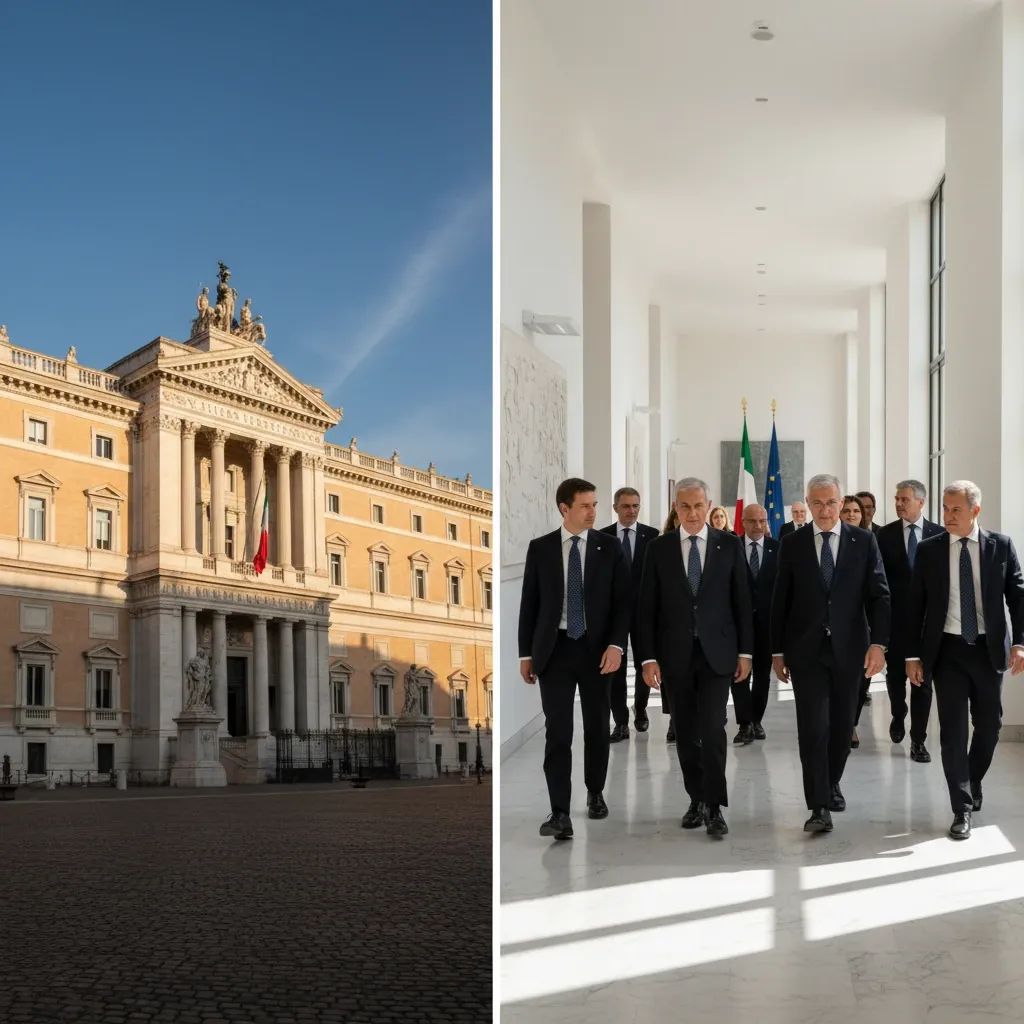
Italy Prime Minister Giorgia Meloni has called for the resignation of Tourism Minister Daniela Santanchè after two government officials stepped down. The move comes in response to Italy's justice reform referendum defeat on March 23, marking a shift in how Meloni's government manages officials facing legal proceedings.
Why This Matters for Residents
On March 23, Italian voters rejected a justice reform proposal supported by Meloni's right-wing coalition, a significant political setback. The referendum focused on measures to limit judicial independence and was considered a cornerstone policy for the government. The defeat exposed fractures within the coalition and raised questions about the government's credibility on law-and-order issues, particularly with multiple cabinet members facing legal investigations.
For residents tracking Italian government stability, this matters because:
• Political vulnerability: The referendum loss weakened the coalition's standing, forcing Meloni to demonstrate resolve on judicial accountability
• Government continuity: If Santanchè departs, Meloni may need to call a parliamentary confidence vote to replace her—a process that could destabilize the government
• Cabinet credibility: The coalition has faced criticism for shielding ministers under investigation while demanding accountability from political opponents
• Coalition tensions: Internal disagreements over how aggressively to respond to the referendum loss have surfaced between coalition partners
The Accountability Ultimatum
In a statement released by Palazzo Chigi on March 24, Prime Minister Meloni's office explicitly thanked Justice Undersecretary Andrea Delmastro and Chief of Staff Giusi Bartolozzi for resigning their posts. The office then expressed hope that Minister of Tourism Daniela Santanchè would demonstrate the same "institutional sensitivity" by stepping aside.
Delmastro and Bartolozzi departed within hours of each other, following intense meetings at Fratelli d'Italia headquarters where Meloni assessed the political damage from pending legal cases. Senior officials concluded that maintaining cabinet members under investigation undermined the government's credibility on governance issues following the referendum defeat.
The public call for resignation represents an escalation in Italy's political culture, where prime ministers traditionally shield cabinet members until conviction becomes unavoidable. However, constitutional procedures limit Meloni's direct authority: under Italy's parliamentary system, ministers serve at the Prime Minister's pleasure but cannot be simply dismissed. If Santanchè refuses to resign, Meloni would need to formally request her dismissal through constitutional procedures, which could require a parliamentary confidence vote depending on the nature of the government reshuffle.
Santanchè's Legal Situation
The Italy Tourism Ministry confirmed that Santanchè maintained her schedule on March 24, consulting with staff remotely before returning to her Rome office on March 25. Her pending commitments include preparations for the International Pet Tourism Forum scheduled for May and an appearance at an industry convention on March 26.
Her legal exposure is substantial. She stands trial in Milan on charges of false accounting related to financial statements of Visibilia, a media group she controlled between 2016 and 2022. The trial involves 15 co-defendants, with prosecutors alleging systematic manipulation of balance sheets. An ex-auditor recently testified about experiencing pressure when flagging irregularities.
Separately, Santanchè faces investigation for alleged bankruptcy fraud and a distinct probe into suspected INPS fraud involving COVID-era payments. The false accounting trial is expected to conclude by June 30, 2026, with reserve dates through October 29. This six-month window is critical because prosecutors have raised concerns about statute-of-limitations deadlines potentially expiring due to procedural delays.
Santanchè has consistently denied all allegations. Sources within the Tourism Ministry state there are "no problems" with her continuing in office, signaling her resistance to resignation pressure.
Coalition Response and Political Calculations
Forza Italia, the centrist coalition partner, privately welcomed Meloni's move. Coalition insiders described it as "politically astute," helping deflate opposition criticism and lower internal tensions. The coalition has struggled with the contradiction between its tough-on-crime rhetoric and the optics of ministers fighting legal battles.
Lega, led by Matteo Salvini, has drawn criticism from Meloni's inner circle for limited engagement in the referendum campaign. Internal analysis identified voter frustration with perceived inconsistency: the government demanded accountability from political opponents while appearing to shield its own members from consequences.
Senate President Ignazio La Russa, a Santanchè ally, was reportedly consulted for behind-the-scenes persuasion efforts—an echo of early 2025 when Santanchè initially faced resignation pressure but conditioned her departure on a direct request from Meloni that never materialized. Now that explicit request has come.
Government Stability and Constitutional Considerations
Meloni does not plan to request a confidence vote from Parliament following the referendum defeat, nor has she scheduled meetings with President Sergio Mattarella to discuss a formal government crisis. Her office frames the personnel changes as a targeted "realignment."
However, under Italy's parliamentary system, replacing a cabinet minister can trigger constitutional requirements for a confidence vote depending on how the transition occurs. Meloni has several options: assuming interim Tourism Ministry duties herself, or appointing a government technocrat to stabilize the portfolio. The Italian tourism sector is economically significant, and leadership continuity is important as the summer high season approaches.
For Giusi Bartolozzi, reports suggest she will receive a position on state-owned enterprise boards during the next round of government appointments. Her departure followed criticism for describing the judiciary as an "execution squad" during the referendum campaign, which complicated the government's messaging.
Delmastro's responsibilities overseeing Italy's prison administration may shift to Deputy Minister Francesco Paolo Sisto or another Fratelli d'Italia official.
The Political Test Ahead
Santanchè's continued resistance tests Meloni's authority within her own party. Fratelli d'Italia has historically protected loyal members, so Meloni's public call for resignation breaks established patterns. The spectacle of a cabinet member publicly defying her superior's explicit wishes while maintaining ministerial duties creates political pressure.
Opposition parties have seized on the turmoil, demanding further resignations—including Justice Minister Carlo Nordio, who initially defended Bartolozzi before orchestrating her departure in a three-hour meeting on March 24. Nordio remains secure in his position, but the referendum defeat has exposed vulnerabilities in the coalition's coordination on key policies.
Meloni's diplomatic mission to Algeria on March 26 left unresolved whether institutional pressure alone will prompt Santanchè's resignation, or whether the Prime Minister will need to pursue formal dismissal proceedings—a constitutional power rarely invoked in Italy's consensus-driven political culture.
The coming weeks will clarify whether this represents a genuine recalibration of how the government handles judicial controversies, or a temporary response to political vulnerability following the referendum defeat.


