
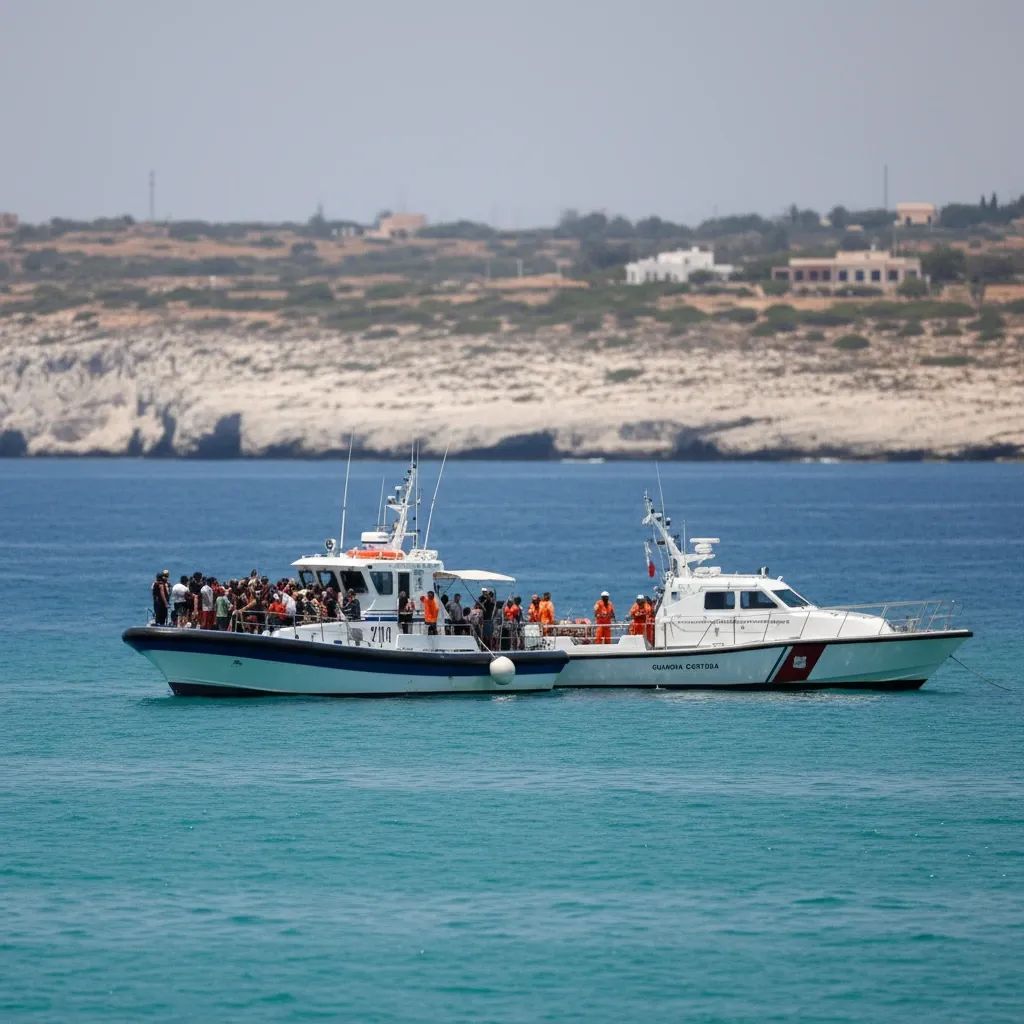
The Italian Coast Guard and Guardia di Finanza intercepted 11 separate migrant landings over the last 36 hours at Lampedusa, bringing 308 people to the tiny Mediterranean island and pushing the Contrada Imbriacola reception center to more than double its official capacity. As of February 27, 396 people were sheltering at the hotspot, with 286 already queued for an overnight ferry transfer to Sicily—a rapid-response measure now standard when arrivals surge.
Why This Matters
• Weather window: The first sustained high-pressure spell since January opened the central Mediterranean and triggered the sharpest spike in departures this year.
• Route reality: The crossing remains the world's deadliest migration passage; 501 people have died or disappeared on this route between January 1 and February 21 alone—roughly 10 deaths every day.
• Structural strain: The hotspot briefly held almost twice its design capacity this week, underlining Italy's reliance on same-day ferries to prevent complete gridlock.
• Pressure drop nationwide: Despite the local surge, Italy's total arrivals for 2026 through February 27 stand at 3,163—well below the 6,527 recorded at this point in 2025.
What This Means for Residents
Lampedusa, an island of roughly 6,000 permanent inhabitants, now functions as a frontline sorting station for the entire central Mediterranean corridor. The rapid-transfer protocol keeps most arrivals on the island for no more than 48 hours, minimizing street presence and pressure on municipal services—a contrast to 2013 and 2015, when hundreds slept outdoors for weeks.
However, residents across Italy should understand the broader implications: political debates around migration policy continue to reshape EU-Italy relations and bilateral agreements with North African countries. These negotiations directly affect Italy's border resources, asylum processing timelines, and cooperation arrangements with other member states. Additionally, periodic spikes in arrivals can trigger enhanced security protocols at transport hubs and border crossings in certain regions—something travelers and commuters should monitor during peak migration seasons.
For tourism and local economies, the situation on Lampedusa remains manageable but fragile. Local fishermen have filed parliamentary petitions this month documenting damage to nets and trawl gear caused by shipwrecks littering the seabed off Cala Pisana and Cala Francese. At least 17 hulls have been located within 12 nautical miles of the harbor entrance, and salvage operations require regional and EU funds that have yet to be allocated. The tourism season, which begins in earnest by mid-April, depends on beach access and a perception of orderly management—both vulnerable to operational disruption.
Five Landings in One Night
Between dusk on Thursday and dawn on Friday, five boats carrying between six and 64 passengers each were intercepted or escorted to Molo Favarolo, the island's main disembarkation quay. The 144 people aboard—Bangladeshi, Egyptian, Syrian, and Pakistani nationals, including women and unaccompanied minors—reported departures from Tajoura, Zuwarah, and Garabulli in Libya and the Tunisian port of Zarzis. All five vessels were small fiberglass dinghies or wooden craft, the kind smuggling networks deploy for short, dangerous crossings when Mediterranean swells drop below one meter.
The day before, the Carabinieri documented six separate landings totaling 164 migrants. Two groups—one of 24, the other of 32—landed unaided at Molo Madonnina and again at Molo Favarolo, walking ashore without assistance. The remaining four groups were met by patrol boats and escorted in. Nationalities included Bangladeshi, Eritrean, Somali, Sudanese, and Egyptian passengers.
Libyan and Tunisian Launch Points
Every passenger interrogated by Italian authorities named one of a handful of departure towns on the North African coast. From Libya, the list includes Tajoura and Garabulli (both suburbs of Tripoli), Zuwarah (west of the capital), and the sprawling port of Zawiya, where trafficking networks have operated openly despite nominal Libyan coast-guard patrols funded in part by European money. From Tunisia, the boats came from Zarzis and Chebba, both on the country's central-eastern shoreline facing Sicily.
The route structure has remained stable for the past 18 months, with Libya accounting for more than three-quarters of departures destined for Italy. Between January and mid-February 2026, 1,386 migrants embarked from Libyan beaches—a 64% decline from the same window in 2025—but the absolute numbers still dwarf Tunisian traffic, which has been lower in 2026 after a brief surge in 2023 and early 2024. EU cooperation frameworks, including tighter patrol agreements with Tunisia, have contributed to reduced departures from Tunisian ports compared to earlier years.
The Hotspot Pressure Valve
The Imbriacola facility, operated under contract by the Italian Red Cross until at least the end of 2027, is designed to hold roughly 190 people in dormitory tents and prefabricated modules. Yet monitoring data collected by the UN refugee agency shows the center ran at 235% of rated capacity during the week ending February 18, with 11,540 migrants disembarking in Italy that week—more than double the same stretch in 2025. When weather closed the sea lanes in mid-February, the backlog eased; when the high-pressure returned this week, capacity was breached again within 48 hours.
The Sansovino ferry, contracted by the Interior Ministry for shuttle runs, departed Friday evening with the 286 migrants—mostly families and single men—bound for Porto Empedocle on Sicily's southern coast. That transfer will bring the hotspot census down to approximately 220, still above the nominal threshold but within operational range. Further arrivals Saturday could reset the count within hours.
The hotspot system, in place since 2015, mandates rapid fingerprinting, nationality screening, and triage into asylum-track or return-track categories. Those claiming persecution or fleeing conflict zones are flagged for transfer to reception centers on the mainland, where formal asylum interviews can take months or longer. Those classified as economic migrants or undocumented third-country nationals face accelerated return procedures, though actual deportation rates remain below 20% of orders issued.
The Deadly Arithmetic
While total arrivals to Italy in 2026 have fallen—3,163 through February 27 compared with 6,527 in 2025 and 4,458 in 2024—the International Organization for Migration reports that drownings and disappearances have accelerated. The 501 confirmed or presumed dead in the seven-week window to February 21 translates to an average of 10 fatalities daily. January alone accounted for 375 deaths, the highest single-month toll on the central Mediterranean route since August 2023.
Humanitarian groups attribute the higher mortality rate to longer crossings, more overloaded boats, and reduced search-and-rescue capacity. The Libyan coast guard, equipped and trained under bilateral accords, intercepts roughly one vessel in three and returns passengers to detention centers in Tripoli and Misrata. International monitors have documented ongoing concerns regarding human-rights protections in interception and return procedures, with testimony that cooperation frameworks must include stronger oversight mechanisms.
Government Strategy and Italy's Role in EU Migration Management
The Italian Ministry of the Interior continues to rely on the hotspot model and bilateral agreements with Libya and Tunisia for migration management. At the EU level, the Migration and Asylum Pact adopted in 2024 introduces mandatory solidarity mechanisms, though implementation remains uneven. Front-line countries like Italy are absorbing the bulk of arrivals while solidarity relocations from other member states have remained limited.
Domestically, the government has allocated €45 million from the 2021–27 Development and Cohesion Fund for infrastructure upgrades on Lampedusa, including road resurfacing, water-supply reinforcement, and hotspot expansion. Construction tenders closed in January, with work expected to begin by late spring.
February's Pattern: Calm, Then Surge
The first seven weeks of 2026 saw scattered arrivals punctuated by storms that shut the crossing entirely for days at a time. Between February 24 and 25, as the first stable anticyclone settled over the strait, six boats carrying 226 people reached Lampedusa. The next 36 hours brought 11 more landings and 308 arrivals. Weather models suggest the high-pressure ridge will hold through early March, and Italian maritime authorities expect further waves in the coming week.
Historically, March through May marks the annual peak, when calmer seas and longer daylight hours combine to create the most favorable—and most heavily trafficked—crossing window. If the 2026 pattern holds, Lampedusa will process several thousand more arrivals before summer, though the nationwide total is forecast to remain well below recent years.
The island's residents, aid workers, and Coast Guard crews have become practiced at managing the cycle: alert, surge, transfer, reset. What has not changed is the arithmetic of risk on the water—where the gap between survival and drowning is measured in a few centimeters of freeboard and a few hours of engine life.


