
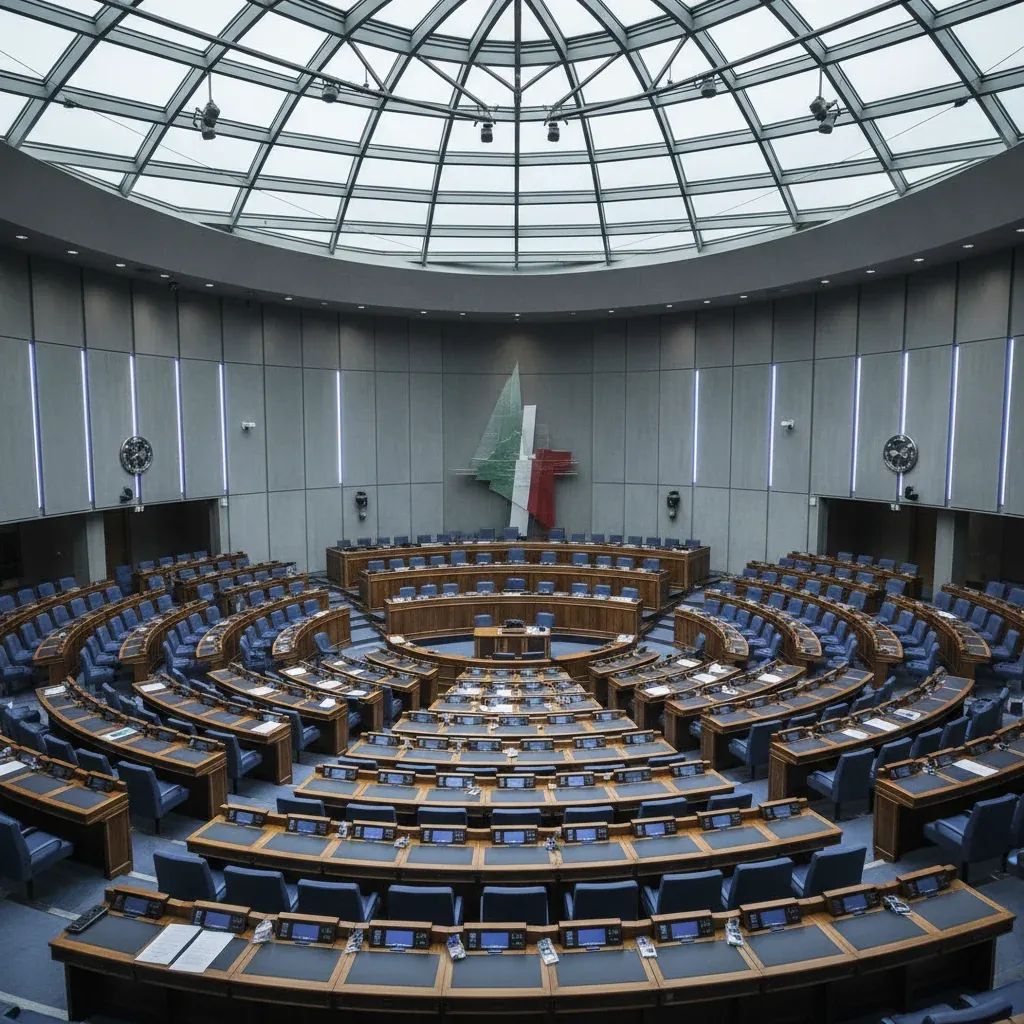
The Italian government has finalized its most comprehensive public safety legislation in recent history, but only after an eleventh-hour scramble to prevent a constitutional standoff with President Sergio Mattarella. The Decree on Public Security (D.L. 23/2026) passed the Chamber of Deputies with 162 votes in favor and 102 against, converting into law just 24 hours before its legal deadline. Within hours, the Cabinet approved a corrective decree to address concerns over attorney compensation in migrant repatriation cases—a provision that had drawn sharp rebukes from the legal profession and the presidential palace.
Why This Matters:
• Immediate enforcement: The law takes effect this week, bringing 14 new criminal offenses, stiffer penalties for public disorder, and expanded police powers into daily life across Italy.
• Migrant legal access restricted: Free legal aid for appealing expulsion orders has been abolished for non-EU nationals unless they meet ordinary income thresholds.
• Protest rules tightened: Organizers face fines up to €10,000 for unauthorized demonstrations; "preventive detention" for up to 12 hours is now legal for individuals deemed security risks.
• Constitutional questions persist: Despite the corrective patch, opposition lawmakers, magistrates, and civil rights groups warn that multiple provisions may still violate the Constitution.
A Legislative Sprint Ends in Controversy
The Italy Ministry of Interior introduced the original decree on February 5, citing a surge in youth gang violence and street crime—particularly the fatal stabbing of a man in Rogoredo and clashes following the eviction of a social center in Turin. The Senate approved the package on April 17 (96–46), but it nearly collapsed Saturday when Article 30-bis triggered alarm bells. That provision offered lawyers a €615 bonus per case for assisting migrants with voluntary repatriation applications, payable only if the client actually departed Italian territory.
The National Council of Lawyers (CNF), which had been named in the text as a partner entity, publicly disavowed the scheme. Legal associations argued the arrangement violated Article 24 of the Constitution (right to defense) by tying attorney fees to outcomes rather than professional service. Magistrates' unions and humanitarian groups joined the chorus, warning that the measure risked transforming lawyers into agents of state immigration policy. By Monday, word leaked that President Mattarella had expressed serious reservations and might refuse to countersign the decree—an extraordinary rebuke that would send the government scrambling.
The Quirinale's Intervention and the Corrective Fix
Undersecretary for the Presidency Alfredo Mantovano climbed the Quirinal Hill for consultations Monday afternoon. Faced with the prospect of a veto, Prime Minister Giorgia Meloni's administration deployed a rarely used maneuver: a corrective decree issued the same day the original law took effect. The fix, titled "Urgent Provisions on Assisted Voluntary Repatriation," removes the outcome-based payment clause. Now the €615 fee is paid upon completion of the administrative application process, regardless of whether the migrant leaves. It also deletes all references to the CNF and opens eligibility to mediators, NGO staff, and third-sector operators, not just attorneys. Terms will be set by an Interior Ministry regulation due within 60 days; the government has allocated €1.4 M through 2028 (€281,055 this year, €561,495 in each of 2027 and 2028).
There are only four precedents in Republican history for corrective decrees targeting laws not yet in force. Three occurred in final days of fiscal years (2003 Berlusconi II, 2007 Prodi II, 2020 Conte II) to fix budget provisions; one in 2009 (Berlusconi IV) adjusted an anti-crisis package on the same day its conversion law took effect. Meloni defended the tactic as legitimate, though the Parliamentary Committee on Legislation has cautioned against using emergency decrees solely to patch other emergency decrees before they take effect.
What This Means for Residents
The consolidated package reshapes daily life for both Italian citizens and foreign nationals residing in the country. Key changes include:
Weapons and Youth CrimeCarrying a blade longer than 8 cm without justified reason is now punishable by six months to three years in prison, with an aggravating circumstance if the offense occurs on public transport. Knives under 5 cm remain exempt—a compromise secured by the center-right in the Senate. Retailers who sell knives to minors face fines between €500 and €3,000. The measures target so-called "maranza" gangs, a term popularized by media coverage of adolescent street crews.
Urban Bans ExpandedPrefects can impose DASPO urbano (city exclusion orders) on individuals merely denounced within the past five years for serious or repeat offenses in designated high-crime zones. The ban also applies to those charged or convicted—even without a final sentence—for crimes committed during protests. Duration can reach 12 months.
Protest and AssemblyOrganizing a gathering without notifying authorities now triggers fines from €1,000 to €10,000. Covering one's face during a demonstration raises the floor to €2,000; refusing to disperse when ordered can cost up to €20,000. Most controversially, police may detain a person deemed a "concrete danger" for up to 12 hours in advance of a planned event, informing the prosecutor immediately. For minors, parents must be notified "without delay." UN human rights experts have called the protest provisions "the gravest attack on freedom of assembly in decades."
Drug Trafficking and ParkingThe "minor entity" defense is abolished for habitual dealers. Vehicles used to transport narcotics may be confiscated. Unauthorized parking attendants ("parcheggiatori abusivi") face fines from €769 to €3,095, doubling for repeat offenders; involving minors in the racket triggers arrest (eight months to 18 months).
Migration and Legal AidThe decree repeals Article 142 of the Consolidated Act on Legal Costs (D.P.R. 115/2002), which guaranteed state-funded counsel for non-EU nationals appealing expulsion orders, irrespective of income. Migrants must now demonstrate they meet standard means-test thresholds to qualify for free representation—a shift advocates say will strand vulnerable individuals without recourse.
Legal Shield for Law Enforcement
A provision labeled the "penal shield" creates a separate investigative registry for police officers and military personnel accused of crimes committed "with justifying cause"—essentially while on duty. Originally drafted for security forces, the registry was extended during Senate review to cover all public officials. The measure was influenced by the January killing of Abdherraim Mansouri by officer Carmelo Cinturrino, who initially claimed self-defense but was later contradicted by forensic evidence. The government pledges legal representation and reimbursement for officers facing investigation. Critics, including the National Magistrates Association (ANM), argue the dual-track system undermines equality before the law and risks shielding misconduct.
Command Extensions and Institutional Continuity
Tucked into the final text is a government amendment extending the mandate of Finance Police (Guardia di Finanza) Commander Andrea De Gennaro through December 31, 2026, and prolonging the term of the Carabinieri Vice Commander by two years. The moves ensure continuity in senior security posts as implementation of the new law begins.
Opposition Outcry and Constitutional Challenges
Debate in the Chamber Thursday morning devolved into a musical duel. Opposition benches sang "Bella Ciao," the partisan anthem, in protest of what Democratic Party deputy Piero De Luca called an "unconstitutional norm" and a "rupture with the Quirinale." Right-wing lawmakers responded by striking up the National Anthem ("Fratelli d'Italia"); the opposition joined in, and the entire hall stood singing Mameli—except for members of the League party and Ministers Matteo Salvini and Matteo Piantedosi. Voting followed swiftly, ending a marathon overnight session.
The ANM has flagged multiple constitutional concerns: the proliferation of vague, overlapping offenses (14 new crimes, harsher penalties for nine existing ones); potential violations of the principles of proportionality, offensiveness, and precision in criminal law; and the risk that preventive detention and urban bans infringe on personal liberty and freedom of movement. The Superior Council of Magistrates (CSM) expressed technical reservations about the preventive-detention clause during earlier consultations. Several regional governments and civil-society coalitions have signaled intent to challenge the law before the Constitutional Court.
Historical Context: Italy's Recurring Security Debate
This is the latest chapter in a two-decade pattern of "security decrees" that blend immigration control with law-and-order measures. The 2008 Maroni Package under Berlusconi introduced biometric data-sharing and tougher policing of irregular migration. The 2017 Minniti-Orlando Decrees accelerated asylum appeals by eliminating second-instance hearings and expanding detention centers. Salvini's 2018–2019 decrees abolished humanitarian-protection permits and imposed million-euro fines on rescue-ship captains. Meloni's April 2025 decree criminalized squatting and protest blockades, drawing UN criticism.
Each iteration has generated similar fault lines: proponents cite public-safety imperatives and the need to deter crime; detractors warn of creeping authoritarianism, racial profiling, and the criminalization of poverty and dissent. The 2026 package differs in scope—it touches criminal procedure, urban policing, migration law, and military justice in a single omnibus—and in the last-minute drama that forced a constitutional repair job.
Prime Minister's Defense and Next Steps
Prime Minister Meloni framed the law as a fulfillment of campaign promises. "With the final approval of the Security Decree, the government takes another concrete step to strengthen citizen protection, defend those in uniform, and affirm a simple principle: in Italy, legality is non-negotiable," she wrote on social media. Deputy Prime Minister and Transport Minister Matteo Salvini, seated beside Interior Minister Piantedosi during the vote, declared it "a beautiful day" and posed for a group selfie with League deputies in the Montecitorio courtyard, joking about sending the photo to Green Party leader Angelo Bonelli.
The corrective decree must clear both chambers by late June or revert to the original, contested wording. Publication in the Official Gazette is expected early next week, at which point the full text becomes enforceable. Municipal police forces, prefectures, and immigration tribunals are already preparing operational guidelines. Legal clinics report a spike in calls from non-EU residents seeking clarity on appeal rights and from civil-liberties groups coordinating test-case litigation.
A Compromise That Pleases No One
The frantic Saturday-to-Thursday sequence underscores the tension between the government's law-and-order agenda and institutional checks embedded in Italy's post-fascist constitutional architecture. By sidestepping a presidential veto through a same-day corrective, Meloni preserved political momentum but handed opponents a narrative of constitutional improvisation. Whether the patch holds—or collapses under judicial scrutiny—will shape Italy's security landscape for years to come.


