
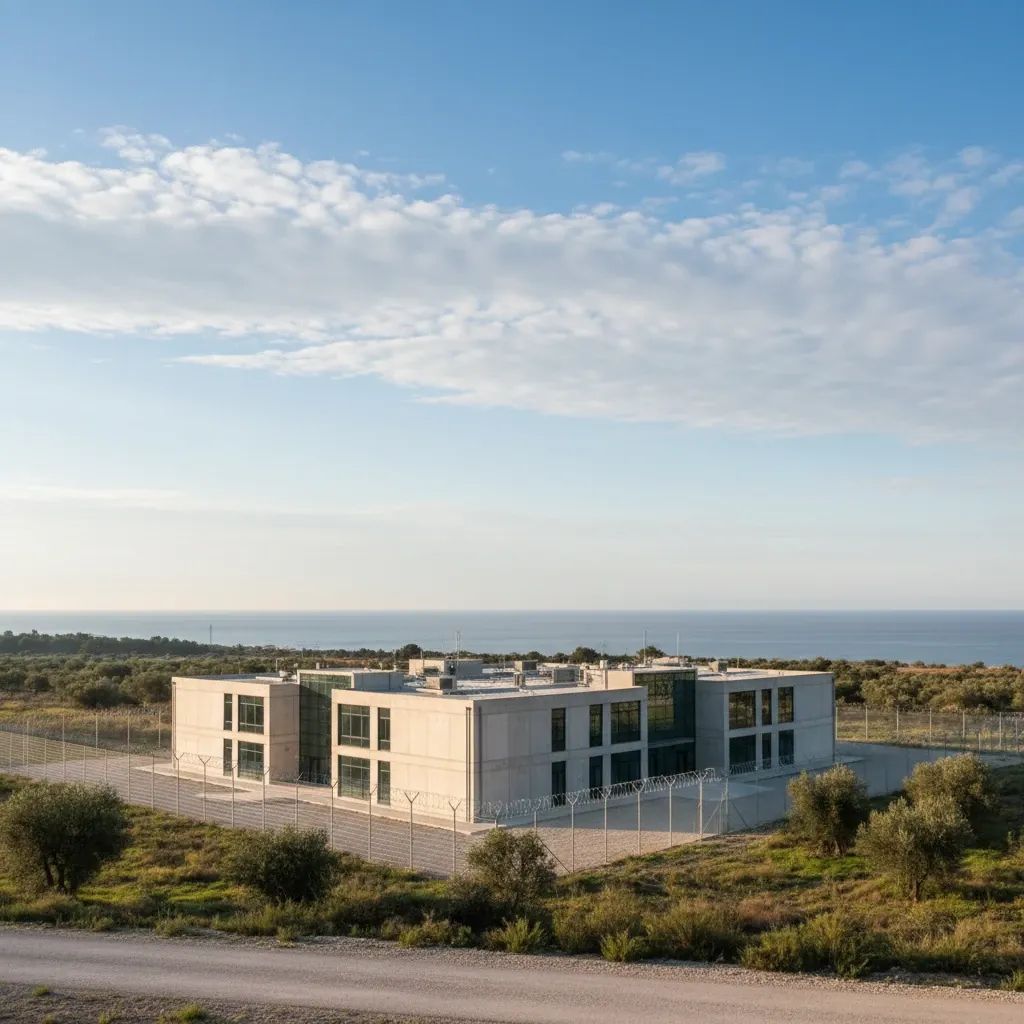
The Italian Ministry of the Interior, via Invitalia, has issued a tender worth €41–43 million for a new immigration detention facility in Castel Volturno, Caserta province. The planned Centro di Permanenza per il Rimpatrio (CPR) will hold 120 irregular migrants before deportation. The decision has triggered fierce opposition across Campania—most notably from Cardinal Domenico Battaglia, Naples' top religious authority, and civil-society coalitions.
The facility will rise on a site known as "Parco umido La Piana," a wetland area barely a stone's throw from a territory already burdened by unemployment, social fragility, and organized crime.
Why This Matters to Residents
Cardinal Battaglia's Direct Opposition: In a sharply worded public statement, Naples' Cardinal Archbishop rejected the plan, arguing Castel Volturno does not need "yet another enclave of marginalisation." He called instead for genuine investment: jobs, services, educational outposts, and legal-economy pathways.
"Migration policy cannot be reduced to containment devices," Battaglia said. "Security is not built by feeding peripheries of indignity. Our Constitution is clear: the person comes before every other consideration, and the Republic must remove obstacles to freedom and equality."
This intervention is significant because it aligns the Catholic Church—which commands considerable moral authority in southern Italy—directly against central-government policy on immigration.
The Cost and Efficacy Problem
The economics are striking:
• €340,000 per detainee: The facility costs roughly this amount per person housed—money critics argue could finance job creation and integration programmes instead.
• Deportation success rate: only 10.4% — Nationwide CPR data for 2024 show just one in ten detainees were actually expelled, calling the system's efficacy into serious question.
• Network is under-filled: Theoretical capacity across Italy's ten existing CPRs stands at 1,238 places, but only 672 are usable. Current occupancy hovers around 546 inmates—less than half capacity.
Despite these figures, the government is expanding the network. Even by its own metric, returns are trending downward. In 2025, total repatriations rose 12.6% to just over 6,000, but forced escorts actually dropped 16% year-on-year. The increase came chiefly from voluntary departures. Deportations via CPR accounted for barely one in ten enforcement actions.
What This Means for Residents in Campania
If you live in Campania—or anywhere in Italy where a CPR sits or is planned—the Castel Volturno debate crystallises a national dilemma: Does Italian law permit indefinite expansion of administrative detention, and at what fiscal and moral cost?
Will this affect your municipality? The €41–43 million contract is proceeding to tender despite nationwide CPR occupancy hovering near half capacity. Critics question whether the Ministry conducted proper cost-benefit analysis or whether the decision was driven by symbolic politics ahead of regional elections. Castel Volturno's mayor, Luigi Petrella, offered measured dissent, saying publicly he would have preferred his municipality be spared, noting that Castel Volturno "has already given so much" on immigration.
Potential legal challenges: Environmental groups and rights monitors signal administrative challenges may follow. The site is wetland, ecologically sensitive, and raises questions about environmental-impact assessments and local consultation.
Practical implications: CPRs do not meaningfully increase public safety. The vast majority of irregular migrants either self-deport, receive regularisation, or slip through enforcement nets; detention captures a tiny fraction. The €340,000-per-place investment could alternatively fund vocational training, legal-economy pathways, or social housing—measures Cardinal Battaglia explicitly calls for.
Local and Civil Opposition
Samuele Ciambriello, Campania's regional ombudsman for persons deprived of liberty, brands CPRs as exercises in "denying rights and squandering public funds." Legambiente Campania, the regional Forum del Terzo Settore, and the Movimento Migranti e Rifugiati di Caserta have likewise labeled the plan a "political and social mistake."
The bishops of Capua and Caserta have joined Cardinal Battaglia in expressing solidarity with detainees' right to dignity, warning against policies that compress fundamental rights.
The Government's Rationale
Prime Minister Giorgia Meloni's administration views CPRs as essential to managing irregular arrivals and upholding the rule of law. The party line holds that detention allows authorities to identify, process, and remove individuals lacking valid residence permits, thereby discouraging clandestine entry and dismantling smuggling networks. Expansion of the CPR network—including the controversial Albania facility that opened in April 2025—forms a pillar of the government's securitised migration strategy.
Gianpiero Zinzi, a Lega party deputy from Campania, defended the Castel Volturno tender, promising it would deliver "security by removing irregulars" and create construction and maintenance jobs. Yet opponents counter that the €41 million price tag will yield negligible deportations and trap vulnerable people in quasi-carceral limbo.
The Broader National Picture on Detention
Italy currently operates ten CPRs scattered from Bari to Trapani. Monitoring reports published in early 2026 by the Tavolo Asilo e Immigrazione (TAI)—a coalition including Emergency, Fondazione Migrantes, and Medici Senza Frontiere—paint a grim picture: detention centres routinely breach fundamental rights, deliver inadequate healthcare, dispense psychotropic drugs without proper prescriptions, and consign detainees to isolation fostering self-harm and mental deterioration. The TAI flatly calls CPRs "total institutions" incompatible with rule-of-law principles and demands their abolition.
The European Context
CPRs are not unique to Italy. France runs 25 "Centres de rétention administrative" (CRA), detaining over 42,000 people in 2021, with 90-day maximums. Spain operates "Centros de Internamiento de Extranjeros" (CIE), criticised as opaque spaces where half detainees are never deported. Germany, Greece, the Netherlands, Austria, and Denmark are in talks with African governments to build offshore detention camps for rejected asylum-seekers—measures human-rights monitors warn could create "legal black holes" where EU procedural safeguards vanish.
Alternative Models Proposed by the Church
Caritas Italiana, the Comunità di Sant'Egidio, and the Italian Episcopal Conference (CEI) have articulated a counter-vision: shut down all CPRs and replace them with non-custodial alternatives. Specific proposals include humanitarian corridors, sponsorship schemes, work-search visas, dispersed community hosting in parishes and families, and enhanced regularisation pathways. The Church's "Liberi di partire, liberi di restare" (Free to Leave, Free to Stay) campaign pairs these with job-creation projects in countries of origin.
What Happens Next
The contract is proceeding to tender. Environmental challenges and legal opposition may emerge. The tender timeline and construction start date remain unclear—residents and municipal leaders are awaiting formal announcements from the Ministry of the Interior. The Constitutional Court and European Court of Human Rights will likely scrutinise any facility that fails procedural safeguards, placing Italy at risk of future rulings mandating compensation or structural reform.
Conclusion: A Constitutional Test Case
Castel Volturno has become a proxy battleground between two visions of Italian statehood. One, articulated by the Meloni government, insists irregular migration must be met with firm enforcement, orderly processing, and swift removal. The other, championed by the Catholic hierarchy and civil-society coalitions, asserts that Italy's constitutional obligation to uphold human dignity precludes locking people in quasi-prisons that generate anguish, cost enormous sums, and rarely achieve their stated aim.
For residents of Campania—and for Italians nationwide—the outcome will test whether public funds flow toward containment or integration, whether security policy rests on exclusion or opportunity, and whether the Republic honours Article 3 of its Constitution: removing obstacles that limit freedom and equality. Cardinal Battaglia's vow to walk alongside those working "in the name of the Constitution, the Gospel, and human dignity" places the Church firmly in the camp advocating for systemic change. Whether that moral pressure can bend policy remains an open question.


