
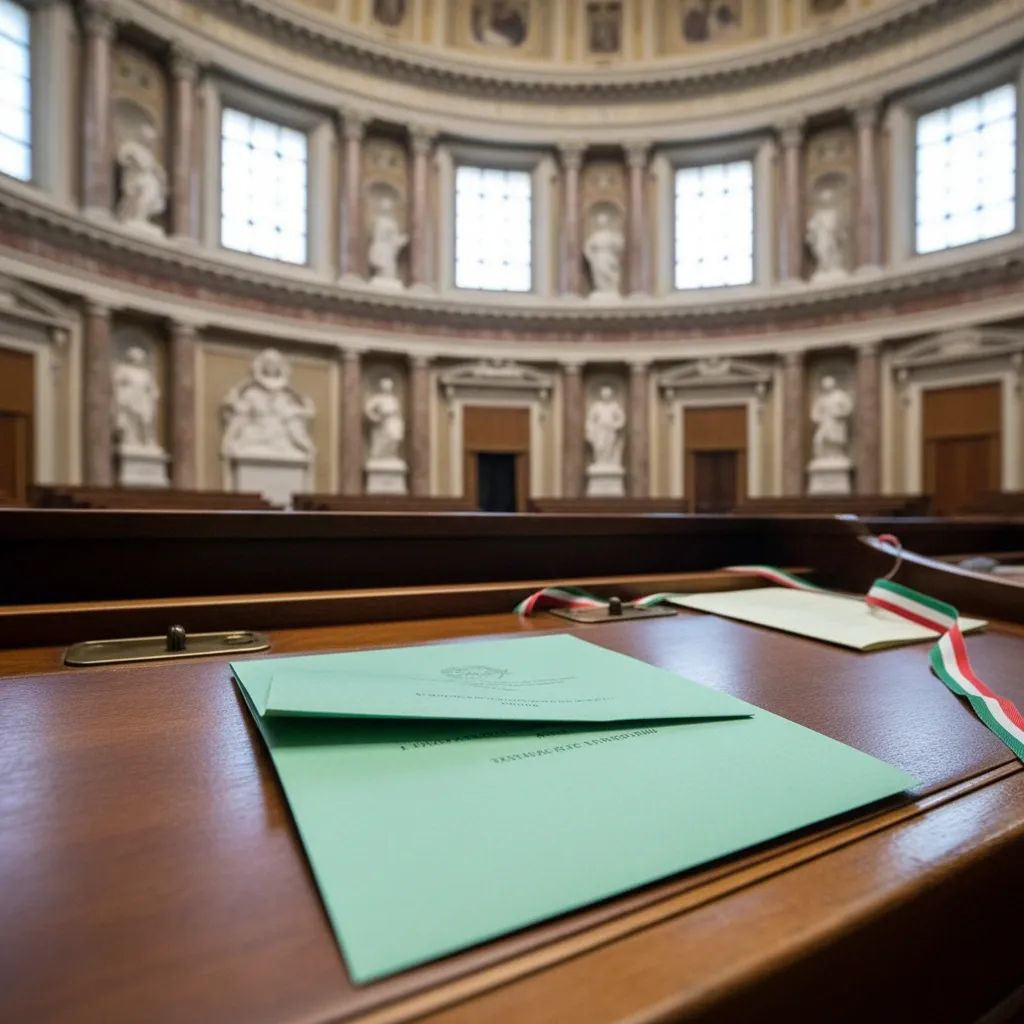
Italy's Cabinet suffered its first major electoral defeat since taking power in 2022, following the March 22-23, 2026 referendum in which Italian voters decisively rejected a constitutional reform aimed at overhauling the country's judicial system. The proposed reform would have separated prosecutorial and judicial careers—a centerpiece of Prime Minister Giorgia Meloni's reform agenda. The "No" camp captured 53.5% of the vote, effectively blocking the measure. With turnout approaching 59%, the outcome signals not just a policy setback but a potential recalibration of power dynamics between government, judiciary, and opposition forces.
Why This Matters
• Constitutional status quo preserved: The proposed judicial separation, two separate Supreme Judicial Councils, and a new disciplinary court will not materialize—Italy's 1948 Constitution remains unchanged.
• Political momentum shifts: Opposition coalitions (Democratic Party, Five Star Movement, Green-Left Alliance) are interpreting the result as a mandate to challenge the government more aggressively ahead of 2027 elections.
• Government credibility tested: Meloni has ruled out resignation but faces internal coalition scrutiny over a campaign widely criticized as incoherent and overly confrontational.
• Justice Minister Carlo Nordio will pivot to administrative efficiency measures rather than structural reform, including hiring drives and procedural tweaks already in the legislative pipeline.
The Vote That Split Italy North-South
While the Lombardy-Veneto corridor delivered "Yes" majorities—Lombardy at 53.5% and Veneto at 58.4%—the reform collapsed across southern Italy and major urban centers. Naples recorded the highest rejection rate among regional capitals at 75.4%, followed by Palermo (68.9%) and Bologna (68.1%). Even in regions governed by center-right coalitions—Lazio, Piedmont, Calabria, Sicily—the "No" camp prevailed, often by double-digit margins.
The geographic divide mirrored broader fractures. Turnout in Sicily languished at 46.1%, the nation's lowest, while Emilia-Romagna led at 66.6%. Analysts at YouTrend and Opinio Italia identified a critical bloc of so-called "dormant voters"—an estimated 10-15% of participants who skipped the 2022 general election but mobilized for this referendum, breaking 65% in favor of "No." This group, politically unaligned and motivated by anti-government sentiment or defense of constitutional principles, proved decisive.
What Went Wrong for the Government
Post-vote autopsies from pollsters and political insiders point to a communication disaster. Stefano Ceccanti, a constitutional law expert who backed the reform despite belonging to the center-left camp, told ANSA that the center-right coalition's "schizophrenic messaging" and "punitive justice rhetoric" alienated moderate voters. Rather than explaining the technical benefits of separating prosecutors from judges, government spokespeople framed the debate as a showdown between politicians and magistrates—a framing that backfired spectacularly.
A gaffe by Justice Ministry chief of staff Giusi Bartolozzi, suggesting the reform would "get rid of judges," became ammunition for opponents. Internal polling by Opinio Italia revealed significant defections within the coalition's moderate flank: 17.9% of Forza Italia and Noi Moderati voters cast "No" ballots, as did 14.1% of Lega supporters. By contrast, opposition parties held their bases more tightly—90.4% of Democratic Party voters rejected the reform, while Five Star Movement loyalty stood at 87%.
Lorenzo Pregliasco of YouTrend summarized the dynamic: "Defending the Constitution resonated with 61% of 'No' voters, but 31% explicitly cited opposition to the Meloni government as their motive. This wasn't just a legal debate—it became a referendum on executive power concentration."
Judicial Sector Celebrates, Cautiously
Inside courthouses from Milan to Naples, magistrates erupted in celebration as projections confirmed victory. Approximately 50 prosecutors and judges gathered at the Naples Courthouse ANM office, singing "Bella Ciao" and chanting the name of appeals court prosecutor general Aldo Policastro, a prominent "No" advocate. Some reportedly chanted, "Chi non salta Meloni è"—a provocative inversion of a 2023 center-right rally slogan targeting communists.
Notably absent from the festivities: Nicola Gratteri, the high-profile anti-mafia prosecutor frequently criticized by government figures. He issued a measured statement instead, calling the outcome "a strong signal that civil society is alive and ready to mobilize when fundamental principles are at stake." Milan Tribunal President Fabio Roia described the vote as validation that "judges and prosecutors did not deserve the continuous attacks and delegitimization from politics."
The National Association of Magistrates (ANM) executive board framed the result as "a starting point, not an endpoint," emphasizing that "citizens have confirmed the soundness of our positions on the real problems facing the justice system." Palermo prosecutor Maurizio de Lucia tempered optimism, noting the rejected reform "would not have solved any of the system's many problems" and urging focus on "concrete solutions, starting with increased resources and personnel."
What This Means for Residents
For anyone navigating Italy's notoriously slow civil and criminal courts, the immediate impact is continuity, not transformation. The rejected reform would have created parallel prosecutorial and judicial career tracks, theoretically reducing conflicts of interest. With that off the table, the existing unified magistrate corps—criticized by some for "ideological bias" and defended by others as essential to judicial independence—remains intact.
Justice Minister Nordio has signaled a tactical retreat to incremental measures already in motion:
• Mandatory pre-detention hearings: A 2024 law requiring judges to question suspects before issuing pre-trial detention orders takes full effect in coming months, aimed at reducing Italy's 15,000-plus inmates awaiting final conviction.
• Procedural code revisions: Proposals to strengthen presumption-of-innocence protections and clarify prosecutorial priorities (currently varying wildly between districts) will advance via legislative channels rather than constitutional amendment.
• Smartphone seizure rules: Legislation regulating digital evidence collection, already Senate-approved but stalled in the Chamber of Deputies, may resume progress.
• Prescription reform: A separate bill overhauling statute-of-limitations rules, dormant in the Senate, could resurface.
Expats and foreign investors should note that judicial unpredictability—a chronic complaint about doing business in Italy—will not improve quickly. The government's broader constitutional agenda, including a "premiership" reform to strengthen executive power and regional autonomy expansion, now faces heightened skepticism after this defeat.
Opposition Eyes 2027, But Divisions Lurk
Democratic Party, Five Star Movement, and Green-Left Alliance leaders have interpreted the victory as proof that their "broad front" strategy works. Party insiders are already floating primary election timelines to select a unified 2027 challenger to Meloni. Stefano Ceccanti, however, cautioned that the 14.4M "No" votes include many citizens "who do not feel represented by the current political offering and could return to abstention" in a general election.
Pollster Lorenzo Pregliasco echoed this skepticism: "The left should not fool itself that these 14 million votes are theirs. A significant share entered the game now precisely because they reject all parties." Constitutional scholar Giovanni Bachelet went further, comparing the referendum to "the partisan struggle or the razor-thin monarchy-to-republic referendum"—a one-time mobilization unlikely to repeat at the ballot box.
Moderate voters who rejected the reform out of concern over executive overreach, rather than allegiance to opposition parties, represent a fluid bloc. Whether they coalesce behind a center-left candidate or fragment by 2027 remains the central question shaping Italy's political trajectory.
Meloni Holds Firm, For Now
The Prime Minister addressed the nation immediately after results finalized, stating, "Popular sovereignty must be respected," but adding defiantly, "We will continue with responsibility and determination." She explicitly rejected comparisons to Matteo Renzi, who resigned after losing a 2016 constitutional referendum—a contrast opposition figures noted with irony.
Internal coalition dynamics bear watching. Forza Italia's Antonio Tajani called for moving past "civil war tones," while Lega figures quietly expressed relief that the referendum's failure spares them from navigating the complex implementing decrees the reform would have required. Speculation about a cabinet reshuffle or Nordio's replacement has surfaced in Rome political circles, though no concrete moves have materialized.
Internationally, the defeat punctures perceptions of Meloni as an unstoppable force. While her government retains a solid parliamentary majority and no immediate threat to its survival exists, the outcome introduces uncertainty about Italy's reform trajectory at a moment when EU partners and investors prize predictability.
The Bigger Picture
This referendum marks Italy's fifth constitutional amendment rejection since 2001, underscoring citizens' deep reluctance to alter the post-war constitutional settlement. Only two reforms have passed in that span: a 2001 devolution of powers to regions (later partially rolled back) and a 2020 parliamentary seat reduction that sailed through with minimal controversy.
The 59% turnout—higher than many expected but below the 2022 general election's 63.9%—reflects genuine engagement on a substantive question, not apathy. That the vote occurred without a participation quorum (abolished in earlier reforms) forced every abstention to count as a de facto position, driving mobilization on both sides.
For ordinary residents, the lesson is clear: Italy's justice system, with all its inefficiencies and controversies, will change slowly if at all. Whether that represents the people's wisdom or a missed opportunity depends entirely on which side of the courtroom one stands.


