
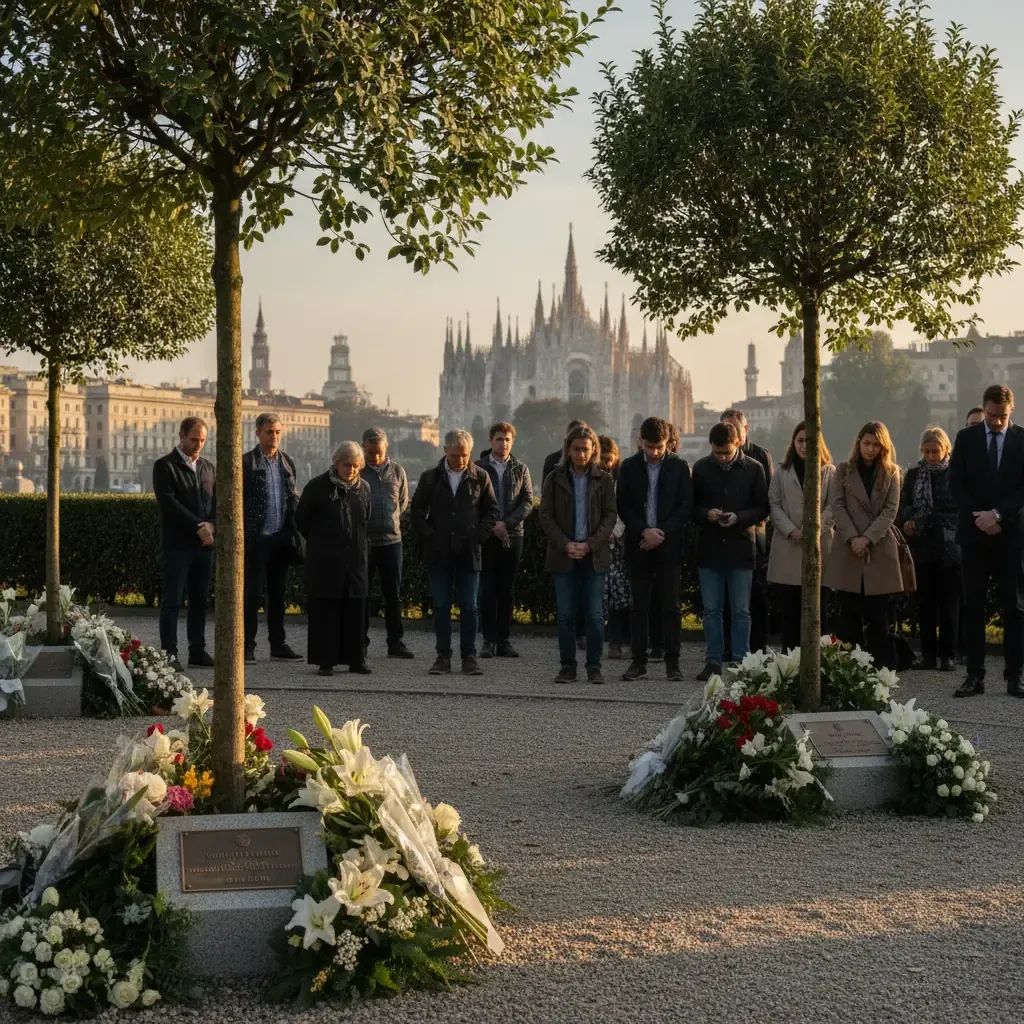
Italy's President Sergio Mattarella led the nation's commemoration of the Fosse Ardeatine massacre on its 82nd anniversary, underscoring Rome's commitment to preserving the memory of one of the darkest episodes of Nazi occupation. The ceremony at the Ardeatine Mausoleum brought together the country's highest officials to honor the 335 civilians and military personnel murdered in a mass reprisal execution on March 24, 1944.
Why This Matters
• Historical significance: The Fosse Ardeatine massacre remains Italy's largest single Nazi atrocity, claiming 335 lives in five hours of systematic execution—including at least 75 Jews, making it the deadliest anti-Jewish massacre on Italian soil.
• Institutional unity: All three branches of government participated, signaling cross-party consensus on defending democratic values and historical memory amid rising concerns about antisemitism and intolerance across Europe.
• Educational push: Rome officials launched citywide initiatives targeting students, from guided tours of Via Tasso prison to theatrical performances, designed to root civic consciousness in wartime history.
• Public engagement: A major public ceremony at Piazza del Campidoglio featured the unfurling of a banner bearing all 335 victims' names down the Cordonata staircase, transforming commemoration into participatory ritual.
State Ceremony at Ardeatine Mausoleum
The Italian President arrived to applause and an honor guard before laying a laurel wreath at the memorial site on Via Ardeatina 174. Defense Minister Guido Crosetto, military chiefs, and Francesco Albertelli, president of the National Association of Italian Martyrs' Families (ANFIM), accompanied Mattarella through the somber protocol.
Senate President Ignazio La Russa, Chamber President Lorenzo Fontana, Rome Mayor Roberto Gualtieri, and Lazio Regional President Francesco Rocca attended the morning rites. The ceremony featured the reading of all 335 victims' names—a roll call lasting several minutes—followed by Catholic and Jewish prayers officiated by Monsignor Gian Franco Saba and Rabbi Riccardo Di Segni, reflecting the diverse faiths among the murdered.
After the outdoor wreath-laying, Mattarella entered the Ardeatine Sacrario, the inner sanctuary where the remains of victims rest in individual tombs, and signed the memorial's Honor Register. The mausoleum, completed in 1949, stands as one of 20th-century Italy's most significant commemorative architectural works, transforming ancient tufa quarries into consecrated ground.
La Russa later wrote on social media: "We honor the 335 victims of one of the most dramatic chapters of our nation. A Nazi crime that calls everyone to the duty of memory and the responsibility to defend, every day, the values of freedom, human dignity, and democracy, so that such atrocities are never repeated."
The Historical Context: Reprisal and Terror
The massacre unfolded as direct retaliation for the Via Rasella attack of March 23, 1944, when partisan fighters from the Patriotic Action Groups (GAP) ambushed a column of the German "Bozen" police regiment, killing 33 soldiers. Adolf Hitler personally demanded a response that would "shake the world," and German command in occupied Rome imposed a ten-to-one reprisal ratio—ten Italians executed for every German soldier killed.
On March 24, SS and Gestapo units pulled prisoners from Regina Coeli and Via Tasso jails. The victims included political prisoners, Jewish detainees, military personnel, and civilians arrested in random sweeps. Many had no connection to the partisan action. Herbert Kappler, Gestapo chief in Rome, supervised the operation alongside Erich Priebke and Karl Hass. The condemned were trucked to the Fosse Ardeatine, ancient pozzolana quarries south of the city.
In groups of five, the prisoners were led into the cave tunnels and shot in the back of the head. The executions spanned roughly five hours, from early afternoon into evening. When the killing ended, German engineers detonated explosives to collapse the cave entrances, intending to bury the evidence permanently. The bodies were not discovered until after Rome's liberation in June 1944.
What This Means for Residents
For Romans and Italians broadly, the annual commemoration serves as a civic anchor, a fixed point in the calendar that reaffirms collective values forged in wartime suffering. The ceremonies are not merely retrospective—they function as moral frameworks for contemporary policy debates on antisemitism, racism, and extremism.
Regional President Rocca emphasized that institutions bear the duty to "preserve these memories through ceremonies, educational initiatives, and public policies capable of countering antisemitism, racism, and every form of intolerance." The message aims particularly at younger generations, many of whom lack direct family connection to the war but inherit responsibility for safeguarding democratic norms.
Rome's municipal government has intensified its educational outreach. Third-year middle school students across the capital are encouraged to visit the Via Tasso Museum—the former Nazi prison—and the Ardeatine Mausoleum as part of civics curricula focused on human rights violations during the Second World War. Rai Scuola, the state broadcaster's educational arm, partnered with radio divisions to bring survivor testimonies and historians into classrooms, constructing what officials describe as "civic conscience grounded in historical memory."
Rome's Public Commemoration
Beyond state protocol, Rome Capitale organized "335 – Roma Ricorda," a public ceremony beginning at 3:00 PM in Piazza del Campidoglio. Open to all citizens, the event blended institutional speeches with symbolic gestures and cultural performance. Mayor Gualtieri addressed the crowd alongside the Culture Assessor, ANFIM President Albertelli, and the president of Rome's Jewish Community.
The centerpiece was a massive banner printed with the names of all 335 victims, slowly unrolled down the Cordonata del Campidoglio, the monumental staircase designed by Michelangelo. As the fabric descended, each name became visible to the assembled crowd—a visual rendering of individual loss aggregated into collective tragedy.
University students from LUMSA read aloud letters written by the widows, mothers, and sisters of the murdered men, some penned immediately after the massacre when families still hoped their loved ones might return. The ceremony concluded with a concert by the Rome Municipal Police Band, performing pieces chosen to evoke both mourning and resilience.
Memorial Walks and Cultural Programming
The local chapters of ANPI, Italy's partisan veterans association, organized a "Stumbling Walk" (Passeggiata d'Inciampo) departing at 5:00 PM from Piazza Bartolomeo Romano. The guided route through the Garbatella neighborhood traces sites connected to Nazi-Fascist repression, aiming to restore "stories and identities to the victims." The walk reflects a broader European trend of hyperlocal memory work, embedding historical trauma into everyday urban geography.
On March 27, the Moby Dick Cultural Center will host the launch of Andrea Zannini's book "L'Arte per la Storia – Mirko Basaldella alle Fosse Ardeatine," examining the role of artist Mirko Basaldella in shaping the mausoleum's aesthetic and symbolic language. The presentation explores how art mediates historical memory, translating abstract loss into tangible form.
Rai Cultura and Rai Storia devoted substantial airtime to the anniversary, broadcasting documentaries, theatrical performances—including Francesca Comencini's "Tante Facce nella Memoria," which recounts the massacre through women's perspectives—and episodes of educational series like "Passato e Presente" and "Pietre d'Inciampo."
Traffic and Logistics
Commemorative events triggered road closures and parking bans around Via Ardeatina and the city center. Public transport lines serving the area were temporarily rerouted during morning ceremonies, with service resuming by early afternoon. Municipal authorities advised residents to plan alternate routes if traveling through the affected zones.
European and Historical Parallels
While deeply rooted in Italian consciousness, the Fosse Ardeatine massacre resonates within the broader European narrative of Nazi atrocities and resistance. The reprisal logic mirrored other German massacres: Oradour-sur-Glane in France, Lidice in Czechoslovakia, and numerous villages across occupied Eastern Europe where Wehrmacht and SS units executed civilians in response to partisan activity.
Within Italy, the Fosse Ardeatine stands alongside Sant'Anna di Stazzema, Monte Sole (Marzabotto), and other sites where German forces slaughtered hundreds. These massacres shared common features—disproportionate reprisals, targeting of specific groups (Jews, political prisoners, suspected partisans), and attempts to conceal evidence through mass burials or cremations.
Postwar justice arrived slowly and unevenly. Herbert Kappler was convicted and sentenced to life imprisonment in 1948 but escaped from a Roman military hospital in 1977, dying in West Germany a year later. Erich Priebke, extradited from Argentina in 1995, was tried and convicted in 1998, living under house arrest in Rome until his death in 2013. These prolonged legal sagas underscore the difficulties of prosecuting wartime crimes and the persistence of survivors and families in demanding accountability.
Guarding Memory Against Forgetting
The sustained attention to the Fosse Ardeatine reflects an institutional consensus that historical memory requires active maintenance. As the generation with direct wartime experience fades, officials and educators worry that younger Italians may perceive these events as remote or irrelevant. The ceremonies, school programs, and media coverage aim to counter that drift, insisting that the massacre's lessons—about state violence, racial hatred, and the fragility of democratic norms—remain urgent.
Regional President Rocca urged young people to "believe in the strength of democracy and never forget the profound meaning of human dignity, inviolable even in the face of hatred and dehumanization." His language reflects a concern that rising antisemitism and xenophobia across Europe threaten the values forged in the rubble of the Second World War.
The Fosse Ardeatine Mausoleum continues to function as both shrine and classroom, a place where civic identity is renewed through collective mourning. The annual rituals—wreath-laying, name-reading, prayers—transform individual acts of remembrance into a national affirmation that certain lines, once crossed, can never be justified or forgotten.


