
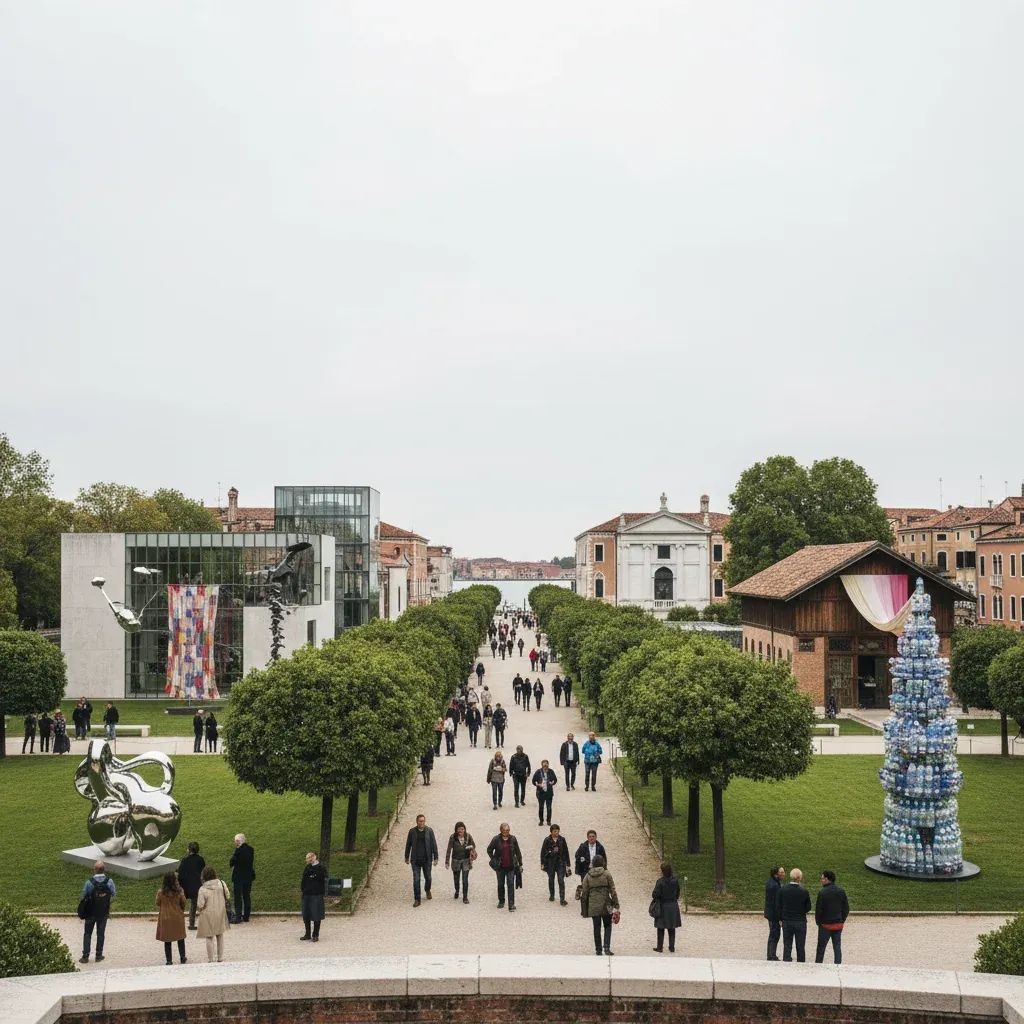
Deputy Prime Minister Matteo Salvini made a high-profile appearance at the contested 61st Venice Biennale (2026) on May 7, deliberately visiting both the Russian and Israeli pavilions amid a geopolitical firestorm that has consumed the world's oldest art fair. His presence comes as roughly 20 national pavilions shuttered their doors in protest against Israel, the European Union threatens to revoke €2M in funding, and Italy's own Culture Minister Alessandro Giuli boycotted the official inauguration.
Speaking outside the Russian pavilion at the Giardini, Salvini positioned himself as a champion of cultural neutrality, declaring that "after four years of conflict, sanctions, and deaths, my hope is that diplomacy will close this war." He toured the pavilion alongside Russian commissioner Anastasia Karneeva, listened to Siberian folk performances, and ascended to the first floor to touch a symbolic tree installation — a gesture that drew immediate condemnation from pro-Ukraine activists and European Commission officials monitoring sanction compliance.
Why This Matters
• €2M EU funding for the Biennale (2025-2028 grant) is now at risk of cancellation due to Russia's participation, which Brussels argues violates EU sanctions prohibiting "providing services" to the Kremlin under EU Sanctions Regulation 833/2014. For Italian cultural institutions, this sets a precedent for compliance enforcement.
• At least 20 pavilions (including Switzerland, Austria, Belgium, Spain, Poland, and the UK) closed in solidarity with Palestine, marking an unprecedented cultural strike.
• Italy's government is openly divided: Salvini attended and defended both Russia and Israel's presence, while Culture Minister Giuli skipped the opening and dispatched inspectors to verify sanction compliance. This reflects tensions within Prime Minister Giorgia Meloni's three-party coalition between the pro-engagement League and the stricter Fratelli d'Italia faction.
• The entire international jury resigned after declaring they would not award prizes to countries whose leaders face ICC charges for crimes against humanity — a move that directly targets Russia and Israel.
A Deliberate Provocation or Cultural Diplomacy?
The leader of the League party framed his Venice tour as a mission to "end the controversy" surrounding the Biennale, but his itinerary — which included the US, Russian, Chinese, and Israeli pavilions — appeared calculated to underscore his long-standing positions on sanctions relief and diplomatic engagement with Moscow.
"Culture and sport should be neutral fields, meeting points," Salvini told reporters at the Giardini. "Those who enter the Russian pavilion will leave with a sense of serenity that they can transpose into their political activity." He drew a parallel to the National Alpine Corps gathering in Genoa, which also faced protests this week, lamenting that Italy has entered "a surreal era where even the rigorous Alpini manage to scandalize and worry people."
The deputy PM's remarks directly contradict the stance of his cabinet colleague. Minister Giuli has publicly accused Biennale President Pietrangelo Buttafuoco of allowing Russia's return "behind the government's back, circumventing sanctions," and called it "inopportune" for Buttafuoco to invoke President Sergio Mattarella's recent speech about artistic freedom at the David di Donatello awards. Giuli announced he would visit only the Italy Pavilion at the Arsenale later this month — "to honor Italian art and Italy. I don't know if Buttafuoco will be there; maybe he'll have something else to do."
What This Means for Italy's Art Funding and International Standing
The European Commission sent multiple formal letters to the Biennale and the Italian government, warning that Russia's presence breaches the terms of a three-year, €2M grant (2025-2028) earmarked for film promotion. The sanctions framework underpinning this enforcement is EU Sanctions Regulation 833/2014, which prohibits EU entities from providing services that could benefit Russian state actors — a rule that directly affects how Italian cultural institutions operate and receive EU funding. Vice President Henna Virkkunen stated that if the violation is confirmed, Brussels "will not hesitate" to suspend or revoke the funds, because "European taxpayers' money should safeguard democratic values and diversity, not those disrespected by current Russia."
The Commission argues that because the Russian pavilion is owned by the Kremlin, any cost borne by Moscow for its delegation indirectly benefits the Biennale and constitutes a prohibited service under EU sanctions. The Biennale was instructed to respond with satisfactory clarifications by Sunday, May 10, 2026, or face contract termination.
Buttafuoco's defense rests on structural and legal grounds: the Biennale has no authority to exclude a country recognized by the Italian Republic, especially when that country owns its pavilion outright. "La Biennale is not a tribunal. It is a garden of peace," he stated. He also noted that inspections conducted by the Ministry of Culture's contemporary creativity directorate found no regulatory breaches.
The Israel Controversy Deepens
While the Russian debate centers on sanctions compliance, the Israeli pavilion sparked an even larger cultural mobilization. The Art Not Genocide Alliance (ANGA) collected nearly 220 signatures from artists, curators, and cultural workers demanding Israel's exclusion over the Gaza conflict. A separate open letter from 70 artists and curators involved in the main exhibition — titled "In Minor Keys" and curated by Koyo Kouoh — extended the call to exclude Russia, Israel, and the United States, describing all three as "states currently responsible for military operations that critics argue constitute violations of international humanitarian law."
On the ground, pavilions from Austria, Belgium, Egypt, Lithuania, Luxembourg, Poland, Slovenia, Spain, Switzerland, Turkey, Finland, the Netherlands, Ireland, Qatar, Malta, Cyprus, Ecuador, and the UK joined the closure strike. Organizers used the Telegram channel Global Project to coordinate a demonstration at 4:30 PM marching from Via Garibaldi toward the Israeli pavilion at the Arsenale, which also advocated for two detained activists from the Global Sumud Flotilla, Thiago and Saif, currently held in Israel.
Israeli artist Belu-Simion Fainaru, whose work is displayed at the Arsenale while Israel's permanent pavilion undergoes renovation, said he felt "racially discriminated against" by the jury's decision and described the environment as "hostile and degrading." The Israeli Ministry of Foreign Affairs denounced the jury's stance as "anti-Israel political indoctrination."
Ukraine's Culture Minister Tetyana Berezhna also weighed in, calling Russia's presence "unacceptable" during the opening of the Ukrainian pavilion, which features a suspended origami deer by artist Zhanna Kadyrova — symbolizing the "insecurity and unknown future of the Ukrainian people."
Record Attendance Amid Chaos
Despite — or perhaps because of — the turmoil, the invitation-only preview days (May 5–8, 2026) saw record turnout, with wait times reaching 90 minutes at the Arsenale. Early estimates suggest 16,000 visitors passed through during the VIP opening, a significant increase over previous years.
The Pussy Riot collective, led by activist Nadya Tolokonnikova, staged a march from San Moisè to Ca' Giustinian, brandishing Ukrainian flags and chanting anti-Putin slogans. Tolokonnikova attempted to meet Buttafuoco but was told by a staffer to "send an email."
The Russian pavilion, titled "The Tree is Rooted in the Sky," features more than 50 musicians, poets, and philosophers presenting culture as "an eternal dimension distinct from political contingencies." However, it remains closed to the general public from May 9 through the Biennale's close on November 22, 2026, with performances projected on exterior screens.
Political Fallout in Rome
The crisis has exposed fissures within Prime Minister Giorgia Meloni's three-party coalition government, which brings together Salvini's League, Giuli's Fratelli d'Italia, and Forza Italia. In Italy's coalition system, ministers often represent different parties with divergent foreign policy positions, and this Biennale dispute exemplifies that tension. Salvini's League champions engagement with Russia and opposes cultural boycotts, while Giuli's Fratelli d'Italia faction aligns more closely with EU sanctions enforcement, creating a rare public clash between cabinet colleagues over international policy.
Opposition lawmakers from the Democratic Party and Five Star Movement demanded Giuli "come to Parliament" and accused him of "fueling chaos" instead of leading. Piero De Luca, head of the PD group on the European Affairs Committee, said: "The Culture Minister is not a bystander. The government must take responsibility."
For residents in Italy, this standoff carries practical implications: it signals how EU sanctions compliance will be enforced against Italian cultural institutions, whether future arts funding might face similar political disputes, and how Italy's coalition dynamics shape its approach to international cultural diplomacy.
The Biennale's official opening to the public is May 9, 2026, with the event running until November 22, 2026. Whether the EU will follow through on its funding threat, and whether Italy's coalition government can present a unified cultural policy, remains to be seen.


