
Why This Matters
• Monthly retirement shortfall: Women in Italy today retire on approximately €1,060 monthly against men's €1,534—a gap of 28.7% that compounds over 20+ years of post-retirement life.
• Geographic fate: Female employment participation fluctuates wildly by region: under 10% non-participation in the North versus 38% in Calabria, determining lifetime earnings before retirement even arrives.
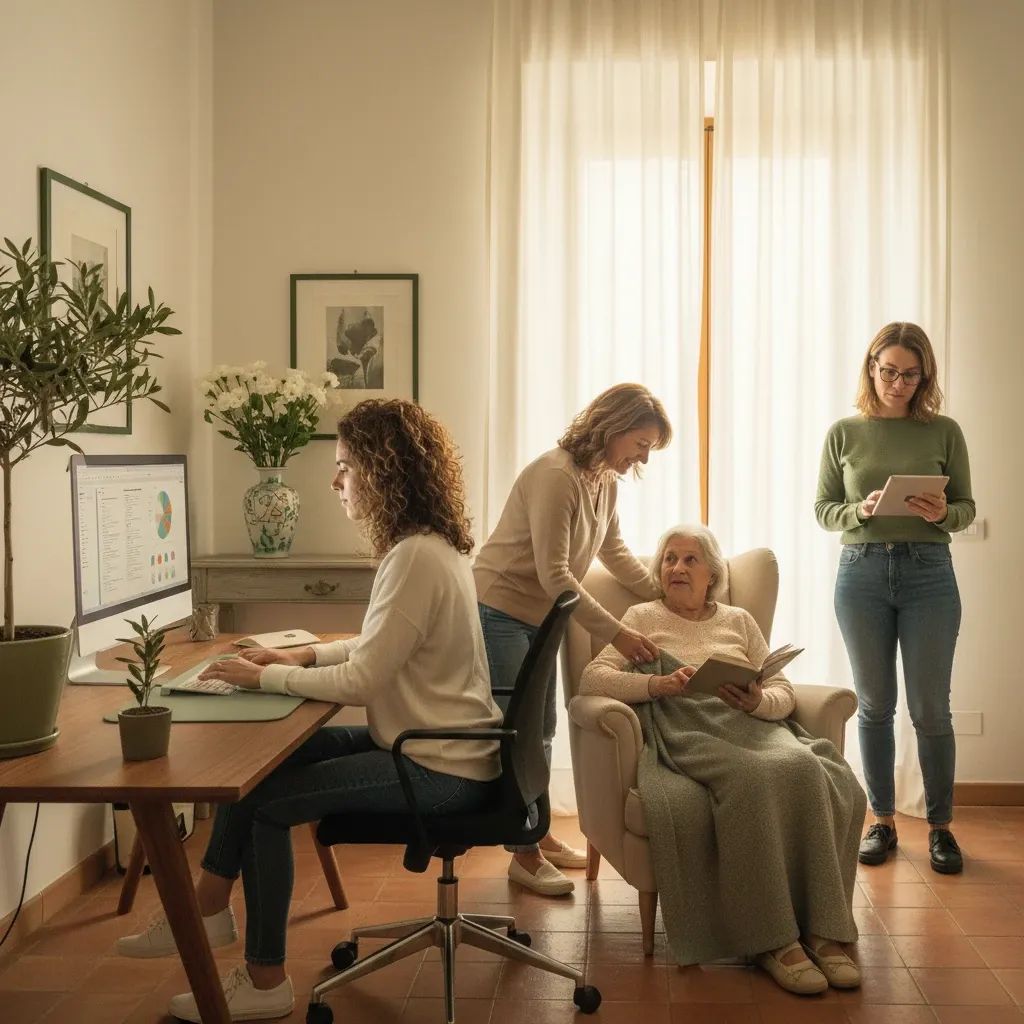
• Caregiving's hidden cost: Women perform 61.6% of family care work nationally, with caregiving directed toward elderly relatives consuming the majority of care hours. Yet women earn zero pension credits for caregiving years, leaving them uniquely exposed to late-life poverty.
• Regulatory shift ahead: The EU's pay transparency directive takes effect in Italy by June 2026, forcing employers to publicly disclose salary bands and gender wage gaps—the first mandatory mechanism to expose entrenched inequities.
The Pension Math: How Disadvantage Compounds Over Decades
An Italian woman retiring today receives a pension calculated under the contributory system, implemented since 1996. The logic is austere: your monthly benefit reflects nothing more than your cumulative contributions and the years you paid into INPS. No career interruption is forgiven. No year spent raising children or tending elderly parents counts.
According to the INPS Gender Report for 2024 (the most recent complete dataset), women retiring on old-age pensions receive approximately 28.7% less than men overall. However, this gap varies significantly by sector. In the private employment sector, the disparity reaches 47.2%: women average €1,047.70 monthly versus men's €1,982.90. In public employment, the gap ranges between 23% and 35% depending on pension type. These sectoral variations reflect different career patterns and contribution histories across employment categories.
The arithmetic is relentless. A woman who worked continuously in a professional role but earned 15-20% less than male colleagues throughout her career—a persistent pattern across Italy's wage structure—will accumulate 15-20% fewer pension credits. A woman who reduced to part-time work for eight years while managing childcare and elder care simultaneously will see her lifetime pension reduced by potentially 30-50%. A woman whose career was fragmented across multiple interruptions faces an even steeper penalty.
Concretely: a woman retiring in 2026 with a baseline €1,060 monthly pension faces approximately 25 years of post-retirement life on roughly €318,000 in cumulative benefits. A comparable male colleague receives around €460,000 over the same period. That €142,000 difference—distributed monthly—shapes whether she maintains her apartment, affords medication, seeks professional healthcare, or becomes financially dependent on family members in her final decades.
The Regional Divide: Employment Destiny Predetermined by Geography
Italy's pension inequality cannot be separated from its labor market geography. The Mezzogiorno functions as a distinct economy, where female labor force participation bears no resemblance to northern regions.
In the North, female non-participation falls below 10%. In the South, it routinely exceeds 25%, reaching 38.3% in Calabria and 36.8% in Campania. This is not a preference for domestic life; it reflects the absence of accessible childcare, employer inflexibility, and scarcity of part-time positions offering both livable hours and reasonable pay.
The wage consequences are equally stark. A woman in Milan averages €28,603 annually—accumulating robust pension credits over a full career. A woman in Vibo Valentia, Calabria's poorest province, earns €10,463. Over a 40-year career, the northern worker accumulates roughly 2.7 times more pension credits than her southern counterpart, before regional cost-of-living differences are even considered. Her retirement income is fundamentally determined by birthplace.
Unpaid domestic and caregiving burdens reinforce this geographic split. Nationally, women perform 61.6% of household and care labor. In southern regions, that proportion surges to 70.4%, and in the islands reaches 68.4%. These are not cultural preferences but structural outcomes: the absence of state childcare services, rigid corporate cultures resistant to flexible scheduling, and limited public elder-care infrastructure force women to absorb caregiving themselves or exit the workforce.
The Double Squeeze: Motherhood, Elder Care, and the Missing Years
For Italian women, motherhood rarely integrates smoothly into professional advancement. Nearly half of mothers—46.5%—exit or reduce paid work after their first child. The phrase "temporary leave" masks permanent career recalibration. A woman who returns part-time after childbearing often remains trapped in part-time status for a decade or longer, unable to resume full-time trajectory even after children mature. Her pension reflects not a brief interruption but a permanent downward shift in contribution accumulation.
Yet motherhood no longer dominates women's caregiving burden. Demographic aging has introduced a parallel crisis. Research finds that the majority of family caregiving hours are directed toward aging parents or in-laws, compared to a smaller proportion for dependent children. Women now confront the simultaneous demands of career and caregiving obligations during precisely the years when they should accumulate their highest pension contributions.
The scale is staggering. Over 90% of Italy's family caregivers for elderly or disabled relatives are women, typically over age 60 themselves. These women dedicate 55+ hours weekly to unpaid labor. The national average for women's daily caregiving work reaches six hours—the second-highest rate in Europe, surpassed only by Portugal. In monetary terms, this work generates approximately €400 billion annually in economic value, with women producing roughly 70% of that output.
The pension system offers zero recognition. INPS does not credit caregiving years toward benefit calculations. A woman who spends a decade tending elderly parents receives no pension credit for that decade. She is treated, for contributory purposes, as though she was unemployed. When she eventually retires, that missing decade translates directly into a lower monthly payment for the remainder of her life.
This exclusion is structurally devastating for vulnerable women. Wealthy women with strong savings or spouse income can absorb the loss. But women in precarious employment—concentrated in the South and in lower-wage service sectors—face compounding entrapment: interrupted careers, chronically lower baseline salaries, caregiving demands that prevent workforce re-entry, and a pension system that penalizes them for years they spent sustaining family survival.
Government Action: Modest Adjustments, Structural Inertia
The Italy Ministry of Labor and Pensions navigated 2025-2026 focused primarily on system solvency rather than gender equity. Standard retirement remains set at 67 years with 20 years of contributions. Early retirement requires 42 years and 10 months of contributions for men and 41 years and 10 months for women—a marginal two-month female advantage that does nothing to compensate for the years-long career gaps many experience.
Two key flexibility measures have been eliminated or expired. Quota 103, allowing retirement at 62 with 41 years of contributions, was eliminated after 2025. Opzione Donna, which permitted women to retire at 61 with 35 years of contributions (subject to actuarial penalty), lapsed at the end of 2024. Data shows exits via Opzione Donna have declined significantly following its expiration, reflecting the disappearance of this pathway from policy options. These were imperfect mechanisms, but they offered marginal flexibility precisely when other options were unavailable. Their elimination removes a tactical exit route some women had planned around.
The APE Sociale program continues to be available, permitting retirement at 63 years and 5 months for caregivers, disabled workers, and those in physically demanding roles. Mothers retain a modest 12-month reduction in contribution requirements per child, capped at 24 months total. These provisions offer fractional relief—a woman with two children gains 24 months of credit reduction across a 40-year career—but scarcely address the underlying reality that women's careers are systematically disrupted by caregiving expectations, and then the system penalizes them for those interruptions.
The OECD has cautioned against policies that create female-specific early retirement pathways, arguing they can paradoxically widen long-term pension disparities by legitimizing women's exit from the workforce rather than supporting their continuous employment. The organization recommends structural policies enabling women to remain working: universal childcare, flexible scheduling, elder-care services, and caregiving year credits. Italy implements none of these systematically.
How Northern Europe Engineered Different Outcomes
The pension gap is not inevitable. Countries with integrated caregiving policies and stronger female labor force participation demonstrate markedly different outcomes.
Sweden provides 480 days of parental leave, with 390 days paid at near-full salary. Crucially, 90 days are reserved exclusively for each parent and non-transferable—a design that forces fathers into active caregiving and reshapes workplace culture around paternity. Denmark maintains 18 months of maternity leave while achieving female labor force participation rates exceeding 70%. Finland and Norway operate similar frameworks, blending generous leave with high income replacement.
Spain recently shifted to gender-neutral parental leave: 16 weeks for each parent at 100% pay, eliminating incentives for mothers to absorb all caregiving. Germany permits both parents to split 14 months of leave at 65% net income replacement, with both required to participate. Critically, parents can work part-time until age 3 with the state covering 67% of the income gap. Families additionally receive Kindergeld, up to €235 monthly per child through age 25.
France combines a 35-hour work week with comprehensive childcare infrastructure. The state covers up to €7,500 annually in childcare costs per child under six. Family size automatically reduces taxable income, protecting household finances. Childcare is treated as public investment, not private family burden.
These policies produce measurable outcomes. Female labor force participation in Sweden and Denmark approaches 70-72%, compared to Italy's 50.4%. Pension gaps in Nordic countries average 15-20%—roughly half Italy's disparity—because women's careers remain continuous and their earnings less suppressed.
The Transparency Directive: First Mandatory Exposure
Beginning in June 2026, the Italy government will enforce the EU's 2023/970 Pay Transparency Directive, requiring companies to systematically disclose salary bands and report gender wage gaps to workers and regulators. For Italian firms, this represents the first mandatory transparency mechanism on a nationwide scale.
The directive mandates that employers with 250+ employees disclose the gender pay gap by wage category and justify substantial differences. Companies with 100-249 employees face phased obligations beginning 2027. Workers gain the right to request pay comparison information against same-role colleagues.
The anticipated impact is mixed but meaningful. Transparency can motivate corrective action—companies face reputational risk and potential legal challenge if gaps appear systematic and unjustified. Yet transparency alone has not closed gaps in countries where it already operates. Sweden, which pioneered gender wage disclosure decades ago, maintains a gender wage gap around 12% despite complete information visibility.
For Italy, the directive's value lies in baseline exposure. Decades of hidden wage structures have allowed systematic underpayment of women to operate invisibly. Public disclosure creates political and reputational pressure for corrective action, even if it does not automatically solve the problem. For southern regions with lowest female employment, transparency matters less than structural access—disclosure cannot conjure childcare or flexible hours where infrastructure does not exist.
Demographic Pressure: The 2066 Horizon
Italy's population includes 24.7% over age 65 as of 2025, with that proportion climbing for decades. Elder care demand will intensify while Italy relies almost entirely on unpaid family labor. Current analysis suggests that gender parity in unpaid care distribution will not arrive for many years—a projection reflecting systemic entrenchment rather than an imminent timeline.
The economic invisibility becomes concrete hardship in late life. A woman who devotes 10 years to family caregiving contributes roughly €400,000 in labor value that yields zero pension credits, zero social insurance eligibility, and zero state recognition. When she retires, she enters post-retirement life on inadequate income, then confronts two decades of depending on an undersized pension while healthcare costs and living expenses accumulate.
The cumulative effect is concentrated vulnerability. Women lacking wealth buffers face heightened poverty risk in their 70s and 80s, when medical expenses surge and family financial capacity weakens. Late-life poverty among women in Italy exceeds that among men by a measurable margin, with pension inadequacy as the primary driver.
What Remains Unaddressed
The 28.7% pension gap is not a market inefficiency or policy oversight. It is the crystallized endpoint of a career-long accumulation of disadvantages: initial wage suppression, interrupted tenure due to caregiving, limited access to senior roles, concentration in lower-wage sectors with weaker legal protections, and geographic employment scarcity in the South.
These disadvantages reinforce cyclically. A woman earning 15% less than her male peer at career entry, taking three years out for childrearing, then working part-time for eight years while managing both children and aging parents, will retire on perhaps €650 monthly. Her male peer receives €1,400. Both had careers; hers was discontinuous and lower-wage. The pension system crystallizes these inequalities into fixed monthly payments that last 20-25 years, typically extending into her late 80s or 90s.
The June 2026 transparency directive will expose wage gaps without solving the caregiving infrastructure crisis or the geographic employment divide. Government cannot mandate gender equity in pension outcomes without simultaneously supporting continuous female employment—through universal childcare, accessible elder-care services, workplace flexibility mandates, and explicit caregiving year credits. Italy has not implemented such structural measures.
Until that changes, the pension gap will persist as the inevitable byproduct of an economy and society that still treats women's caregiving as free labor and inexorable obligation, rather than as work deserving recognition, reciprocal support, and economic security in retirement.


