
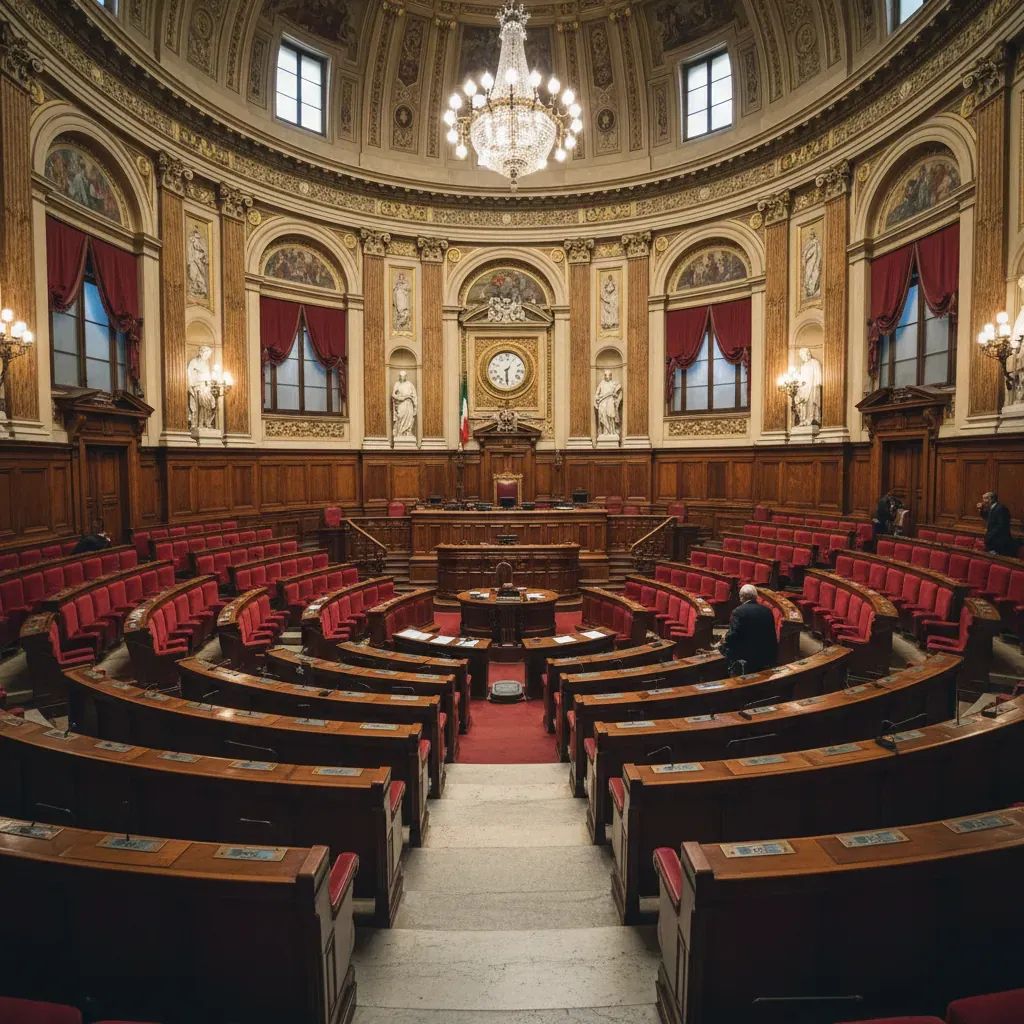
The Italy Senate has finalized a defense and humanitarian package extending military and logistical support to Ukraine through the end of 2026, but the legislative path has exposed procedural tensions that left even pro-Ukraine opposition parties voting against the measure.
Why This Matters
• Military aid renewed: Italy will continue transferring military equipment, prioritizing air defense systems, medical supplies, and logistical support until 31 December 2026.
• Residence permits extended: Ukrainian citizens holding special protection permits can renew them through 4 March 2027, ensuring legal stability for thousands currently in Italy.
• Freelance journalists protected: New mandatory safety training and insurance coverage rules take effect for reporters working in conflict zones, with state funding piloted in 2026.
Parliamentary Arithmetic and the Confidence Maneuver
The vote concluded on 25 February 2026 with 106 senators in favor, 57 against, and 2 abstentions. The tally itself was never in doubt—what made headlines was the procedural tactic. Prime Minister Giorgia Meloni's coalition invoked a confidence motion, a mechanism that bundles the entire decree into a single yes-or-no vote and bars amendments.
Under Senate rules, a confidence vote forces parties to choose between backing the government or triggering a potential cabinet crisis. As a result, every opposition bloc—Partito Democratico, Movimento 5 Stelle, Alleanza Verdi e Sinistra, Italia Viva, and Azione—voted no, even though several have long records of supporting Ukrainian defense efforts.
"We were forced by the confidence procedure," said Senator Alessandro Alfieri of the Partito Democratico, echoing complaints heard across the chamber. Marco Lombardo of Azione, whose party has consistently backed military assistance to Kyiv, accused the majority of using the maneuver "to cover your own differences and internal difficulties."
What the Decree Actually Does
The package is built around three pillars, each addressing a distinct operational or legal gap.
Military and civil-defense transfers receive formal authorization through year-end 2026. The decree explicitly prioritizes anti-aircraft and anti-missile systems, field hospitals, and logistical materiel—categories deemed most urgent given the trajectory of the conflict. The Italy Ministry of Defense will coordinate shipments in alignment with commitments made through NATO, the European Union, and United Nations frameworks.
Residency protections for Ukrainians in Italy get a 13-month extension. Permits originally issued under special-protection provisions can now be renewed on request until early March 2027, removing uncertainty for an estimated tens of thousands of displaced persons who have built interim lives across Italian cities and towns. The measure is administratively straightforward but carries significant stability value for communities hosting refugee populations.
Journalist safety provisions represent a new regulatory front. Editors and publishers must now provide mandatory pre-deployment training and insurance coverage for freelancers reporting from conflict zones. A pilot state subsidy will run through 2026 to offset costs, particularly for smaller outlets. The clause emerged from advocacy by press unions following injuries to Italian freelancers in Ukraine and the Middle East over the past two years.
The Coalition's Internal Geography
The confidence vote masked real fault lines within the governing coalition. Fratelli d'Italia, led by Meloni, has maintained unwavering rhetorical and material support for Ukraine. Giovanbattista Fazzolari, undersecretary to the prime minister, reiterated that additional aid packages will follow through the year, framing the commitment as central to Italy's Atlantic and European alignment.
Forza Italia, now directed by Foreign Minister Antonio Tajani, has leaned into a pro-Ukraine stance inherited from the party's realignment after Silvio Berlusconi's death. Tajani has emphasized that military support is intended to strengthen Ukraine's position at any future negotiating table, not to prolong hostilities indefinitely.
Lega presents the most complex profile. While the party voted for the decree, its rhetoric has oscillated. Capogruppo Massimiliano Romeo explained the "yes" vote as necessary to avoid weakening Ukraine's bargaining power in potential talks, but the party continues to call for greater emphasis on humanitarian and reconstruction aid over weapons transfers. The recent departure of General Roberto Vannacci, whose breakaway movement "Futuro Nazionale" explicitly opposes further arms shipments, underscores the strain. By invoking confidence, the government preempted a public vote that might have revealed dissent within Lega ranks.
Opposition Dilemma: Substance Versus Procedure
The opposition's unified "no" conceals divergent substantive positions.
Movimento 5 Stelle and Alleanza Verdi e Sinistra oppose weapons transfers on principle, favoring diplomatic engagement and cease-fire negotiations. For them, the confidence vote aligned procedural objection with policy conviction. M5S leader Giuseppe Conte has repeatedly called for a diplomatic turning point and criticized what he views as an open-ended military commitment.
Partito Democratico, by contrast, has historically supported aid to Ukraine—both under the Draghi government and in subsequent votes. The party's "no" this time was framed entirely as a protest against the confidence mechanism, which Senator Alfieri described as an evasion of genuine parliamentary scrutiny.
Azione and Italia Viva, both centrist and firmly pro-Ukraine, found themselves in the most uncomfortable position. Carlo Calenda's Azione and Matteo Renzi's Italia Viva have backed every previous aid package and advocate for robust Western support to Kyiv. Yet Senate procedure left them no option to vote on the substance alone. Both parties issued statements clarifying that their negative votes were compelled by the confidence tactic, not by opposition to the aid itself.
Impact on Residents and the Broader Policy Landscape
For Italians, the decree's passage ensures continuity on three operational fronts. Defense exports remain authorized without legal ambiguity, keeping Italy in step with its European allies and avoiding friction within NATO coordination structures. Ukrainian residents receive clarity on their legal status, which matters for employment, housing contracts, school enrollment, and access to healthcare—all areas where expired or uncertain permits create cascading administrative problems.
The journalist-safety clause establishes a compliance burden for media organizations but addresses a real gap. Freelancers have historically borne their own training and insurance costs, creating inequities between staff correspondents and independent reporters. The state subsidy is modest and time-limited, but it signals recognition of the sector's structural vulnerabilities.
Politically, the confidence vote sets a precedent that may return on future contested legislation. The government used it here not because the votes were lacking—the majority held—but because the debate itself risked exposing disunity. Opposition leaders argue this approach hollows out parliamentary function and transforms the legislature into a rubber stamp. Government allies counter that confidence votes are a constitutional tool designed precisely to ensure coherence on essential policy.
Legal and Diplomatic Continuity
The decree codifies commitments Italy has already signaled in multilateral forums. At the NATO ministerial meeting in Brussels earlier this month, Tajani confirmed Italy's intention to sustain material support through 2026. The European Council has coordinated member-state contributions through a voluntary pledging system, and Italy's package aligns with the broader €50B European Peace Facility framework supporting Ukraine's defense.
The United Nations General Assembly has seen Italy vote consistently in favor of resolutions affirming Ukraine's territorial integrity and condemning violations of international law. The decree translates diplomatic posture into binding domestic law, eliminating any gap between Italy's international statements and its legal authority to act.
What Comes Next
The Chamber of Deputies approved the decree on 11 February, and with Senate passage, it now enters the statute books. Implementation will be managed by the Ministry of Defense for materiel transfers, the Ministry of Interior for residence permits, and a joint committee of the Ministry of Culture and Ministry of Labor for journalist-safety standards.
Additional aid packages are expected before summer. Fazzolari's announcement that "further support will follow" suggests at least one more decree or budget appropriation before the parliamentary recess in August. The composition and volume of future transfers will depend on battlefield conditions, requests from Kyiv, and continued coordination with European and NATO partners.
For opposition parties, the confidence episode has sharpened calls for procedural reform. Italia Viva and Azione are expected to propose amendments to Senate rules limiting the use of confidence votes on decree-laws that do not involve fiscal emergencies or constitutional deadlines. Whether such reforms gain traction depends on the majority's willingness to constrain its own tools—a historically rare outcome in Italian parliamentary practice.
The Ukrainian community in Italy, meanwhile, gains 13 months of legal certainty. The Ministry of Interior estimates that roughly 150,000 Ukrainians currently hold special-protection permits. Renewal procedures will be handled through local prefectures, with streamlined documentation requirements to avoid administrative backlogs. Legal-aid organizations have welcomed the extension but continue to advocate for longer-term pathways, including access to standard work permits and family reunification channels that do not depend on emergency decrees.


