
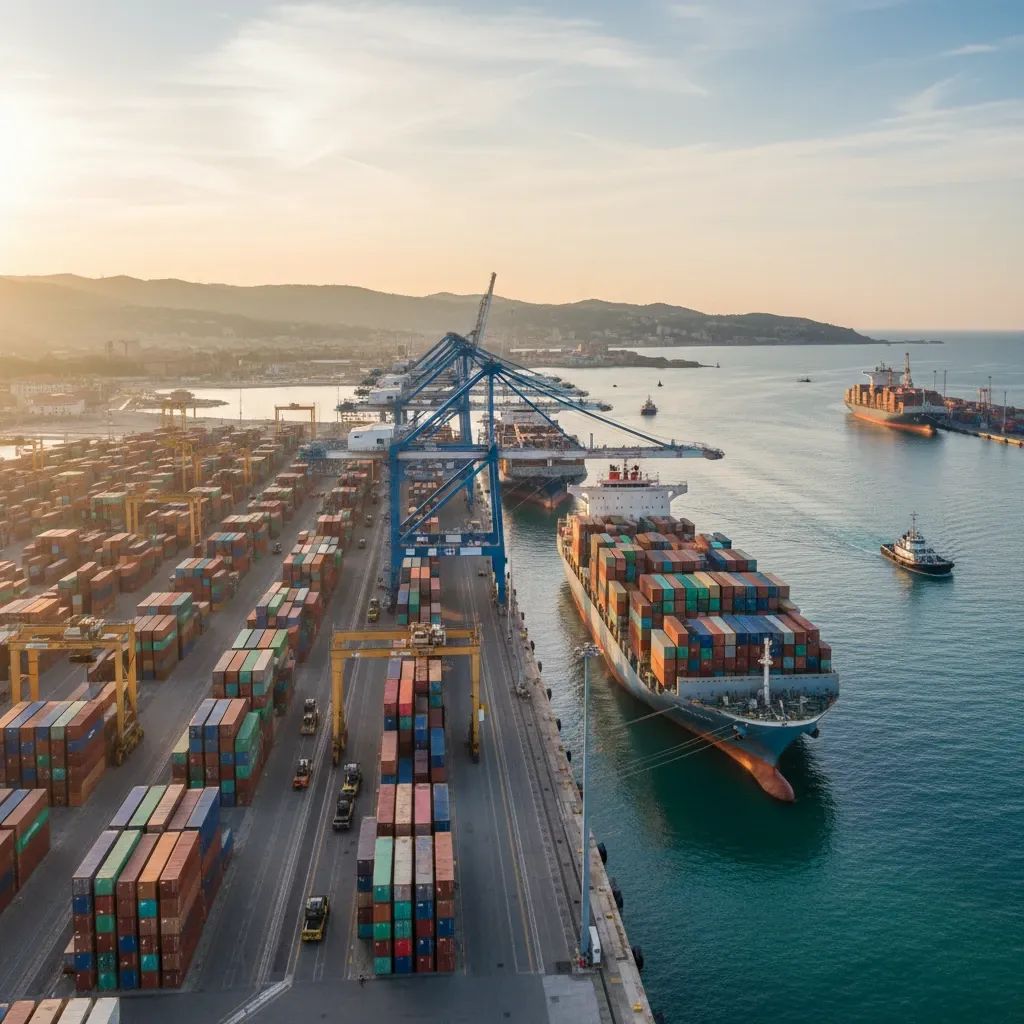
The Italy Eastern Adriatic Sea Port Authority has positioned Trieste and its neighboring port of Monfalcone as pivotal hubs in the IMEC (India-Middle East-Europe Economic Corridor), a 6,000 km multimodal infrastructure network designed to slash transit times by 40% and costs by 30% on the Asia-Europe trade route. For residents across Italy, particularly in Friuli Venezia Giulia, this strategic positioning translates into tangible opportunities: enhanced trade connectivity, job growth in the maritime and logistics sectors, and potential regional GDP expansion—backed by over €700M in annual port-related revenue already flowing into the regional economy.
Gateway to Central Europe
Trieste is being marketed as Europe's strategic entry point for IMEC cargo, with direct rail connections to Austria, Germany, and Central-Eastern Europe. The port already anchors a system supporting over 9,000 jobs and generating more than €2B annually. Roberto Petri, president of Assoporti (Italy's national ports association), met recently with Marco Consalvo, head of the Eastern Adriatic Sea Port System Authority, to discuss how the port infrastructure can capture IMEC flows. The meeting underscored Trieste's dominance in rail freight traffic—over 90% of goods handled are destined for foreign markets, and the port maintains one of Europe's highest rail-mode shares.
Trieste's competitive advantage rests on its 54% rail-mode share (exceeding the EU's 50% target) and direct connections spanning from Austria to Slovakia. The port boasts over 200 weekly rail services to European industrial zones, with the Pontebbana line capable of handling 220 trains daily.
The Corridor Takes Shape
The IMEC project, announced at the 2023 G20 in New Delhi, aims to connect India to Europe via maritime routes, rail networks, energy pipelines, and data cables through the Middle East. After diplomatic momentum stalled during the Israel-Hamas conflict, a ceasefire and renewed engagement in early 2026 have brought the project back into execution phase.
The corridor is structured in two segments: the Eastern Corridor, linking India to the UAE and Saudi Arabia via sea and rail, and the Northern Corridor, extending from Saudi Arabia through Jordan and Israel to Mediterranean ports—with Haifa, Marseille-Fos, and Trieste as key nodes.
A significant milestone arrived on February 19, 2026, when India and France formalized an "IMEC Ports Club" memorandum, coordinating major ports along the corridor. The agreement names Adani Ports (India), Marseille-Fos (France), and Trieste as the corridor's anchors. The long-awaited India-EU free trade agreement, concluded in January 2026, is expected to boost India's export value by 5-8% annually—approximately €21.85B in additional trade—creating substantial demand for European transshipment capacity.
Italy has reinforced its commitment by appointing a Special Envoy for IMEC and hosting a Trieste Summit in 2025 to position the city as the gateway for goods destined for Central and Eastern Europe. The government is leveraging Trieste's deep, sheltered port and its historical legacy as a Habsburg "free port" to secure this strategic role.
The Reality on the Ground
Trieste's 2025 performance presented a mixed picture. Total cargo reached approximately 60M tonnes, essentially flat year-on-year, with liquid bulk surging to 43M tonnes due to increased crude oil demand. The Czech Republic, facing interruptions to the Russian Druzhba pipeline, is expected to rely entirely on Trieste for oil supply in 2026—potentially pushing SIOT terminal capacity to 46M tonnes.
Container traffic, however, contracted sharply by 19% to 681,733 TEU, driven by the end of the 2M Alliance and the collapse of transshipment activity. Direct trade with Central Europe remained stable, with full containers growing 5%.
Monfalcone, Trieste's smaller neighbor, delivered stronger numbers, surpassing 4M tonnes with double-digit growth across all segments. The combined Trieste-Monfalcone rail system handled 11,600 trains in 2025, with Monfalcone processing over 2,000 trains for the first time.
Infrastructure Investment and Challenges
The Italy Eastern Adriatic Sea Port Authority is investing over €280M in rail infrastructure upgrades, including enhancements to Campo Marzio station and design work for the new Servola station. At Molo VII, container terminal electrification is nearing completion.
However, 2026 presents significant operational hurdles. A planned one-month closure of the Udine-Tarvisio line (August 22 to September 20, 2026) will force roughly half the region's freight traffic to reroute via the Brenner corridor. The Venice-Trieste line is undergoing parallel upgrades to eliminate level crossings and increase capacity from 7 to 10 trains per hour, with some projects extending into 2027.
Mediterranean Competition and Broader Context
Trieste competes against established Northern European powerhouses like Rotterdam (13.82M TEU in 2024) and Antwerp-Bruges (13.53M TEU), as well as Mediterranean rivals including Piraeus, Gioia Tauro (3.55M TEU), and Tanger Med. The North Adriatic Port Association (NAPA)—comprising Venice, Trieste, Ravenna, Koper, and Rijeka—is branding itself as the fastest link between the Far East and Europe, potentially saving 8 days compared to the Shanghai-Hamburg route.
Container volumes remain modest by European standards, and draft limitations in neighboring ports constrain the ability to accommodate ultra-large container vessels. The EU Emissions Trading System for maritime transport also poses cost pressures on long-haul Asia-Europe routes.
The Next Phase
Port officials and government envoys are betting on the next 12 to 18 months as decisive. Marco Consalvo's recent meeting with Assoporti signals consolidated national strategy, while infrastructure upgrades and the India-EU trade agreement create tangible momentum. Private capital is also aligning—the UAE has pledged €40B in Italy investments, and MSC (Mediterranean Shipping Company) is engaged in Indian port projects, including the new Vadhavan Port.
Trieste's ability to translate its geographic and infrastructural advantages into sustained cargo volumes depends on three factors: the pace of rail infrastructure upgrades, resolution of bottlenecks like the 2026 line closures, and competitive positioning within a crowded Mediterranean. If IMEC implementation proceeds as planned, Trieste stands to reclaim its historical role as a gateway between East and West. The port's success will serve as a measure of whether the corridor itself can move from diplomatic promise to commercial reality.


