
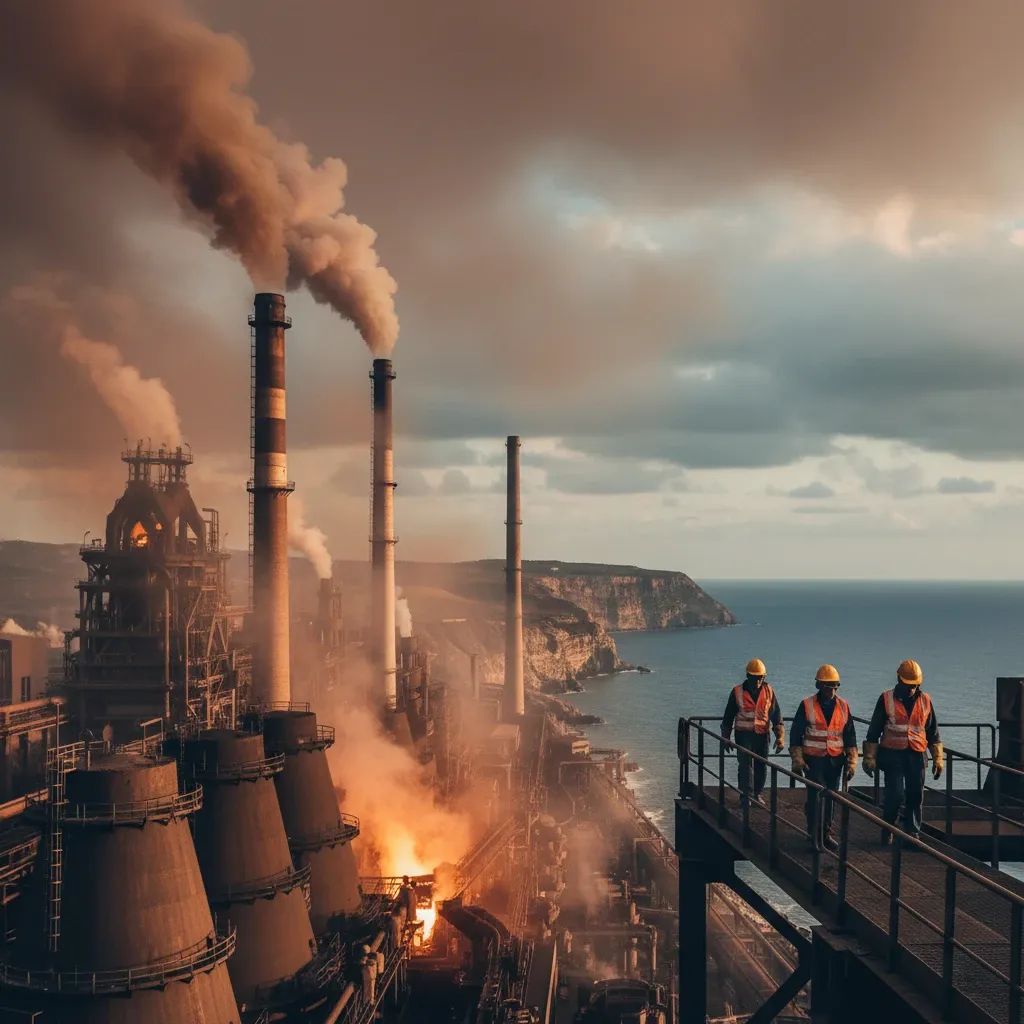
The Italian metalworking employers' federation Federmeccanica has declared the former Ilva steel plant in Taranto to be Europe's greenest steelworks, a claim that clashes sharply with the facility's troubled environmental legacy and the ongoing legal and financial battles surrounding its future.
Why This Matters:
• Strategic industrial asset: The plant remains critical to Italy's steel supply chain, supporting thousands of jobs and manufacturing industries dependent on primary steel.
• €2B environmental investment: Recent upgrades aim to reduce emissions and align with EU environmental standards, though full decarbonization remains years away.
• 12-year operating permit: A renewed authorization allows up to 6M tons of annual production under 472 binding environmental conditions, but faces legal challenges.
• Competing narratives: Industry leaders tout environmental progress while environmental groups and local communities cite persistent health risks and delayed green transition.
A "Green" Label Under Scrutiny
Simone Bettini, president of Federmeccanica, toured the Taranto facility in March 2026 alongside Confindustria Taranto president Salvatore Toma and plant management. His emphatic endorsement—calling the site essential to Italy's industrial sovereignty and praising government investments in pollution controls—reflects the industrial sector's determination to keep the plant operational.
Bettini credited recent management and state funding for installing equipment that has "reduced environmental impact" and insisted the facility now operates with "environmental parameters that have no equals" among European steelmakers. He expressed frustration that despite these improvements, the plant's future remains unresolved.
Yet this optimistic framing sits uncomfortably alongside the plant's complex reality. Environmental advocates and independent analysts have labeled such claims "hazardous or anachronistic," given that Acciaierie d'Italia—the entity now operating the former Ilva—still relies primarily on blast furnace steelmaking, the most carbon-intensive production method in the industry.
What Environmental Progress Actually Means
The facility has indeed undergone significant remediation. Over €2B in investments have funded covered storage areas for raw materials, enclosed conveyor belts, dust reduction systems in coke batteries, wastewater treatment upgrades, and modernized desulfurization units. These measures address localized pollution sources that have historically plagued Taranto, a city long associated with elevated rates of respiratory illness and cancer linked to industrial emissions.
In July 2025, Italy's environment ministry approved a renewed Integrated Environmental Authorization (AIA) valid for 12 years, capping annual production at 6M tons—half the plant's original capacity—and imposing 472 prescriptive conditions based on the EU's Best Available Techniques (BAT) standards. For the first time, health impact assessments were integrated into the permit framework.
However, the authorization has provoked legal challenges. A hearing at the Regional Administrative Court of Lecce in January 2026 questioned whether granting a long-term operating license to a facility with such a damaging environmental and health record is ethically defensible. Local opposition groups argue that the permit perpetuates harm rather than remedying it.
The Decarbonization Dilemma
The path to genuinely "green" steel hinges on decarbonization—replacing carbon-intensive blast furnaces with electric arc furnaces (EAFs) powered by renewable electricity and, ideally, direct reduced iron (DRI) produced using green hydrogen. Italy's 2026 budget allocated €100M for decarbonization at the former Ilva, though original plans for a full DRI plant—estimated to cost around €1B—have been scaled back, with funding shifted from the National Recovery and Resilience Plan (PNRR) to the Development and Cohesion Fund.
A study by the University of Bari for Legambiente in October 2025 explored scenarios that could cut CO₂ emissions by 75%-90% if green hydrogen were fully integrated. But the infrastructure required—renewable energy generation, hydrogen production and distribution networks, and new furnace installations—remains years from realization.
Current plans envision a phased transition over 7-8 years (2026-2033), aiming for four EAFs: three in Taranto and one in Genoa. Only one blast furnace—Altoforno 2—is currently operating, and even that intermittently. Production has plummeted to under 3M tons annually, less than half the site's potential, amid chronic cash flow problems and a debt burden exceeding €5B.
Europe's Steel Industry Context
To assess Bettini's "greenest in Europe" claim, context is essential. The EU steel sector is responsible for 5% of the bloc's CO₂ emissions and faces binding targets: an 80%-90% reduction by 2050 compared to 1990 levels, with a 30% cut by 2030 versus 2018.
Average global steel production generates roughly 1.92 tons of CO₂ per ton of steel. Blast furnace-basic oxygen furnace (BF-BOF) routes—the method still dominant at Taranto—emit about 2.33 tons CO₂ per ton, while EAF steelmaking using scrap metal emits only 0.67 tons CO₂ per ton. Italy's broader steel industry, where 85.8% of production already uses EAFs, averages 0.74 tons CO₂ per ton, placing it among Europe's more efficient producers.
By 2030, the EU expects to install 28 new EAFs, 24 of which will replace blast furnace capacity. Italy leads Europe in ferrous scrap recycling, with an 85% recovery rate in 2023, underpinning a circular economy model. Italian steelmakers have cut energy consumption per ton by 33% since 2000, achieving 38% greater efficiency than the European average.
Against this backdrop, the former Ilva's blast furnace operations lag behind plants that have already transitioned or are further along in adopting hydrogen-based DRI and renewable-powered EAFs. ArcelorMittal, a former operator, has cited unfavorable European policy and market conditions as obstacles to meeting ambitious decarbonization goals without major regulatory shifts.
Impact on Residents and the Local Economy
For Taranto's population of roughly 190,000, the plant is both an economic lifeline and a public health burden. Thousands of direct jobs and tens of thousands in the supply chain depend on continued operations, but decades of pollution have left a toxic legacy. The plant's vast footprint—much of it now idle—requires extensive remediation.
A December 2025 decree allocated funding for professional retraining of furloughed workers to participate in site cleanup and remediation projects. Approximately €200M has been earmarked for 34 cleanup initiatives across Taranto, including intervention in the Mar Piccolo lagoon and repurposing former industrial zones for new economic activities.
The transition to EAFs will inevitably reduce workforce requirements, as electric steelmaking is less labor-intensive than blast furnace operations. Unions are pressing for early retirement schemes, voluntary exit incentives, and requalification programs to cushion the social impact.
Industry Versus Environment: A Persistent Standoff
Environmental groups—including Greenpeace, Legambiente, WWF Italia, and Europa Verde—are demanding the establishment of a binding national roundtable involving government, regions, unions, municipalities, businesses, and civil society. They advocate for a state-controlled enterprise to oversee decarbonization, diversification, cleanup, and job protection, with a firm deadline to shut down blast furnaces and coke ovens by 2030.
Industrial associations, including Assofermet and Federmeccanica, argue that Italy cannot afford to lose primary steel production capacity and stress the strategic necessity of maintaining a domestic supply chain, provided environmental standards are met.
The tension reflects a broader European challenge: balancing industrial sovereignty, employment, environmental health, and climate obligations. EU regulations on state aid and the Carbon Border Adjustment Mechanism (CBAM)—which will impose tariffs on carbon-intensive imports—complicate efforts to stabilize the plant financially while undergoing costly green transformation.
What Comes Next
The Italian government is conducting a tender process to find a new industrial partner willing to invest in decarbonization and maintain employment levels. The administration has extended bridge financing—€108M in residual funds with a potential additional €149M in 2026—to keep operations alive while negotiations proceed.
But prospective buyers face daunting conditions: a debt-laden balance sheet, aging infrastructure, legal uncertainty over environmental liability, and the need for billions in capital expenditure. Previous operators, including ArcelorMittal, withdrew after the government rescinded legal protections (the so-called "scudo penale") that shielded executives from criminal prosecution while implementing the environmental plan.
Whether the former Ilva can credibly claim the title of Europe's greenest steelworks depends less on recent pollution control upgrades and more on the pace and scale of its shift to low-carbon production. Until electric arc furnaces are operational and fed by green electricity and hydrogen, the plant remains tethered to the industrial past rather than leading the sector's future.
For now, the steelworks at Taranto embodies Italy's broader struggle to reconcile industrial heritage with environmental imperatives—a process that will unfold over years, not months, and whose outcome will shape not only the local economy but Italy's position in Europe's decarbonizing industrial landscape.


