
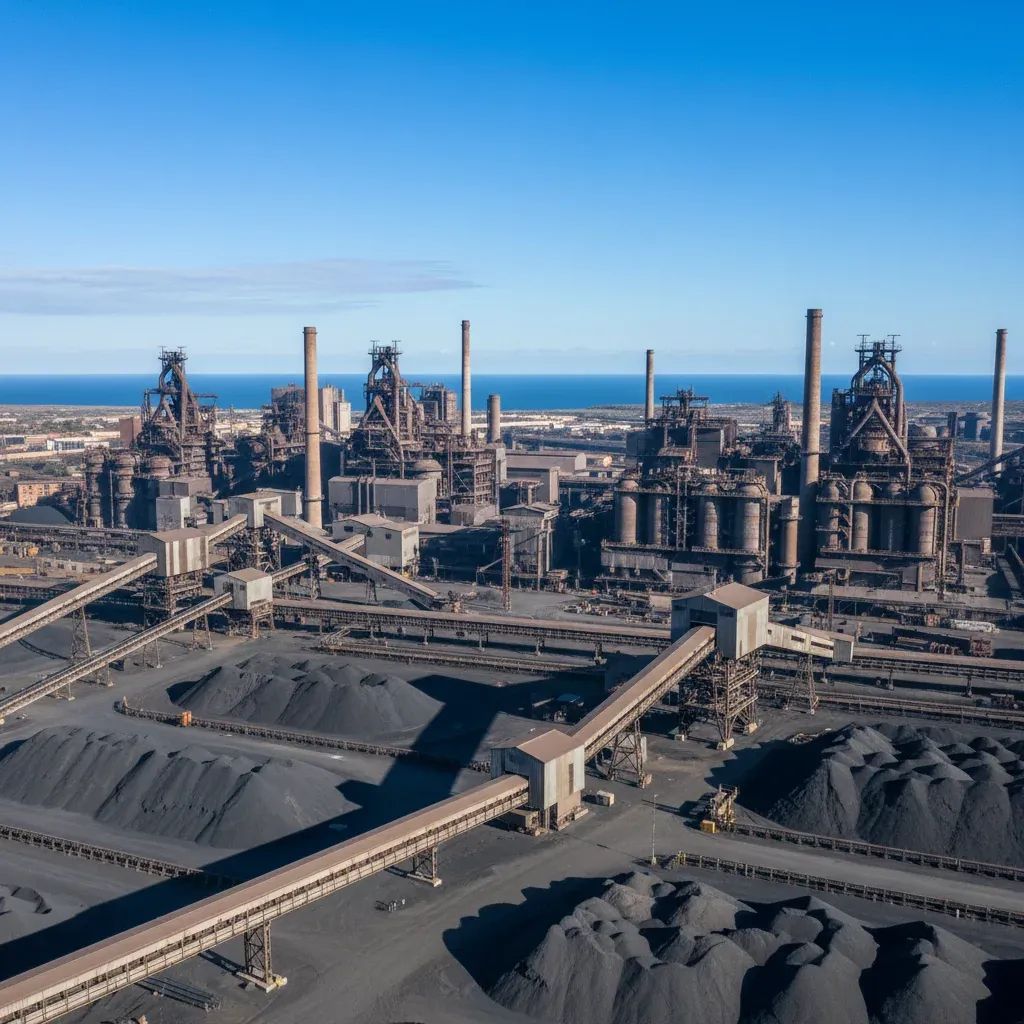
Two competing visions for Italy's most troubled industrial asset have emerged, with the Indian steelmaker Jindal Steel International re-entering the race to acquire the former ILVA complex in Taranto just as the American investment firm Flacks presses forward with its own proposal. The Italy Ministry of Business and Made in Italy confirmed this week that state administrators now face the task of evaluating both bids against strict national criteria—a decision window that closes at the end of April, before a looming court order could force temporary plant closure this summer.
Why This Matters
• Two fundamentally different approaches to the future of Italy's steel industry compete for approval: one emphasizing complete electrification by 2030, the other preserving hybrid capacity for specialized products while transitioning gradually toward cleaner methods.
• Environmental redemption hangs in the balance. Taranto residents have endured decades of some of Western Europe's most severe industrial pollution, with cancer rates far exceeding national averages and a history of mass occupational disease.
• Employment for thousands of workers remains contested. Both bidders promise job retention, but their technical choices carry vastly different implications for workforce size and skillset demand.
• A judicial suspension order set for August 24 adds urgency to negotiations, effectively forcing a decision before environmental restrictions could interrupt production at a critical moment.
The Stakes in Taranto
Begin with the human reality. Over 12 years, beginning in the late 1990s, the steelworks pumped into Taranto's air and waterways toxins that poisoned an entire city. Between 1998 and 2010, experts documented approximately 30 deaths annually linked directly to industrial emissions—mostly from cardiovascular failure and cancer. By 2012, childhood lymphoma rates had doubled compared to the rest of the nation. The neighborhoods nearest the plant, such as Tamburi and Paolo VI, recorded tumor diagnoses at 70% above the city average.
The pollution wasn't confined to the atmosphere. In the early 2000s, Taranto registered dioxin concentrations that were the highest recorded anywhere in Western Europe. The plant alone was responsible for roughly 90% of all Italian dioxin emissions at that time. Disproportionate levels appeared in mother's milk, drinking water, and seawater. Livestock within a 20-kilometer radius suffered mass die-offs. The contamination left entire sectors of local agriculture economically unfeasible.
What changed hands was not conscience but ownership. ArcelorMittal's withdrawal from the facility in early 2024 after a decade of disputes over liability, investment commitments, and criminal protections left the plant under state receivership. The Italian government has made clear that any new ownership structure must reverse this legacy with concrete action, not rhetoric. That means binding timelines for decarbonization, verifiable emissions reductions, and demonstrated financial capacity to follow through.
Jindal's Bet on Full Electrification
Jindal Steel International, one of the world's largest steelmakers by output, proposes a €4 billion total commitment, subdivided into €1 billion to purchase assets and €3 billion to rebuild the facility. The industrial strategy rests on complete elimination of coal-dependent production by 2030. All traditional blast furnaces—the heart of the plant since the 1960s—would be retired and replaced with two electric arc furnaces (EAFs), each fed by direct reduced iron (DRI).
Initially, the company would source DRI from its existing production capacity in Oman rather than immediately investing in on-site facilities. Over time, if long-term gas supply agreements materialize and the Italian government provides the required incentive packages, Jindal proposes constructing DRI plants in Taranto itself. The production target is 6 million tonnes annually by 2030, with potential expansion to the plant's historical ceiling of 10 million tonnes per year in subsequent phases.
Jindal frames this as creating a "Green Industrial Cluster" in southern Puglia—a hub for low-carbon steel serving European automotive, renewable-energy, and infrastructure sectors. The company emphasizes that phasing out coke ovens and converting the site to full electrification aligns precisely with European Union decarbonization mandates under the Green Deal. A completely electric steelworks fueled by renewable energy would transform the facility from Europe's most notoriously polluting industrial site into a model for post-carbon manufacturing.
The trade-off is significant. EAF technology requires sourcing high-quality scrap metal and DRI, which means shifting from the traditional vertical-integration model. Employment levels would decline through natural attrition rather than layoffs, Jindal says, though the company has acknowledged that the workforce would shrink compared to historical levels.
Flacks: A Pragmatic Hybrid Model
Flacks Group, a New York-based investment fund, submitted its formal expression of interest in December 2025 and has been in exclusive negotiation with the Italian government since January. Its offer structure is unconventional: a symbolic purchase price of €1 paired with up to €5 billion in capital expenditure.
Flacks proposes retaining one operational blast furnace alongside two EAF units. The hybrid configuration would deliver approximately 6 million tonnes of annual capacity: 4 million from the modern electric furnaces and 2 million from the traditional furnace. The reasoning is economically pragmatic. Certain high-strength steel grades—required by the automotive industry, offshore energy platforms, and naval construction—remain difficult or impossible to produce using EAF technology alone. Flacks argues that eliminating that production capacity would forfeit a lucrative market segment while leaving Italy dependent on imports from competitors.
The environmental pathway is phased. Initially, the plant would operate on natural gas, substantially cleaner than coal but not carbon-free. Flacks has installed pilot programs in other European steelworks using hydrogen-ready technologies (MIDREX and ENERGIRON HYL systems), which could be deployed progressively to achieve 90-95% emissions reductions by 2035. The company contends that attempting immediate transition to hydrogen across a facility of this scale would be financially unrealistic given current green-hydrogen infrastructure constraints across Europe.
A politically significant element of Flacks' proposal reserves 40% equity ownership for the Italian government as a strategic partner, with an option for Flacks to acquire an additional 40% in the future for between €500 million and €1 billion. This structure preserves state influence over long-term direction. Flacks has also explicitly committed to maintaining approximately 8,500 skilled workers and has signaled willingness to operate without the controversial "criminal shield" that previously protected company management from prosecution over environmental violations.
The Government's Framework and the Golden Power
Minister Adolfo Urso outlined three non-negotiable conditions that any buyer must satisfy. First, the buyer must commit to divesting non-productive land parcels in both Taranto and Genoa for reindustrialization projects—a requirement tied to regional economic diversification beyond steel. Second, the ownership structure must include experienced steel-sector operators, not pure financial investors with no operational expertise. Third, any transaction must demonstrate long-term financial sustainability, meaning adequate capitalization and viable market positioning beyond the first decade.
The Italy government has explicitly reserved the right to invoke "golden power" provisions, legal instruments that allow Rome to veto foreign acquisitions or impose binding conditions on domestic ones when national security, employment, or critical infrastructure is at stake. In this case, the government will retain the power to dictate the pace of environmental remediation, enforce employment thresholds, and override commercial decisions that conflict with EU climate commitments or national industrial policy.
State-appointed commissioners are conducting parallel due diligence. Key evaluation criteria include the financial credibility of each bidder, technical feasibility of their decarbonization roadmaps, employment retention specifics, and compatibility with Italy's steel strategy within the broader European manufacturing landscape. The April deadline is intentionally tight, designed to force a decision before the Milan court's suspension order takes legal effect on August 24.
The Court Order: An Artificial Urgency
In August, unless suspended, a court ruling responding to a petition by Taranto residents will impose a temporary halt to certain activities at the plant on public health grounds. The judicial decision reflects decades of grievance litigation and a growing body of evidence linking current operations to elevated disease rates. The plant's state administrators are contesting the ruling, but the uncertainty creates a compressed negotiation window. Any new owner will inherit a facility operating under a loose deadline to demonstrate environmental compliance or face forced operational restrictions.
This judicial pressure is not arbitrary. Expert reports have documented the mechanism: particulate matter emitted during blast-furnace operation reaches residential neighborhoods within 5 kilometers, where air quality regularly exceeds WHO thresholds. The health data is consistent and undeniable. A 2012 judicial expert report attributed approximately 386 premature deaths over a 12-year period to industrial emissions. Childhood lymphoma rates doubled between 2012 and 2019. The neighborhoods closest to the facility recorded tumor incidence 70% above the city average.
Both bidders understand that environmental credibility is non-negotiable in Taranto. The question is which pathway—Jindal's accelerated full electrification or Flacks' graduated hybrid transition—will satisfy both judicial oversight and community expectations.
Employment and the Industrial Transition
Neither proposal eliminates the reality that steelmaking is becoming more capital-intensive and less labor-intensive. The question is whether the transition is orderly or chaotic.
Jindal has pledged to minimize workforce reduction through natural attrition and retraining rather than immediate layoffs. The complete shift to EAF technology would require different technical skills—fewer coke oven operators and blast-furnace specialists, more expertise in scrap management, electric-system operation, and DRI-handling procedures. Workers would require reskilling, and some positions may be permanently eliminated.
Flacks explicitly commits to retaining 8,500 jobs, a threshold that may be achievable if the hybrid model sustains demand for traditional steel grades. The company has signaled openness to negotiating severance agreements, retraining packages, and social safety nets for workers whose roles are displaced. The presence of government equity ownership in Flacks' structure also means Rome retains leverage to enforce employment commitments.
For Taranto's worker population—historically heavily unionized and politically active—job security is paramount. Both proposals are attractive on that front, but Flacks' explicit numerical commitment is more concrete.
The Outcome for Taranto's Health
Regardless of which bidder prevails, the next owner must demonstrate tangible environmental progress within months, not years. This means investing immediately in air-quality monitoring, particulate control, and operational adjustments to bring emissions below established thresholds. It means compliance with Italy's anti-pollution ordinances and European Industrial Emissions Directive specifications.
For residents, the practical difference between Jindal and Flacks is timing. Jindal promises faster elimination of coal-dependent production but requires infrastructure investment and DRI sourcing that takes time to materialize. The initial phase may still involve emissions reductions but not total cessation of blast-furnace activity. Flacks explicitly accepts a longer timeline but offers clearer intermediate targets and government-backed accountability through state equity.
Both proposals require that the new owner invest billions not only in production modernization but also in remediation of contaminated soil, groundwater treatment, and atmospheric cleanup systems. Neither can produce a guarantee of zero emissions. What they can provide is verifiable reduction trajectories and binding financial mechanisms to ensure those reductions actually occur.
The Broader Industrial Picture
Italy's steel sector has contracted significantly over the past two decades, with the Taranto plant representing roughly 30% of national production capacity. European steelmakers collectively face intense pressure from cheaper production in Asia and rising energy costs across the continent. A shutdown or severe contraction at Taranto would diminish Italy's industrial footprint and increase dependence on imports.
Both bidders recognize this. Jindal has a global network of steelworks and can cross-subsidize investments in Taranto if short-term returns are modest. Flacks brings private-equity capital and an operational philosophy of gradual value extraction. The government's three-condition framework—requiring industrial expertise, divestment of non-productive assets, and financial durability—is designed to ensure that whoever wins will commit to genuine revival rather than asset-stripping or financial engineering.
What Happens Next
Commissioners will spend the coming weeks stress-testing both proposals. They will examine Jindal's funding guarantees and DRI supply-chain feasibility. They will probe Flacks' capacity to sustain hybrid operations in an increasingly carbon-constrained market. They will negotiate binding commitments on environmental timelines, employment floors, and investment thresholds. The government will eventually exercise its golden power to impose conditions that both protect national interests and align with Italy's EU climate commitments.
For Taranto, the April decision is consequential but not final. The court's August ruling will activate regardless, placing external pressure on the new owner to perform. Environmental groups and resident organizations will continue monitoring. Future administrations in Rome may adjust terms if performance lags. The steelworks' future is being negotiated in real time, with decades of accumulated suffering shaping every contract clause and performance target.
Neither Jindal nor Flacks can erase the past. What they can do is chart a different future. Whether that future prioritizes speed of transformation or pragmatic sustainability will depend on which vision the Italian government ultimately trusts to deliver.


