
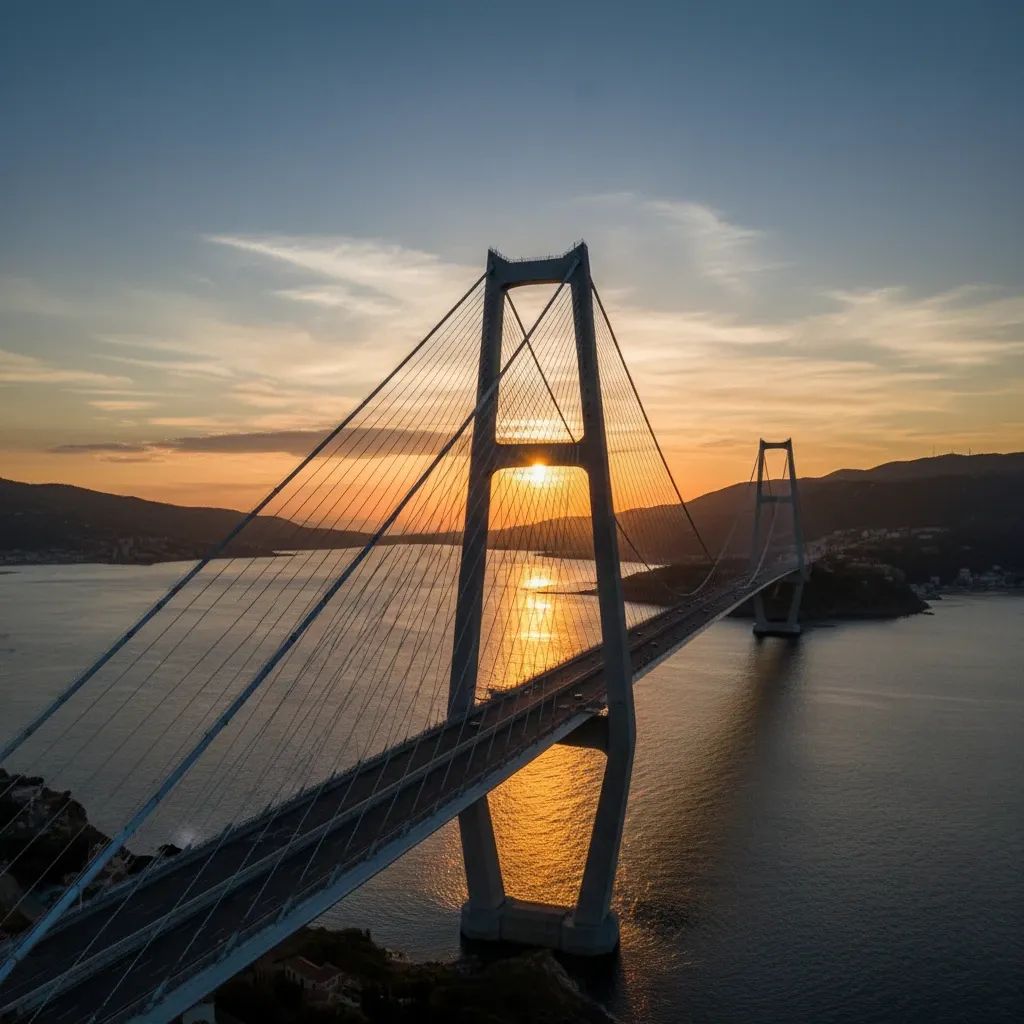
The Italian Chamber of Deputies has finalized legislation that effectively greenlights the administrative pathway for the long-debated Strait of Messina Bridge, a €13.5B infrastructure project connecting Sicily and mainland Calabria. The so-called "Decree on Extraordinary Commissioners and Concessions" passed with 160 votes in favor, 110 against, and 7 abstentions, converting urgent executive measures into binding law after the government secured confidence the previous day.
Why This Matters:
• Project timeline accelerates: Construction could begin as early as September 2026, with a 7-year build phase targeting completion by 2032-2033.
• Funding reshuffled: €2.8B originally earmarked for 2026-2029 has been deferred to 2030-2034 to ease immediate debt exposure for Italy's national rail operator.
• Broader infrastructure package: The decree also unlocks budgets for Rome's Metro Line C, the Gran Sasso tunnel retrofit, and UEFA Euro 2032 stadium projects.
• Legal workaround: The law circumvents earlier objections from Italy's Court of Auditors, which had blocked the project over procedural and cost-compliance concerns in late 2025.
What the Law Actually Does
Structured across 10 articles, the decree reorders the bureaucratic sequence required by the Italian Ministry of Infrastructure and Transport to advance the Sicily-Calabria link—a single-span suspension bridge of 3,300 meters, designed to carry both road and rail traffic. Article 1 specifically reconfigures approval steps to address the Court of Auditors' denial of legitimacy issued in October 2025 over the inter-ministerial planning committee (CIPESS) resolution.
Beyond the bridge, the legislation empowers extraordinary commissioners to expedite decisions on a slate of nationally significant projects. These include safety upgrades to the A24 and A25 highways connecting Rome to the Adriatic, structural improvements to the Gran Sasso road tunnel (which passes beneath Europe's southernmost glacier), and the final push to complete Rome Metro Line C—a project stalled for over a decade. Provisions also cover the Venice Lagoon protection system (MOSE), the Italian State Railways (RFI) concession framework, and venue construction tied to Italy's co-hosting of the 2032 UEFA European Championship.
The Bridge: Timeline, Costs, and Financing
The Sicily-Calabria bridge remains the centerpiece. According to the revised schedule, regulatory approvals should conclude by late summer 2026, clearing the path for site mobilization in the final quarter of this year. The total investment of €13.5B draws from multiple sources:
• €6.96B from the national budget
• €3.88B from the National Development and Cohesion Fund
• €1.6B from regional cohesion funds (€1.3B from Sicily, €300M from Calabria)
• €718M from central-government development funds
• €370M from the Strait of Messina concessionaire company
• €24.7M in European Union co-financing for technical design
However, the decree authorizes a fiscal maneuver that temporarily redirects €2.787B from the bridge budget to Rete Ferroviaria Italiana between 2026 and 2029, ostensibly to reduce RFI's leverage ratio. Those funds are scheduled to return to the bridge project starting in 2030. Opposition lawmakers have called for permanent reallocation to repair flood-damaged roads and rail lines in the south, particularly in the wake of extreme weather events that struck Calabria in early 2026.
Political Fracture and Procedural Controversy
The government invoked a confidence vote to expedite passage, a tactic that blocked all amendments proposed by opposition benches. The Democratic Party (PD), Five Star Movement (M5S), and Green and Left Alliance (AVS) condemned the move as an abuse of emergency decree powers—pointing out that more than 100 laws in the current legislature have bypassed normal parliamentary debate through this mechanism.
Angelo Bonelli of AVS labeled the decree a "contra legem maneuver" that favors private consortium interests and sidesteps the Court of Auditors' substantive critiques. M5S argued that "€15B remains locked up for a project where everything must be redone: design, procedures, cost estimates, environmental impact assessments." The party contends the legislation does not address fundamental legal and technical deficiencies flagged by the auditing body.
Meanwhile, Infrastructure Minister Matteo Salvini of the League celebrated the vote as a "decisive step" toward realizing what would become the world's longest single-span suspension bridge. Government supporters maintain that the project will catalyze economic integration in southern Italy, where per-capita GDP lags the national average by roughly 40%.
Environmental and Fiscal Scrutiny
A coalition of environmental organizations—Greenpeace Italy, Legambiente, Lipu, and WWF Italy—dismissed the decree as "useless," arguing it fails to demonstrate the necessity and urgency required under Italy's constitutional standards for emergency legislation. They reiterated concerns over compliance with the EU Habitats Directive and noted that formal infringement proceedings, while not yet opened, remain a risk if the project proceeds without adequate biodiversity safeguards.
The Comitato "Invece del Ponte" (Instead of the Bridge Committee) issued a detailed critique, highlighting:
• No competitive tender requirement, raising questions under EU procurement directives
• Shift from project financing to full public funding, without demonstrated justification for cost overruns exceeding the 50% legal cap
• Potential conflicts of interest tied to commissioner appointments and the incumbent Eurolink consortium
The General Confederation of Italian Labor (CGIL) characterized the bridge as a "strategic error" that diverts scarce resources from urgent upgrades to existing roads and railways across the Mezzogiorno, where the backlog of maintenance and modernization projects runs into tens of billions of euros.
What This Means for Residents
For people living in Sicily and Calabria, the decree signals a concrete—though contested—commitment to physical integration with the national transport grid. If timelines hold, the bridge could shorten the Sicily-Naples journey by roughly two hours and enable seamless rail freight movement, potentially lowering consumer prices for goods imported to the island.
However, the 7-year construction phase will entail land expropriations, traffic disruptions along approach corridors, and uncertainty over whether complementary investments—port upgrades, intermodal terminals, and high-capacity rail links—will materialize in parallel. Without that integrated logistics ecosystem, economic analyses suggest the bridge alone may deliver returns of less than 25% of its cost over three decades, translating to roughly €500M annually split between the two regions.
For taxpayers nationwide, the decree locks in multi-year commitments that limit fiscal flexibility, particularly given Italy's debt-to-GDP ratio hovering near 140%. The temporary fund reallocation to RFI underscores the government's balancing act between infrastructure ambitions and immediate budgetary constraints.
Parallel Infrastructure Push
Beyond the headline bridge project, residents in Rome, Abruzzo, and the Veneto stand to benefit from accelerated works:
• Rome Metro Line C extensions should advance faster under streamlined commissioner oversight, easing chronic congestion on the capital's eastern corridor.
• The Gran Sasso tunnel, a critical artery for cross-Apennine traffic, will undergo seismic and safety retrofits long overdue given its proximity to Italy's earthquake-prone central spine.
• A24 and A25 motorways, currently under complex concession disputes, will see expedited upgrades funded through revised toll structures.
For travelers and logistics operators, these measures promise incremental but tangible improvements in journey times and reliability, provided that administrative execution matches legislative ambition.
Implementation Challenges Ahead
With the decree now law, attention shifts to the Ministry of Infrastructure and appointed commissioners. The regulatory approval gauntlet includes opinions from the Superior Council of Public Works, the Transport Regulatory Authority, and ongoing dialogue with the European Commission to preempt infringement procedures. Any delay in securing these clearances could push construction starts into 2027, compressing the already tight timeline.
Financial markets and credit rating agencies will monitor whether the €2.8B deferral to RFI signals deeper budget pressures or merely a tactical accounting move. Opposition parties have vowed to scrutinize procurement awards for transparency and compliance, setting up potential litigation that could further delay ground-breaking.
The Broader Context
Italy's southern regions have historically received €28B for road networks and €48B for rail infrastructure under various national and EU programs, yet project completion rates have lagged northern counterparts. The Strait of Messina Bridge, conceived decades ago and repeatedly shelved, embodies both the promise and the pitfalls of large-scale public works in a fragmented political landscape.
Whether the decree proves a turning point or another chapter in a protracted saga will depend on execution over the next 18 months. For now, the legislative hurdle has been cleared—but the engineering, environmental, and fiscal tests lie ahead.


