
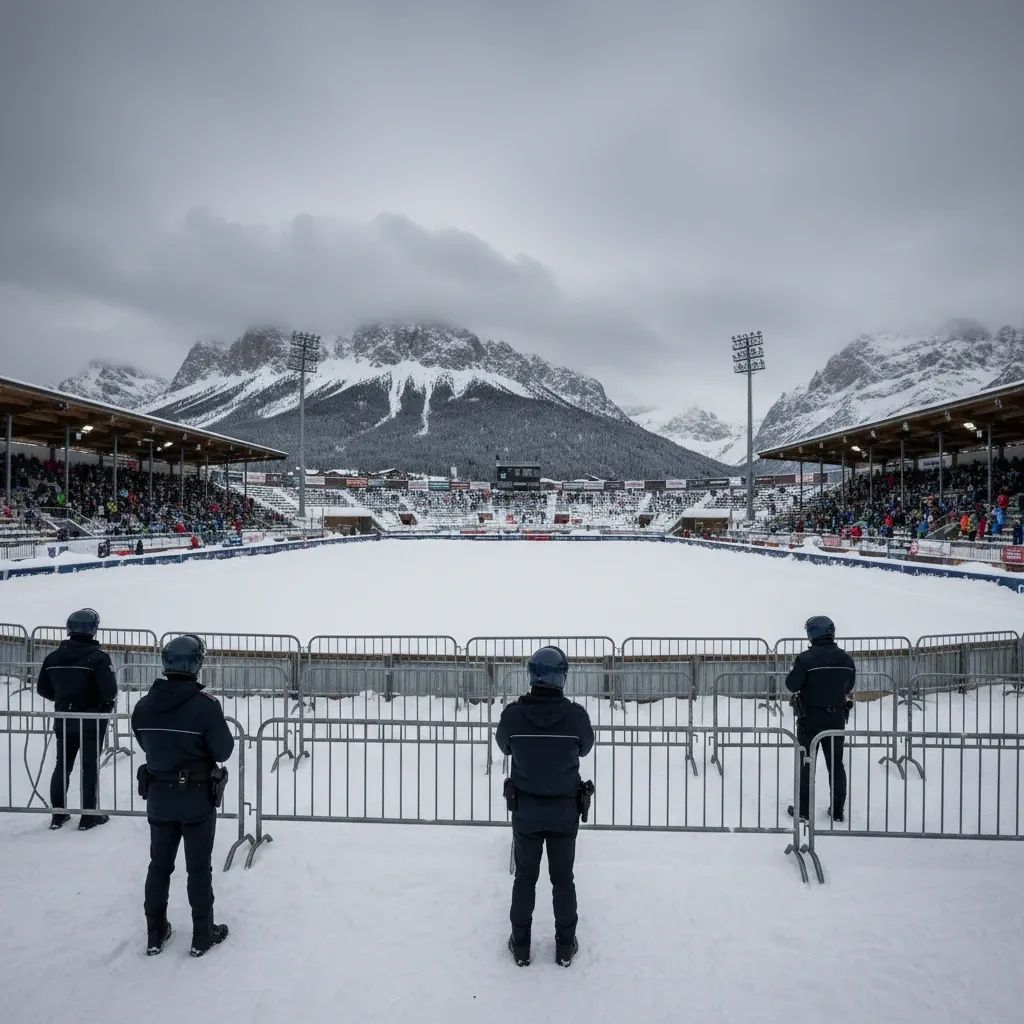
The Italy-hosted Milano Cortina 2026 Winter Paralympics opened in Verona's Arena with a ceremonial march that underscored the fractures created by Russia and Belarus's controversial reinstatement. Just 29 of the 55 competing nations sent athletes down the parade route, while 7 countries explicitly boycotted for political reasons, challenging the International Paralympic Committee's decision to allow the two nations to compete under their own flags and anthems.
Why This Matters
• Political Boycott: Czech Republic, Estonia, Finland, Latvia, Lithuania, Poland, and Ukraine refused to participate in the ceremony to protest the IPC's September 2025 vote restoring full rights to Russian and Belarusian Paralympic committees.
• Volunteer Flag-Bearers: In a break from tradition, volunteers—not athletes—carried all national flags during the parade, a move the IPC attributed to logistics but widely interpreted as damage control.
• Impact on Olympic Truce: Italy's Minister for Sport and Youth, Andrea Abodi, publicly condemned the decision as "mortifying the value of the Olympic Truce" and disrespecting Ukraine, a nation still under invasion.
• Limited Russian/Belarusian Presence: Despite reinstatement, only 6 Russian and 4 Belarusian athletes qualified across para alpine skiing, para cross-country, and para snowboard, as international federations have maintained their own restrictions on qualification pathways.
For spectators: All 55 nations, including the seven that boycotted the opening ceremony, will compete in the Games through March 15. The boycott affects only ceremonial participation, not athletic competition.
A Ceremony of Symbolic Absences
The Arena di Verona staged the opening of the XIV Winter Paralympic Games with its customary spectacle—lights, music, choreography—but the emotional heart of the event was defined as much by who was missing as by who attended. Of 55 delegations competing through March 15 across Lombardy, Veneto, Trentino, and South Tyrol, fewer than half chose to send athletes into the parade.
Many absences stemmed from mundane logistics: the multi-hour drive from Paralympic villages to Verona and the proximity of early-round competition schedules meant teams from Canada, Great Britain, and other nations opted to skip the ceremony for practical reasons. Yet the political boycott was clearly evident.
Ukraine led the charge, with its National Paralympic Committee announcing athletes would not attend the opening ceremony in solidarity with their country, still reeling from Russia's ongoing invasion. Six other nations—Czech Republic, Estonia, Finland, Latvia, Lithuania, and Poland—joined Ukraine in this explicit political boycott. Many other nations, including Germany, the Netherlands, and France, also skipped the ceremony, though their reasons varied between political opposition and logistical considerations.
The IPC's decision to allow Russian and Belarusian athletes to march under their national symbols overturned a ban imposed after the 2022 full-scale invasion. Critics argue the move undermines the Olympic Truce—the ancient Greek practice revived by the International Olympic Committee in 1991—which calls for a cessation of hostilities during the Games. The truce, symbolized by murals in the Olympic villages and a dedicated segment in the opening ceremony, is meant to emphasize peace, dialogue, and unity through sport.
The Political Fracture Within the Paralympic Movement
The controversy traces back to September 2025, when the IPC General Assembly voted against motions to fully or partially suspend the National Paralympic Committees of Russia and Belarus. That vote restored their full membership rights and privileges, allowing athletes from both countries to compete under their own flags and with their anthems played—a status denied since the 2022 invasion.
IPC President Andrew Parsons has defended the decision as a matter of neutrality, insisting the committee must focus on sport rather than geopolitics. Yet the vote has fractured the Paralympic community. Canada, which voted against reinstatement, will still compete but made its opposition clear. Ukraine's sports minister announced that Ukrainian officials would not attend the Games at all, a stance echoed by several European allies.
For context, many Ukrainian Paralympians are veterans injured in the conflict, making the decision to allow Russian and Belarusian symbols particularly painful. This marks the first time Russia has competed under its own flag at the Winter Paralympics since 2014, when the country was sanctioned for doping violations and the annexation of Crimea.
What This Means for Italy and the Games
Italy, as host nation, finds itself navigating the diplomatic fallout. Andrea Abodi, Italy's Minister for Sport and Youth, used the social media platform X to express his conflicted emotions following the ceremony. While praising the "joy in the eyes of the few athletes and athletes who paraded," he added, "the thought did not lose sight of those who were absent."
Abodi went further, stating he would "cheer passionately for our Azzurri" and support all athletes who earned their place in competition, but explicitly not for the two flags and two anthems reinstated by the IPC, which he said "mortified the value of the Olympic Truce" and showed disrespect to "an invaded and devastated nation, Ukraine, and its suffering people."
The minister's public stance reflects the delicate position of Italy, which has supported Ukraine diplomatically and materially but also must fulfill its role as a neutral host. The controversy could cast a shadow over the Games, which are scheduled to run through March 15, 2026, with events across alpine, cross-country, and snowboard disciplines in multiple Italian regions.
Practically, the impact of Russia and Belarus's reinstatement has been limited. International federations like the International Ski and Snowboard Federation (FIS), the International Biathlon Union (IBU), and World Curling have maintained their own restrictions, making it difficult for Russian and Belarusian athletes to qualify. The FIS, for example, voted not to facilitate participation in its qualification events, and the IBU has kept its suspension of the Belarusian and Russian biathlon federations in place. As a result, only 10 athletes from the two countries will compete, far fewer than the delegations from most participating nations.
The Broader Debate on Sport and Politics
The boycott has reignited the perennial debate over whether sport can—or should—remain neutral in the face of geopolitical conflict. The Olympic Truce, enshrined in United Nations resolutions since 1993, is a symbolic gesture rather than a binding commitment, and its relevance in the 21st century is increasingly questioned. While the ancient Greeks used the truce to ensure safe passage to the Games, modern conflicts are global and complex, and the truce has never stopped a war.
For residents of Italy, the controversy underscores the country's role on the European stage as both a cultural bridge and a political actor. The decision to host the Paralympics places Italy at the center of a debate that extends far beyond sport, touching on questions of sovereignty, solidarity, and the limits of neutrality. The boycott also raises practical questions about the future of international sporting events: Can they continue to claim neutrality when the world is so divided?
As the competition phase begins, the focus will shift to the athletes and their performances. But the symbolic fracture of the opening ceremony—the empty spaces where delegations should have stood, the volunteers carrying flags instead of athletes, the public rebuke from Italy's own sports minister—will linger as a reminder that sport, no matter how neutral it claims to be, cannot escape the politics of the world in which it exists.


