
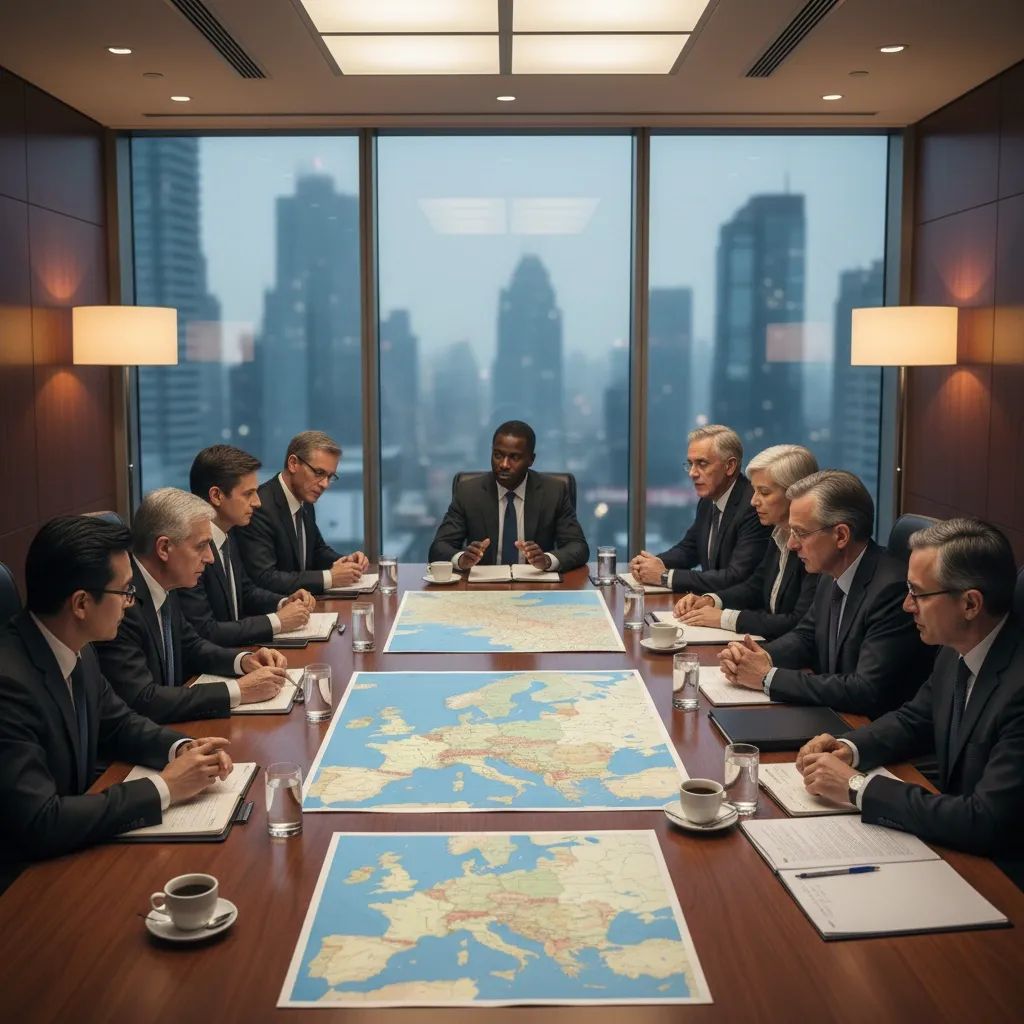
The Kremlin has doubled down on its claim that Russia will secure victory in Ukraine, with presidential spokesman Dmitry Peskov declaring on May 10 that "this is our war, and we will win it." The statement comes as US envoys prepare to fly to Moscow for renewed peace talks and as diplomatic maneuvering accelerates around a conflict that continues to reshape European security and economic relationships.
As US envoys prepare to fly to Moscow for renewed peace talks, Russian officials are doubling down on victory claims—a stance that could determine whether Italian energy costs stabilize or remain elevated through 2026.
Why This Matters:
• Peace talks remain fragile: A three-day ceasefire produced prisoner exchanges but no breakthrough on territorial disputes or Ukraine's sovereignty.
• US mediation intensifies: Envoys Steve Witkoff and Jared Kushner are expected "very soon" in Moscow to continue dialogue, signaling Washington's push for a negotiated settlement.
• European unity tested: Russia's proposal to use former German Chancellor Gerhard Schröder as mediator has been rejected by Berlin as a "hybrid strategy" to divide Western allies.
• Economic pressure persists: Any settlement will require addressing sanctions, energy flows, and reconstruction financing—all directly affecting Italy's fiscal and energy stability.
Russian Confidence Meets Diplomatic Reality
President Vladimir Putin stated earlier this week that the conflict is "coming to an end," a sentiment echoed by Peskov's triumphalist tone. Yet the gap between Moscow's rhetoric and negotiating realities remains vast. Russia continues to demand that Ukraine formally recognize Russian sovereignty over Crimea and the four partially occupied oblasts of Zaporizhzhia, Kherson, Luhansk, and Donetsk—territorial concessions that Kyiv has flatly refused.
According to previous reporting on Russian negotiating positions from March 2025, Moscow has sought additional demands: the removal of President Volodymyr Zelensky through new elections, Ukraine's permanent renunciation of NATO membership, an immediate halt to Western military aid, full lifting of sanctions, and the creation of buffer zones in Russia's Bryansk and Belgorod border regions. Moscow also opposes any European peacekeeping force on Ukrainian soil, proposing instead neutral "observers" to monitor compliance.
These maximalist conditions explain why the recent three-day ceasefire from May 9–11, brokered by Donald Trump to coincide with Russia's Victory Day, produced only a symbolic prisoner exchange—1,000 prisoners per side—without any substantive progress toward a lasting settlement. Trump expressed hope the truce could be extended, but Kyiv rejected Moscow's unilateral gestures, insisting on a durable ceasefire backed by concrete security guarantees.
American Shuttle Diplomacy Returns
Yuri Ushakov, a senior Kremlin adviser, confirmed that Witkoff and Kushner will arrive in Moscow "sooner or later, and I believe quite soon" to continue dialogue. The pair, who have emerged as Trump's primary emissaries on the Ukraine file, are expected to visit Kyiv in the coming months as well, according to Zelensky's office. Their mission: to explore pathways toward a comprehensive peace deal that would end the war while addressing both Russian security concerns and Ukrainian sovereignty.
Witkoff, Trump's special envoy for the Middle East, and Kushner, the former president's son-in-law and a veteran dealmaker from the 2020 Abraham Accords, have already been active in parallel crises, including recent US-Iran tensions and the Israel-Hamas ceasefire negotiations. Their involvement in Ukraine signals Trump's preference for personal diplomacy and transactional negotiation over multilateral institutional frameworks.
For residents of Italy, this American-led diplomatic push carries significant implications. Italy imported approximately 40% of its natural gas from Russia as of early 2026, and energy security remains a priority despite diversification efforts since 2022. A negotiated settlement that stabilizes gas flows through Ukraine or unlocks sanctions relief could ease pressure on Italian household energy bills—currently 15-20% higher than pre-war averages—and reduce industrial costs for manufacturing sectors dependent on affordable energy. Conversely, a prolonged stalemate threatens to prolong inflationary pressures and fiscal constraints tied to defense spending and refugee support.
If a settlement is reached on Russian terms—territorial concessions without robust security guarantees—Italian residents face dual risks: continued price volatility from supply chain uncertainty, and potential longer-term instability that could disrupt grain exports through Italian ports that supply European food markets. Industrial production, particularly in energy-intensive sectors like textiles and machinery, could face further compression if energy costs remain elevated.
Berlin Rejects Schröder Gambit
Putin's suggestion that Gerhard Schröder, Germany's Social Democratic chancellor from 1998 to 2005, serve as mediator between Russia and the European Union has been met with icy skepticism in Berlin. German government sources told AFP that the proposal fits a pattern of "false offers" designed to exploit divisions within the EU and undermine collective Western resolve.
Schröder, who has maintained close personal and business ties to Putin for decades—including roles in the Nord Stream 1 and 2 consortia and on the board of Rosneft—attempted informal mediation in March 2022 at Ukraine's request, flying to Istanbul and Moscow for talks that yielded no results. His office has declined to comment on Putin's latest overture.
Berlin's foreign ministry emphasized that credible negotiations require Ukraine's direct participation and close coordination among EU member states, conditions Russia has not met. A German official said that "a first test of credibility would be for Russia to extend the ceasefire," a step Moscow has not taken. The European Council, led by President Antonio Costa, has scheduled an informal meeting of foreign ministers for May 27–28 in Cyprus to discuss potential engagement with Russia, but only if Moscow demonstrates genuine willingness to compromise.
What This Means for Italy
For Italians, the Ukraine conflict's trajectory affects more than geopolitical abstractions. Italy's energy vulnerability is concrete: households currently pay approximately €0.35-0.40 per kilowatt-hour for electricity, a 30% increase from 2021 levels, with further exposure to price shocks if energy markets destabilize. The country also hosts approximately 180,000 Ukrainian refugees whose integration depends on both domestic policy and the war's duration. A genuine peace settlement could stabilize energy markets, reduce fiscal pressure from defense commitments under NATO's 2% spending targets, and open opportunities for Italian firms in Ukrainian reconstruction—potentially creating jobs in sectors ranging from construction to agriculture.
However, a settlement on Russian terms—territorial concessions without security guarantees—could embolden future aggression and destabilize the broader European order, threatening Italy's trade relationships, energy security, and security environment. Italy's government, led by Prime Minister Giorgia Meloni, has consistently supported Ukraine while maintaining pragmatic channels to Moscow, a balancing act that will face new tests as negotiations intensify.
The proposed Witkoff-Kushner shuttle diplomacy offers a potential pathway out of the deadlock, but success hinges on whether Washington can persuade Moscow to moderate its demands and Kyiv to accept compromises on sovereignty and security architecture. The next few weeks will clarify whether the ceasefire represents a genuine opening or merely another tactical pause before renewed fighting.
The Road Ahead
Analysts who track the conflict note that while the Kremlin projects confidence, Russia's military advances have slowed considerably in recent months despite earlier predictions of rapid gains. Ukrainian fortifications, Western weapons deliveries, and manpower mobilization have all complicated Moscow's battlefield calculus. Recent intelligence assessments suggest Russian forces may attempt to exploit open terrain in the coming weeks, but those gains have not materialized at the pace initially anticipated.
Meanwhile, sanctions fatigue in parts of Europe and Trump's transactional approach to foreign policy have created diplomatic openings Moscow is eager to exploit. Putin's insistence that talks focus on signing a final peace agreement rather than prolonged negotiations reflects Russian impatience with incremental diplomacy and a desire to lock in territorial gains before Western resolve hardens further.
For Italy and the broader EU, the challenge remains striking a balance between pragmatic engagement and principled defense of international law. The Schröder episode underscores the risks of allowing Moscow to handpick interlocutors who lack credibility with Ukraine and Western allies. As the Witkoff-Kushner mission unfolds, European capitals will watch closely to ensure that any American-brokered deal does not sacrifice Ukrainian sovereignty or European security for the sake of a headline truce.
The coming weeks will test whether the rhetoric of peace can translate into concrete progress—or whether the war grinds on, with all the economic, humanitarian, and strategic costs that entails for Italy and the continent.


