
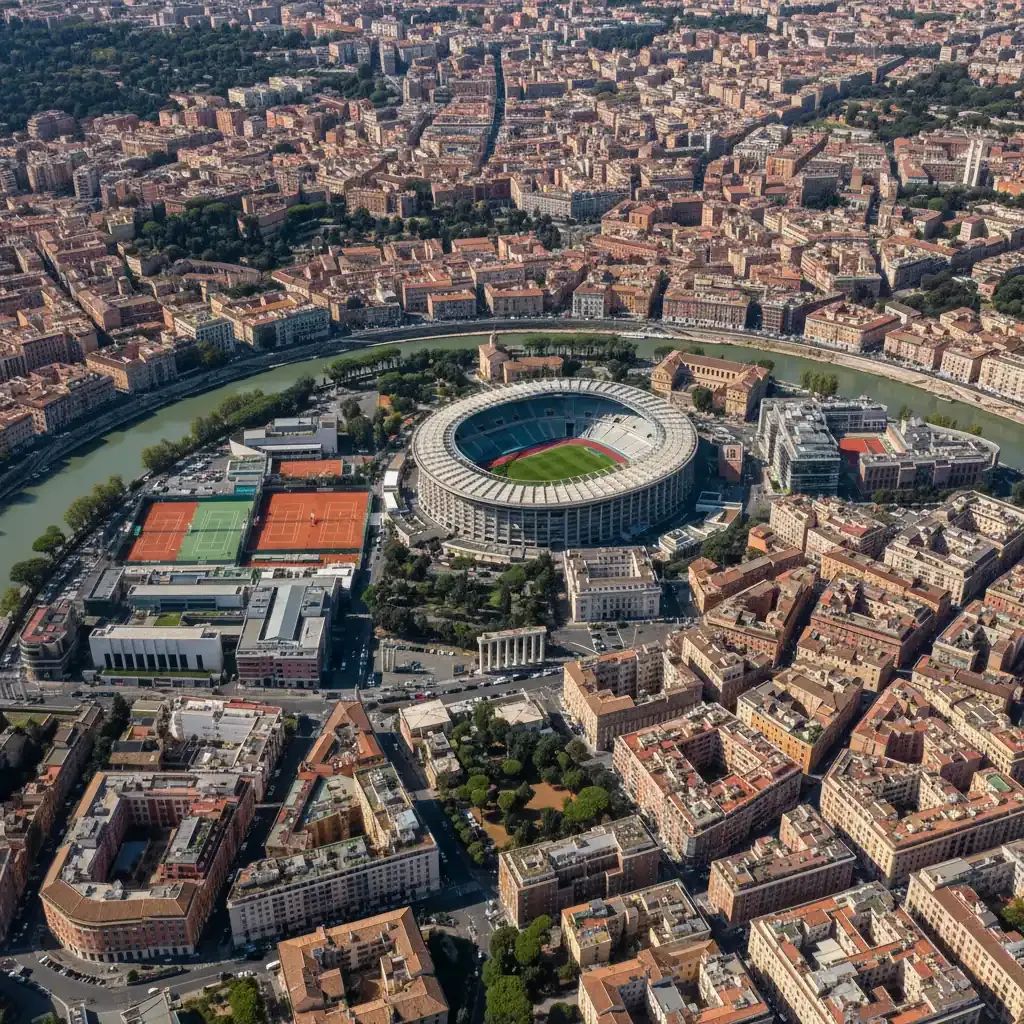
Italy's administrative court has stepped back from ruling on a bitter scheduling clash between Serie A and Rome's Prefecture, instead urging both parties to negotiate directly—and they did. The Roma-Lazio derby between A.S. Roma and S.S. Lazio will now kick off at 12:00 on Sunday, May 17, 2026, averting a last-minute postponement that would have disrupted the final stretch of the league calendar.
Why This Matters
• Fixture confirmed: The Stadio Olimpico derby goes ahead Sunday at noon, not Monday night as the Prefecture initially demanded.
• Security compromise: Authorities accepted an earlier kickoff in exchange for reinforced safety protocols at both the Olimpico stadium and the nearby Foro Italico tennis complex.
• League integrity preserved: Four other Serie A matches involving Champions League contenders will proceed simultaneously, as competition rules require.
What This Means for Romans
For residents and visitors, Sunday will test the city's event-management capacity. Expect significant disruptions across northern Rome:
• Metro Line A congestion: Both the Olimpico (Flaminio and Ottaviano stops) and Foro Italico (Flaminio) rely on the same subway artery. Plan alternative routes or travel well in advance.
• Road closures: The Lungotevere and Viale delle Olimpiadi will face rolling restrictions from 10:00 to 19:00.
• Police presence: Roughly 1,500 officers will be on duty, the largest deployment for a single-day sporting event in Rome this year.
• Parking bans: Both the Parioli and Flaminio districts will enforce no-parking zones from Saturday night.
If you live near the sports precinct or planned a weekend outing in northern Rome, factor in delays and heightened security checks.
The Flashpoint: Two Mega-Events, One Neighborhood
Rome's Stadio Olimpico and the Foro Italico—home to the BNL Internazionali d'Italia tennis championship—sit less than 500 meters apart in the same sports precinct. When both were scheduled to host major events on the same Sunday afternoon, the Rome Prefecture flagged the overlap as a public-order emergency.
The Roma-Lazio derby is one of Europe's most heated football rivalries, routinely drawing 60,000 fans. The intensity of these matches has historically led to security incidents, with clashes between rival supporters and police sometimes occurring before, during, and after evening matches. Simultaneously, the tennis final was expected to fill the Foro Italico's approximately 10,000-seat center court, with the possibility of President Sergio Mattarella attending if Italy's Jannik Sinner reached the final—a prospect that would trigger presidential security protocols.
Citing unmanageable crowd flows and the track record of incidents at evening derbies, the Prefecture issued an ordinance on Wednesday rescheduling the match to Monday, May 18, at 20:45. That unilateral move set off a legal and political firestorm.
Serie A's Rebellion and the TAR Intervention
The Lega Serie A, which oversees Italy's top football division, filed an emergency appeal with the TAR Lazio (Regional Administrative Court), arguing the postponement violated sporting fairness. With five clubs—Milan, Juventus, Napoli, Como, and both Rome sides—locked in a tight race for UEFA Champions League qualification, shifting the derby to Monday would break the simultaneous kickoff rule mandated for the final two matchdays.
"This is an issue of ego," said Francesco Rocca, president of the Lazio Region, during a family policy conference. "The football league is gambling recklessly with the safety of our city. The prefect and police chief gave technical assessments free from bias, and they must be respected. There was a clear planning error—scheduling the derby the same day as an international tennis tournament in such a confined area."
Rather than issue a ruling, TAR President Roberto Politi convened a hearing Thursday afternoon and declined to impose a preliminary injunction, instead urging the Prefecture and the league to hammer out a deal. Within hours, both sides reconvened at the Prefecture's offices.
The Compromise: Noon Kickoff, Beefed-Up Security
By late Thursday evening, agreement was reached. The derby will start at 12:00 on Sunday, three hours earlier than the league's original proposal of 12:30. The tennis final remains at 17:00, providing a five-hour buffer for stadium egress and crowd dispersal.
In return, Sport e Salute S.p.A., the state-owned firm that manages both venues, pledged enhanced coordination. The agreement includes:
• Staggered access lanes to separate football and tennis attendees.
• Additional riot police deployed across the Flaminio district and along the Tiber riverbanks.
• Real-time liaison between stadium security, the Rome Questura (police headquarters), and the tennis organizers.
The deal allows the other four Serie A fixtures in contention—each decisive for European qualification—to proceed at the same time, preserving the competitive integrity the league sought to protect.
A Pattern of Friction
This is not the first time Rome's dual-event calendar has caused friction. In previous years, the Lega Serie A and local authorities have clashed over match schedules during papal events, state visits, and cultural festivals. The city's compact geography—most major venues lie within a two-kilometer radius—makes logistics a perpetual flashpoint.
Serie A clubs frequently lament that Italy's fragmented security governance gives prefects sweeping powers to override sporting calendars, a prerogative seldom exercised in other major European leagues. Critics counter that Italy's history of football violence justifies a cautious approach.
Rocca's accusation of "planning error" points to a deeper issue: the Internazionali di Roma tennis calendar had been confirmed since late 2025, while Serie A's fixture list was published in July 2025. The two organizations failed to coordinate adequately before finalizing their schedules, forcing this crisis negotiation just 72 hours before kickoff. This scheduling overlap could have been avoided through better inter-organizational communication earlier in the planning cycle.
The Broader Implications
The resolution averts a precedent that could have empowered local authorities to routinely override league schedules late in the season. Had the TAR sided with the Prefecture, every major Italian city with overlapping events might have invoked similar powers, fragmenting the national calendar.
Yet the compromise also underscores that public safety retains primacy over commercial and sporting convenience. The early kickoff satisfies both principles, but it required a judge's nudge and high-level negotiation to get there.
For fans, the outcome is simple: the Roma-Lazio derby happens Sunday at noon, and the four-way Champions League scramble unfolds in real time. For city administrators, it's a reminder that Rome's Renaissance-era street plan was never designed for 21st-century mega-events—and that every May, the same logistical puzzle returns.


