
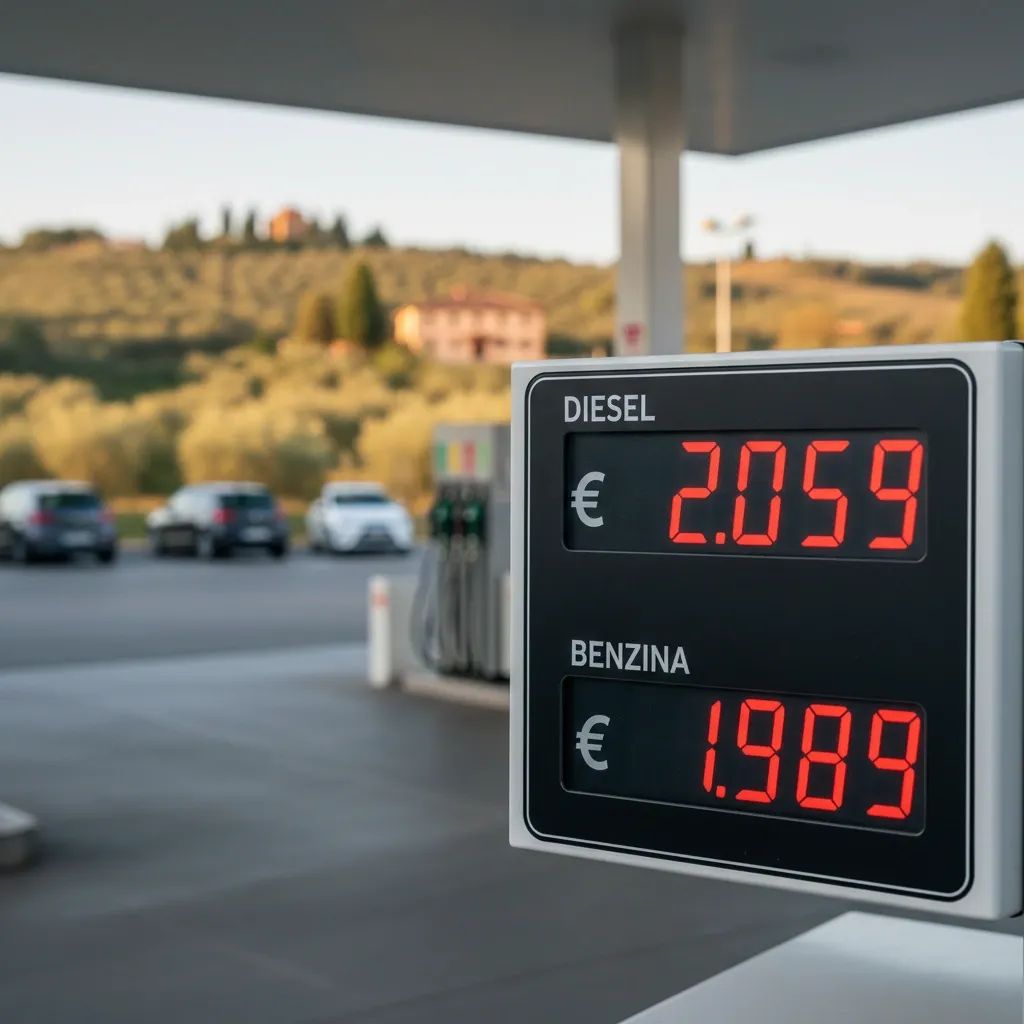
The Italian government has activated a new fuel excise tax cut starting May 2, but with a critical twist: diesel drivers will save significantly more than petrol users, and the measure's lifespan remains tangled in bureaucratic maneuvering. The move aims to cushion transport costs and inflation, but motorists filling up with petrol face an immediate hit to their wallets.
Why This Matters:
• Diesel gets 20 cents off per liter at the pump, while petrol receives a 5-cent excise reduction, which translates to approximately 6 cents total savings when VAT is included.
• The official decree runs only until May 10, but government sources confirm a ministerial decree will extend it to May 22.
• Budget allocation: The entire package costs €400M, with €146.5M covering the first phase through May 10 and another €250M for the extension.
A Two-Step Fuel Relief Strategy
Italy's latest response to volatile energy prices unfolds in two distinct legal phases. The government decree, which took effect on May 2, formally authorizes the excise reduction through May 10. The condensed timeline surprised observers, given that official government communications had initially promised relief through May 21.
Government insiders clarified the discrepancy: a separate ministerial order will bridge the gap, prolonging the tax break until May 22. This dual-decree approach allows Rome to sequence budgetary allocations while maintaining the appearance of a three-week intervention window. Antitrust penalties and surplus VAT revenues are funding the operation, according to Finance Ministry sources.
The structure reflects the Italian government's balancing act between fiscal discipline and political pressure to respond visibly to fuel price spikes linked to international energy market turbulence.
The Diesel-Petrol Divide
The most consequential feature of this package is its asymmetric design. Diesel users — including the critical freight, agriculture, and fishing sectors — retain a substantial 20-cent-per-liter excise reduction, effectively lowering pump prices by approximately 24-25 cents when VAT savings are factored in.
Petrol drivers, by contrast, face a drastically scaled-back 5-cent excise reduction, yielding roughly 6 cents total savings at the pump. This represents a dramatic downgrade from previous uniform cuts that applied equally to both fuel types.
Why the split? Government economic advisers cite recent price trajectories: diesel wholesale prices surged approximately 24% in recent weeks, compared to a more modest 6% climb for petrol. By concentrating fiscal firepower on diesel, policymakers aim to stabilize costs across the logistics backbone of the Italian economy, preventing cascading price increases in food, construction materials, and consumer goods.
A single heavy goods vehicle operator could save hundreds of euros during the three-week window, according to estimates from Unimpresa, Italy's association of small and medium enterprises. For fleets running dozens of trucks, the cumulative benefit becomes substantial enough to justify holding transport tariffs steady rather than passing fuel inflation through to clients.
What This Means for Residents
For petrol car owners — roughly half of Italian passenger vehicle drivers — the new regime delivers a €9 surcharge per 50-liter fill-up compared to pricing under the previous, more generous excise regime. With average petrol prices hovering around €1.93 per liter, household transport budgets take an immediate hit.
Consumer advocacy groups, including Codacons, have labeled the petrol component a "stangata" — Italian slang for a punishing financial blow. Families relying on petrol vehicles for commuting, school runs, and weekend mobility face a cumulative monthly increase that could exceed €40 for typical two-car households.
Diesel vehicle owners, meanwhile, enjoy meaningful relief, though the benefit remains vulnerable to crude oil price volatility. If Brent crude continues its upward trajectory, even the 20-cent cushion may prove insufficient to prevent pump price escalation.
Commercial drivers and small business owners operating delivery vans, refrigerated trucks, or agricultural machinery stand to benefit most directly. The government has signaled additional support measures, including a tax credit for professional hauliers, though implementation details remain under negotiation with industry associations.
Parliamentary Scrutiny and Opposition Pushback
The government decree now enters the conversion process in Italy's Parliament, where opposition parties have already sharpened their criticism. The Democratic Party (PD) and Five Star Movement (M5S) dismissed the intervention as politically expedient but structurally hollow — a charge echoed by Alleanza Verdi e Sinistra (Green and Left Alliance).
PD Deputy Marco Simiani called the package "insufficient electoral crumbs," arguing it fails to address Italy's dependency on volatile fossil fuel imports. Opposition lawmakers have revived demands for the "sliding excise" mechanism — a legal framework established in 2023 but never activated — that would automatically reduce excise rates when pump prices surge, funded by the surplus VAT revenue those higher prices generate.
PD Secretary Elly Schlein accused Prime Minister Giorgia Meloni's cabinet of hoarding extra VAT windfall rather than returning it to motorists. The sliding excise model would theoretically self-finance relief during price spikes without requiring parliamentary appropriations.
Critics from M5S, including lawmakers Chiara Appendino and Mario Turco, argue that temporary excise cuts — which have now consumed over €1B in cumulative fiscal resources across multiple rounds since 2022 — represent crisis management rather than energy policy. They advocate transitioning fiscal support toward public transport infrastructure and renewable energy adoption to reduce Italy's structural vulnerability to Middle Eastern geopolitical risk.
Codacons proposed redirecting any available funds toward means-tested support for low-income households rather than broad-based excise reductions that deliver proportionally greater savings to high-mileage, affluent drivers.
Fiscal Reality and Long-Term Constraints
Fuel excise taxes generate approximately €26B annually for Italy's treasury — a revenue stream comparable to the entire national education budget. Permanent abolition, or even indefinite suspension, would require either dramatic spending cuts elsewhere or equivalent new revenue sources.
The OECD has explicitly recommended that member states, including Italy, move away from generalized fuel tax holidays. Economists note that such interventions can delay necessary behavioral adjustments — such as vehicle electrification, carpooling adoption, or modal shifts to rail — while subsidizing carbon emissions during a climate transition period.
The current package's relatively modest size and short duration reflect these fiscal constraints. By targeting diesel more generously, Rome attempts to maximize anti-inflation impact per euro spent, leveraging the fuel's outsized role in price formation across the broader economy.
What Comes Next
Barring amendments during parliamentary review, the excise reduction will expire on May 22. Energy analysts expect the government to reassess the policy at that juncture based on crude oil price trends and domestic inflation data.
The Ministry of Economic Development is simultaneously negotiating a separate support package for professional road hauliers, potentially including direct subsidies or expanded tax credits. Those measures would likely target registered commercial operators rather than providing universal pump-price relief.
For Italy's 36 million motorists, the immediate calculus is straightforward: diesel remains partially shielded, petrol users absorb most of the price pressure, and political consensus for deeper, longer-lasting intervention remains elusive. Whether this latest decree marks a temporary patch or the beginning of sustained policy differentiation between fuel types will become clearer as parliamentary debate unfolds and international energy markets evolve through the critical summer travel season.


