
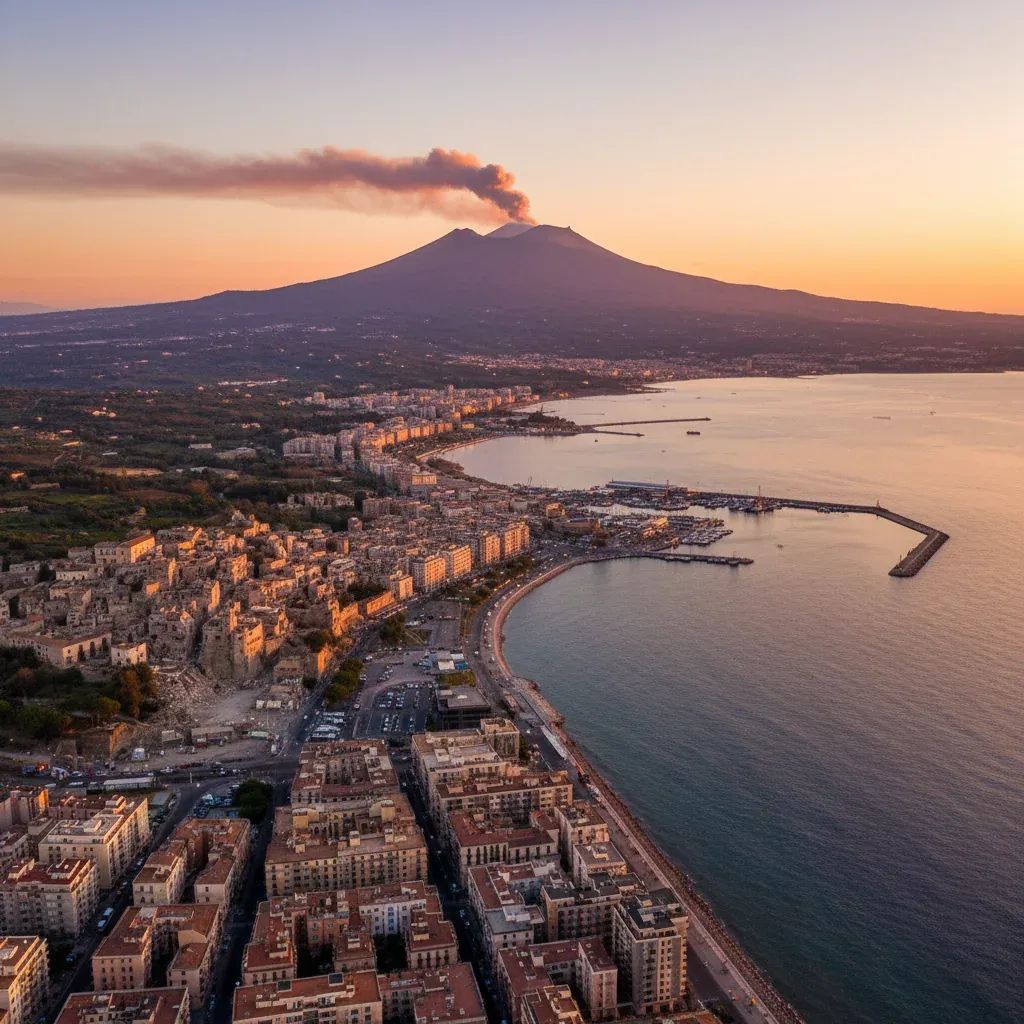
The Italian National Institute of Geophysics and Volcanology (INGV) registered a 4.5-magnitude earthquake on the slopes of Mount Etna this morning at 7:05 AM local time, shaking multiple provinces across eastern Sicily and prompting precautionary school closures throughout the Catania metropolitan area. The shallow tremor—centered just 3 km northwest of Ragalna at a depth of roughly 4 km—was distinctly felt across Catania, Messina, and Siracusa, marking the strongest seismic event in the region since the volcano's ongoing eruptive phase began in late December.
Why This Matters
• Schools closed across Catania: Authorities ordered inspections of educational buildings in the provincial capital and surrounding municipalities to verify structural safety.
• Damage reported in Ragalna: Local mayor Antonio Caruso confirmed structural harm to residences and public facilities in the epicentral zone, though no injuries were reported regionally.
• Seven aftershocks recorded: Follow-up tremors ranging from magnitude 1.2 to 2.7 rattled the area in the hours following the main shock, keeping residents on edge.
Epicenter in a High-Risk Zone
The quake's epicenter lies in a triangular corridor between Ragalna, Biancavilla, and Santa Maria di Licodia—three towns sitting astride one of the most seismically active belts in Sicily. INGV seismologists attribute the event to a combination of Etna's magmatic pressures and the tectonic faults that run parallel to the volcano's western flank. That dual origin makes shallow earthquakes in this district both frequent and potentially destructive, especially given the proximity of population centers.
Residents in Augusta, a coastal town more than 40 km south in Siracusa province, also reported clear tremors, underscoring the quake's wide propagation through the region's sedimentary basins. Civil protection officials in Catania confirmed that no major structural failures occurred in the provincial capital itself, where the majority of Sicily's earthquake-monitoring infrastructure is concentrated.
School Inspections and Precautionary Measures
Educational authorities in Catania city and several outlying municipalities suspended classes immediately after the main shock to allow technical teams to survey buildings for cracks, tilting, or compromised load-bearing elements. This protocol has become standard practice in the province since a wave of reclassifications placed four nearby municipalities—Licodia Eubea, Militello in Val di Catania, Scordia, and Vizzini—into Seismic Zone 1, the nation's highest-risk category, in February 2022.
Buildings constructed before 1981, the year Sicily first adopted mandatory seismic codes, remain particularly vulnerable. Much of Catania's historic core, rebuilt after the catastrophic 1693 earthquake, lacks modern reinforcement, and municipal risk assessments conducted under the EU-funded Risk-UE project have flagged hundreds of residential blocks and public facilities for potential retrofit. The Sisma Bonus incentive program offers tax breaks for anti-seismic upgrades, yet uptake has been uneven across the province, leaving pockets of older masonry stock exposed.
Etna's Recent Activity and Seismic Context
This morning's tremor arrives against a backdrop of heightened volcanic unrest. On January 1, a fissure opened at 2,100 meters on the north wall of the Valle del Bove, feeding a sluggish lava flow that advanced through the valley before stalling by mid-January as effusion rates declined. Strombolian explosions at the Voragine crater have continued intermittently, producing ash plumes visible from Catania on calm days.
Seismic surveillance data from late January and February showed low fracturing activity, with most tremors registering below magnitude 2.0 and volcanic tremor amplitude hovering at medium-to-low levels. The relative calm made today's 4.5 event all the more jarring for local populations accustomed to minor rumbles but unaccustomed to this scale of ground shaking in recent weeks.
Worth noting is a magnitude 5.1 offshore earthquake in the Ionian Sea on January 10, which raised questions about possible stress transfer along the broader fault network linking the Calabrian Arc to the Etna edifice. While no definitive link has been established, seismologists monitor such patterns closely, given the potential for cascading ruptures in heavily faulted terrain.
What This Means for Residents
For anyone living in or near the Etna footprint, today's quake is a stark reminder that volcanic seismicity can spike without obvious precursors in surface activity. The INGV continues around-the-clock monitoring through the Osservatorio Etneo in Catania, which feeds real-time data to regional civil protection headquarters.
If you reside in Ragalna or adjacent hill towns, prioritize the following steps:
• Check your home for new cracks, especially around doorframes, load-bearing walls, and staircases. Report significant damage to your municipal technical office.
• Secure heavy furniture and appliances. Aftershocks can dislodge items weakened by the main event.
• Review your household emergency kit: bottled water, battery-powered radio, flashlight, and essential medications. Cellphone networks can overload during sustained sequences.
• Stay informed via official INGV bulletins and local civil protection channels rather than unverified social media posts.
Homeowners seeking to retrofit properties can consult the Sisma Bonus guidelines on the Italian Revenue Agency website; the program covers up to 85% of eligible costs for interventions that improve a building's seismic class by two levels.
Broader Implications for Eastern Sicily
Eastern Sicily's geological reality—active volcanism superimposed on a complex tectonic boundary—means that magnitude 4+ events are neither rare nor entirely predictable. The province of Catania alone hosts roughly 1.1 million residents, many clustered in multi-story apartment blocks dating from the post-war construction boom. As climate adaptation and disaster resilience climb the national policy agenda, regional authorities face mounting pressure to accelerate vulnerability assessments and enforce stricter building codes, particularly for critical infrastructure such as schools, hospitals, and transport hubs.
Today's tremor caused no fatalities, but the damage in Ragalna illustrates that proximity to the epicenter remains the dominant risk factor. Structural engineers note that even moderate-magnitude quakes at shallow depths can generate peak ground accelerations sufficient to crack unreinforced masonry and topple chimneys, especially on ridgelines and steep slopes where site amplification effects are pronounced.
Monitoring and Next Steps
INGV analysts will continue to track aftershock evolution and any changes in volcanic tremor amplitude or gas emissions. Historical precedent suggests that sequences of this type can persist for days or taper off within hours; the variability depends on whether magma movement is driving the rupture or whether tectonic stress release dominates.
Civil protection teams remain on standby, and the regional government has activated coordination protocols to streamline damage assessments and potential relief measures. No evacuation orders have been issued, and the A19 motorway linking Catania to Palermo remains fully operational, though drivers should expect increased police presence near affected municipalities.
For now, life in Catania and the surrounding towns proceeds with cautious normalcy—schools await clearance to reopen, engineers compile inspection reports, and residents keep radios tuned for updates. The morning's jolt has passed, but the underlying forces that shaped it continue to simmer beneath one of Europe's most restless landscapes.


