
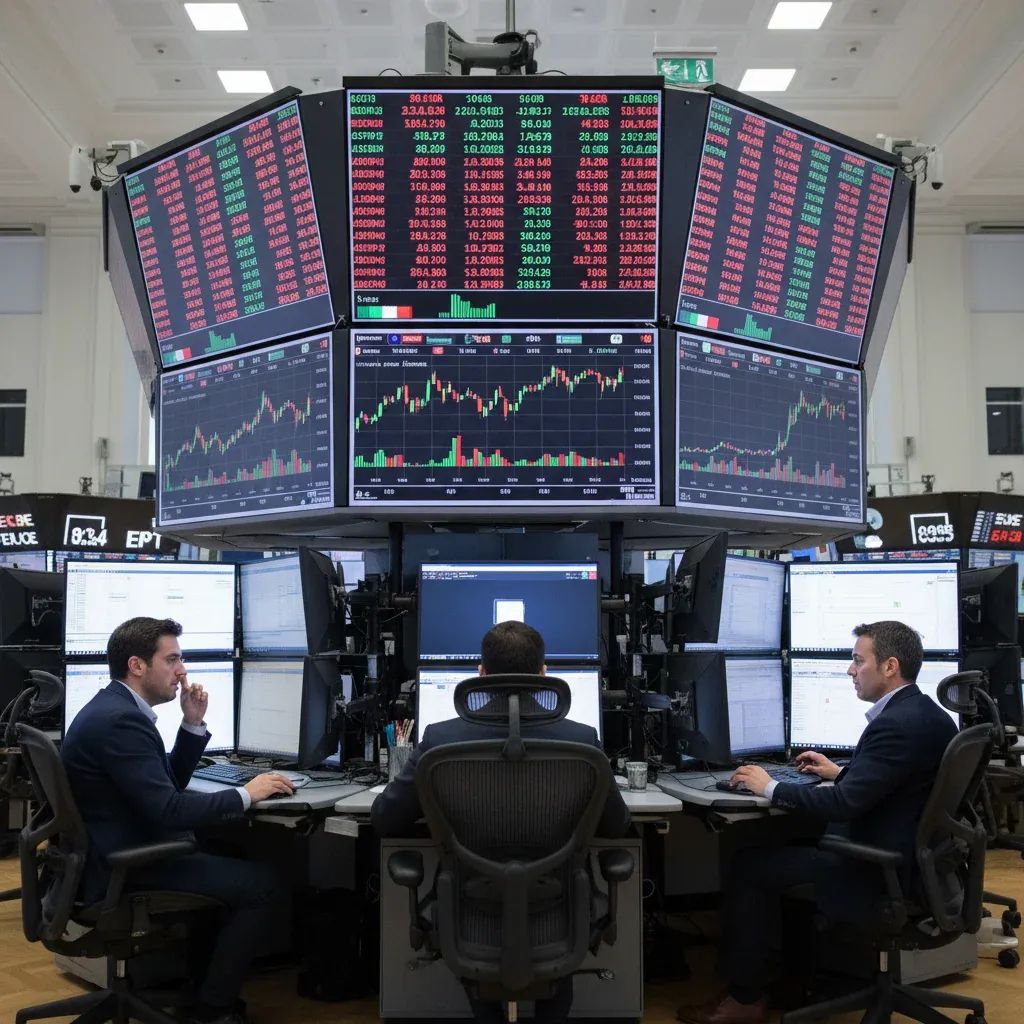
Milan's main stock index opened with a fractional 0.4% decline, reflecting cautious sentiment across European equity markets as investors monitored escalating tensions in the Middle East and resulting energy commodity price movements. The FTSE MIB in Piazza Affari hovered near breakeven through morning trading, supported by strength in defense and luxury stocks despite broader uncertainty.
Why This Matters
• Energy costs are climbing: Crude oil has jumped 5% and natural gas by 3%, adding to household budget pressures already strained by elevated energy costs.
• Defense sector outperformance: Leonardo surged 9% after reporting strong 2025 results and a dividend increase, showing how specific sectors can benefit amid geopolitical uncertainty.
• Volatility likely to continue: With Italy's energy dependence and rate policy uncertainty, expect continued market movements until the situation stabilizes or supply disruptions ease.
Defense and Luxury Stocks Lead
The session's strongest performer was Leonardo, the Rome-based aerospace and defense company. Shares climbed 9% following management reports of 2025 revenues of €19.5 billion—an 11% annual increase—and adjusted net profit of €1 billion, up 19% year-on-year. The company proposed a €0.63 per-share dividend, a 21% increase from the prior year, reflecting confidence in its €23.8 billion order book, which grew 15%.
Fincantieri, the state-controlled shipbuilder, added 3% as investors responded to recent guidance confirming approximately €9 billion in 2025 revenues and a 7.4% EBITDA margin. Its €60 billion order backlog supported continued positive sentiment, though dividend payments have been postponed until 2028.
Luxury goods maker Salvatore Ferragamo jumped 7% to €6.50 after releasing 2025 results that exceeded expectations, demonstrating resilient demand in premium segments.
Financials and Construction Decline
On the downside, Monte dei Paschi di Siena shed 1.8% and Mediobanca fell 1.4%, reflecting broader financial sector weakness as rate-cut expectations were pushed further into 2026. Construction and engineering group Webuild tumbled 8% to €2.72 following completion of its industrial plan through 2025, despite exceeding original targets.
Energy Price Movement and Market Context
The cautious tone reflected a U.S.-Israel military operation targeting sites in Iran, which pushed Brent crude higher. By midday, Brent futures were trading around $92, up more than 5% intraday, while European natural gas futures rose 3%, extending a rally that has seen prices climb approximately 50% since early March.
For Italy, which imports most of its energy, the implications are direct. The national wholesale electricity price (PUN) has fluctuated significantly, reaching €168.54 per megawatt-hour on March 10 before settling closer to €143.59. The PSV gas index for Italy hit €0.53 per standard cubic meter, up nearly 4% day-on-day and roughly 50% higher than a month prior.
These movements have raised concerns that the European Central Bank may delay anticipated rate cuts, with markets now pricing in potential rate increases as inflation risks resurface.
What This Means for Italian Households and Investors
For Italian residents, the main concern is renewed upward pressure on electricity, heating, and fuel bills. With natural gas prices up 50% over the month and crude oil rising, household budgets face renewed strain. The timing of bill impacts depends on local utility contracts and government support measures, which may provide some cushion.
Investors with diversified portfolios may find some protection through defense and energy equities, which have outperformed during this downturn. ENI, Italy's state-backed energy major, has held relatively steady as higher crude prices support upstream margins. Conversely, exposure to banking, construction, and consumer discretionary sectors has underperformed.
Broader European Picture
Across the continent, equity performance remained mixed. Madrid's IBEX 35 declined 0.9%, London's FTSE 100 and Paris's CAC 40 each fell 0.4%, and Amsterdam's AEX slipped 0.3%. Frankfurt's DAX edged down 0.1% but has declined 4.7% over the past week, reflecting Germany's sensitivity to energy price movements and manufacturing concerns.
The Euro Stoxx 50 declined 0.3% to 5,779 points, with monthly losses extending to 3.5%. Volatility has remained elevated, with investor positioning tilted defensive.
Outlook: Monitoring Geopolitical Developments
Market participants expect continued volatility until the situation in the Middle East clarifies. The International Energy Agency has noted current supply disruptions are among the largest in recent history. Should the conflict extend or widen, energy prices could move significantly higher, affecting inflation and economic growth across the eurozone.
For now, Milan's market reflects the tension between resilient pockets of strength—particularly in defense and select luxury goods—and fragility tied to energy dependence and rate uncertainty. Investors will be watching ECB communications, Middle East developments, and any European Commission measures to manage energy shocks before sentiment stabilizes.


