
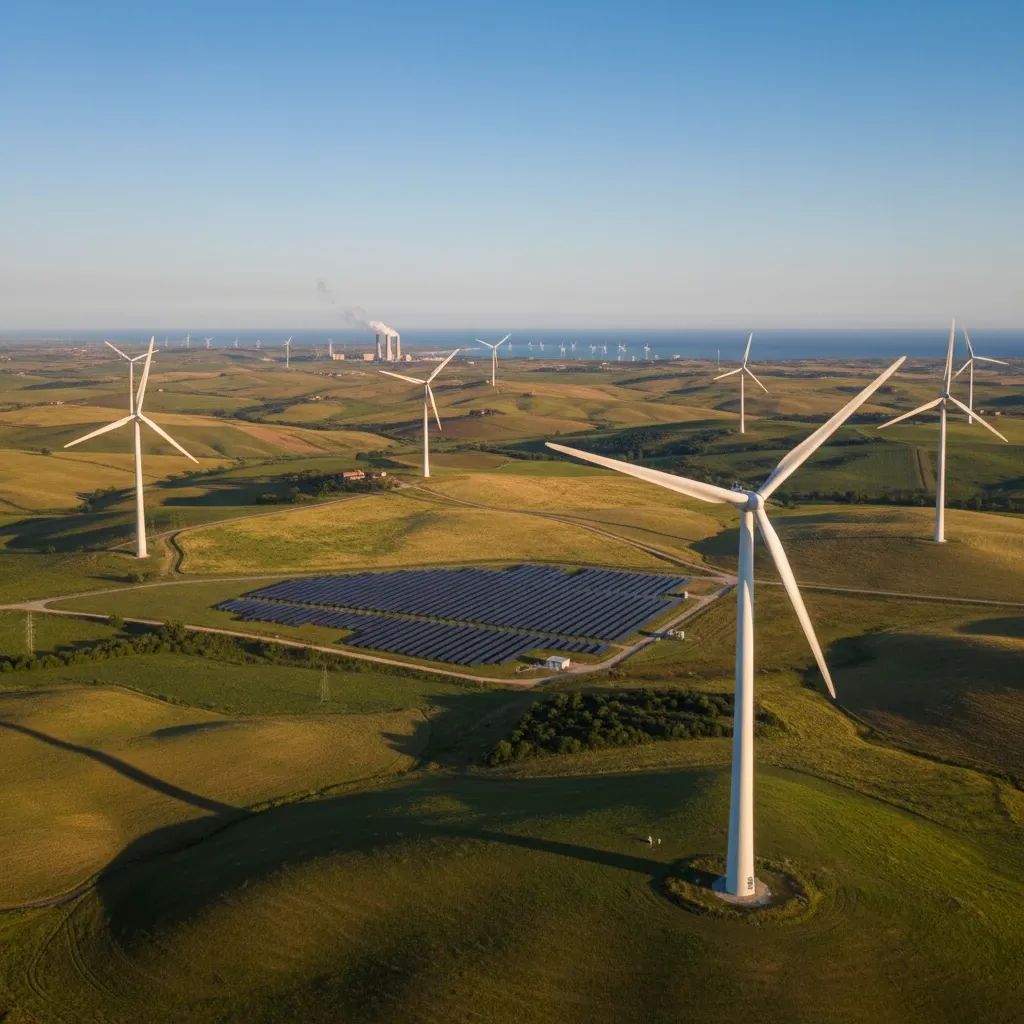
Italy's electricity consumption climbed 2.1% in February 2026 to reach 25.4 billion kWh, driven by a dramatic surge in renewable energy output that now covers nearly 38% of national demand—a shift that positions wind power as the country's leading clean energy source for the first time.
Why This Matters:
• Wind power dominance: Wind turbines generated 2.8 billion kWh in February, more than doubling output (+117%) compared to the same month in 2025, overtaking both solar and hydroelectric for the first time.
• Industrial recovery continues: Manufacturing electricity demand rose 4.6% year-on-year, marking the sixth consecutive month of industrial growth—a signal of sustained economic momentum.
• Olympic infrastructure stress test: The Milano Cortina 2026 Winter Games drove energy exchanges in host zones up 38-50% during competition days, validating €300M in grid upgrades by Terna, the state transmission operator.
• Renewable momentum: Total clean energy production jumped 27.8%, with renewables now supplying 37.9% of Italy's electricity versus 30.3% a year earlier.
Wind Takes the Lead in Italy's Energy Mix
For the first time in the country's energy history, wind turbines outpaced all other renewable sources in monthly generation. The Italy transmission grid operator Terna, led by CEO Giuseppina Di Foggia, reported that wind farms delivered 2.8 billion kWh in February—a figure that dwarfed both photovoltaic solar and hydroelectric output.
The 117% year-on-year surge reflects both favorable weather patterns across the peninsula and the fruits of accelerated turbine installations over the past 18 months. Solar photovoltaic still showed robust growth at +25.5%, while hydroelectric generation climbed a more modest 5.8%. Only geothermal output declined, slipping 2.7%.
Italy added 559 MW of new renewable capacity in February alone, a pace that aligns with the government's Piano Nazionale Integrato Energia e Clima (PNIEC) targets calling for 131 GW of total renewable capacity by 2030—a 57% increase over current levels. To hit that benchmark, Italy must nearly double its photovoltaic footprint from 43.6 GW in 2025 to 80 GW within four years, and more than double wind capacity from 13.6 GW to 28 GW.
Industry watchers note that 2025 saw an 8.2% drop in new renewable installations to 6.2 GW, ending a four-year growth streak. Regulatory uncertainty and protracted permitting delays were blamed for the slowdown, prompting trade groups like ANIE Rinnovabili to warn that bureaucratic friction risks stalling the energy transition and prolonging fossil fuel dependence.
Manufacturing Demand Surges Across Key Sectors
The Italy Terna IMCEI industrial consumption index registered its sixth straight monthly gain, with February's 4.6% increase fueled by strong performance in steel production, non-ferrous metals, ceramics, and glassworks. By contrast, cement, paper, mechanical engineering, and chemicals posted declines, while food processing and transport equipment held steady.
The sustained industrial uptick suggests that energy-intensive manufacturers are ramping up output as the broader economy stabilizes. Overall national demand, adjusted for temperature and calendar effects, rose 2.4% year-on-year—though it dipped 1.8% from January's seasonally adjusted figure.
Geographically, consumption growth was uniform across the country: the North saw a 1.8% bump, the Centre 2.2%, and the South plus islands 2.8%. In the first two months of 2026 combined, Italy's electricity demand climbed 3.1% versus the equivalent period last year.
Olympic Games Put Grid Upgrades to the Test
The Milano Cortina 2026 Winter Olympics, which ran from February 6 to 22, offered an unscheduled stress test for Italy's modernized transmission infrastructure. Primary substations serving Olympic venues recorded a 38% jump in energy flows compared to the same fortnight in 2025, with spikes hitting 50% on days hosting marquee events.
Terna's €300M investment program—focused on Lombardy, Veneto, and Trentino-Alto Adige—delivered 130 km of new underground high-voltage cables designed to minimize landscape impact in sensitive alpine zones and enhance resilience against extreme weather. Key projects included:
• A new primary substation at Livigno at 2,177 meters altitude, making it Italy's highest, built entirely underground to blend into the mountain terrain.
• Upgraded connections at Milan's San Cristoforo and Rogoredo substations, as well as the Laion-Corvara line in South Tyrol and the Cortina-Auronzo di Cadore link in Veneto.
• A new Arabba primary cabin to reinforce grid mesh across a broad swath of northern Italy.
Organizers sourced 100% certified renewable electricity for all Olympic sites and deployed biocarburante HVO diesel—produced from renewable feedstocks—in roughly 250 temporary generators. Temporary outdoor lighting relied on low-impact LED systems, and 21% of the operational vehicle fleet ran on battery power.
Critics, however, flagged an estimated 930,000 tons of CO₂ equivalent emissions tied to the Games, including 301,000 tons from ancillary activities and mobility. A separate October 2025 study calculated 59 hectares of land consumed by Olympic construction, while the heavy use of artificial snow—necessitated by warming winters—raised concerns over water and energy intensity.
What This Means for Residents and Businesses
Italy's accelerating renewable build-out translates to greater grid stability and potentially lower wholesale electricity costs as wind and solar displace pricier gas-fired generation. Households and small businesses enrolled in variable-rate contracts may already notice savings, particularly during months when renewables cover a larger share of the load.
The industrial consumption rebound is a leading indicator of economic health, signaling that factories are confident enough to maintain or expand production schedules. For companies in energy-intensive sectors—steel, glass, ceramics—the shift toward cheaper renewable power can improve margins and competitiveness.
Terna's Olympic-driven infrastructure enhancements now form a permanent legacy for the northern regions, reducing outage risk and supporting future load growth from tourism, manufacturing, and electrified transport. The 130 km of buried cable also removes visual clutter from alpine vistas, a win for heritage and tourism stakeholders.
Yet the regulatory bottleneck that caused 2025's installation slump remains unresolved. Unless permitting timelines shorten and policy frameworks stabilize, Italy risks falling short of its 2030 renewable targets—forcing continued reliance on imported fossil fuels and jeopardizing EU climate commitments.
Policy and Investment Outlook
Major utilities are betting on the transition: energy group A2A announced €3.7 billion earmarked for solar and wind projects, plus another €1 billion for hydroelectric modernization. The Italian government has extended "bonus casa" tax deductions at 50% for primary residences (36% for second homes), fueling residential solar uptake and battery storage adoption.
Global forecasts suggest photovoltaic generation will surpass both wind and nuclear worldwide by 2026, and Italy is tracking that trend. Domestic solar capacity is projected to reach 49.37 GW by year-end, with the market entering a mature phase characterized by stable pricing and proven technology.
Offshore wind, meanwhile, holds enormous potential but faces bureaucratic and regulatory hurdles that have delayed projects. Planned port infrastructure investments aim to unlock that capacity, though tangible progress remains years away.
The PNIEC roadmap calls for aggressive annual build rates through the end of the decade. Achieving those benchmarks will require not only capital—which appears available—but streamlined approvals and clearer long-term rules to de-risk private investment.
Longer-Term Energy Security
February's data underscores a broader structural shift: Italy is steadily decoupling electricity supply from fossil imports. Renewables now cover nearly four-tenths of demand, up from three-tenths a year ago, reducing exposure to volatile global gas prices and improving energy sovereignty.
Temperature adjustments played a role in February's consumption figures—the month was 1.1°C warmer than February 2025, with 20 working days in both periods. Stripping out weather and calendar effects still leaves a solid 2.4% underlying growth rate, suggesting genuine expansion rather than statistical noise.
The six-month manufacturing rebound, paired with stable service-sector demand, points to a resilient domestic economy. If industrial momentum holds and renewable installations accelerate, Italy could outpace its 2030 targets, positioning itself as a regional leader in clean energy and industrial decarbonization.
For now, the takeaway is clear: wind is no longer a niche player in Italy's energy portfolio, and the combination of natural resources, capital investment, and grid modernization is reshaping how the country powers its homes, factories, and infrastructure. Whether that momentum survives the permitting maze will determine if Italy's energy transition accelerates—or stalls.


