
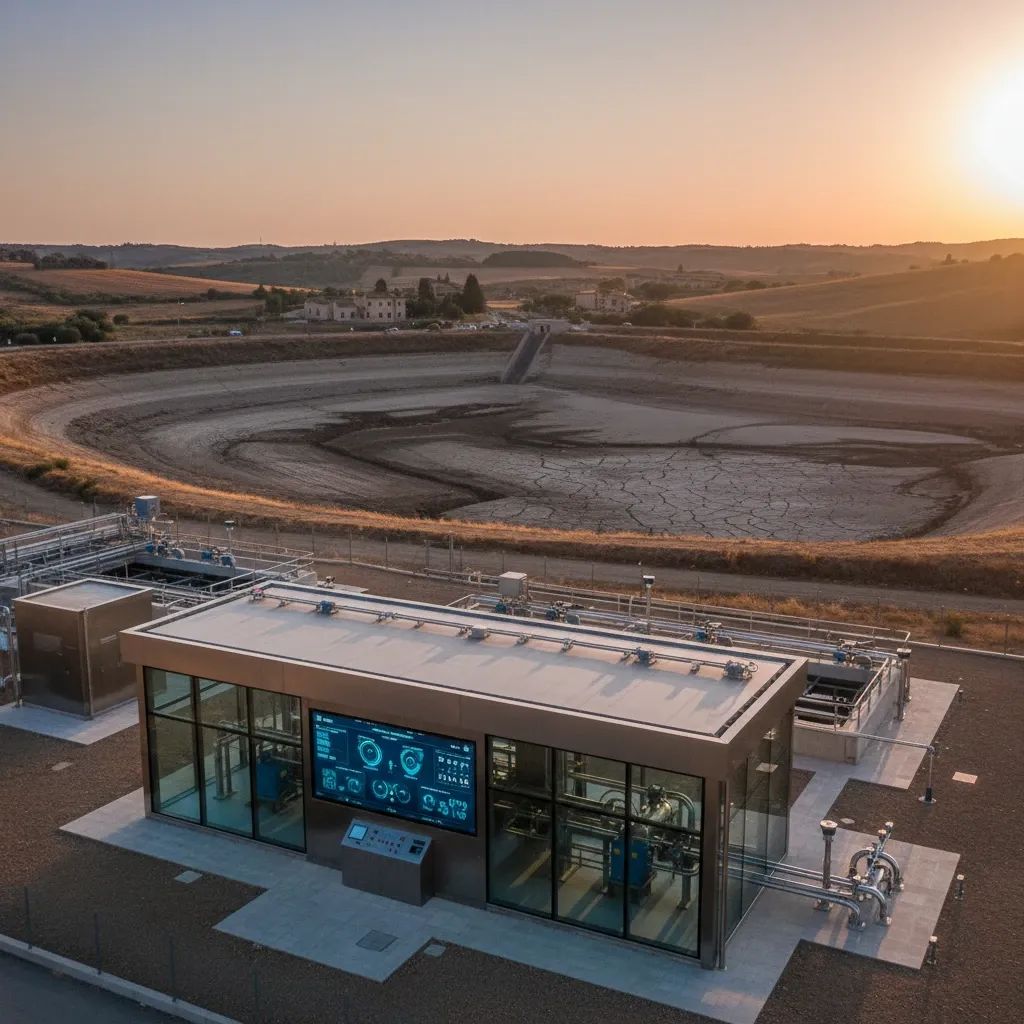
Italy's water infrastructure is entering a rare period of capital expansion. Investment per resident is climbing to €106 annually during the 2025–2026 fiscal cycle—the highest level in two decades. This surge, fueled largely by the National Recovery and Resilience Plan (PNRR), marks a 60% jump from the €66 baseline set in 2021.
Yet industry leaders and regulators warn the momentum will stall without sustained public financing beyond the PNRR deadline. Climate stress and stricter European water-quality rules demand a long-term funding commitment the current framework cannot deliver.
What This Means for Your Household:
• Near-term: Expect fewer water interruptions and cleaner tap water if projects stay on schedule, particularly in southern regions currently experiencing rationing.
• Bills rising: The average annual water bill reached €528 in 2025, up 5.4% year-on-year; continued tariff increases are likely as utilities invest in infrastructure upgrades.
• Geographic divide: Northern cities with industrial utilities offer stable service, while southern regions may still experience summer shutoffs despite improvement efforts.
• Long-term resilience: Without €2B/year in public subsidies, tariffs may spike sharply after 2026, or infrastructure maintenance will be deferred, affecting service reliability.
Why This Matters Beyond 2026:
• €106 per capita in 2025–2026, then a decline to €90/year through 2029—still 21% above pre-PNRR levels, but a steep drop.
• Utility executives demand €2B/year in public subsidies for the next decade to prevent infrastructure collapse.
• New EU directives mandate PFAS monitoring by December 2026 and quaternary wastewater treatment for mid-sized plants by 2045.
• Southern Italy faces 60% water-loss rates, chronic rationing, and delayed project rollouts despite receiving 40% of PNRR water funds.
The PNRR Push and What Comes After
The Italy Government allocated €4.3B through the PNRR for water infrastructure, later augmented by an additional €1B earmarked specifically for leak reduction. This injection—part of the broader €191.5B EU-backed recovery package—is concentrating on four pillars: constructing primary water supply systems (€2B for 25 mega-projects), digitizing distribution networks (€1.9B total, including the leak-reduction supplement), modernizing agricultural irrigation (€800M), and expanding sewage treatment and reuse capacity (€600M).
By March 2026, the Ministry for Infrastructure and Transport expects the completion of all 25 complex water-system projects, which prioritize the drought-prone Mezzogiorno (Southern Italy). Still, execution lags behind ambition. As of September 2025, only 30% of PNRR water funds had been spent, even though 53% of interventions were nominally in progress or undergoing final testing. A mere 2% carried official completion certificates, exposing bottlenecks at the regional and municipal level. Industrial operators and land-reclamation consortia have advanced faster, but local authorities—especially in the south—struggle with procurement delays and bureaucratic friction.
To bridge the gap between PNRR deadlines and long-term needs, the Italy Cabinet introduced the SFNIISSI (National Financial Instrument for Infrastructure Investment and Security in the Water Sector) via Decree-Law 19/2026. The instrument debuted with €1B in seed capital and will prioritize projects already catalogued in the PNIISSI (National Plan of Infrastructure Interventions and Security in the Water Sector). In October 2025, the first PNIISSI tranche earmarked €957M for 75 interventions spanning 2025–2029, with at least 40% reserved for the south. These funds target drought mitigation, reservoir construction, and network efficiency.
What This Means for Residents
For households, the immediate benefit is fewer interruptions and cleaner tap water—if projects stay on schedule. The ARERA (Italy Authority for Energy, Networks, and Environment) has documented steady quality gains in areas served by industrial-scale utilities, which now operate under harmonized tariff schemes and performance benchmarks. Residents in municipalities with modern, privately managed systems have seen pressure stabilization and faster leak repairs, thanks to IoT sensors and real-time monitoring rolled out under PNRR digitization grants.
Yet the experience diverges sharply by geography. In 2024, more than 1M residents in southern provincial capitals endured water rationing, with Sicilian cities accounting for 726,230 of that total. Agrigento endured 209 days of total shutoff and 157 days of reduced flow, while Vibo Valentia, Enna, Messina, and Palermo also faced prolonged outages. The culprit: loss rates exceeding 60% in Basilicata (65.5%) and Abruzzo (62.5%), compared to a 25% EU average. In Potenza, more than 70 cents of every liter pumped vanishes before reaching a tap.
Tariff increases compound the frustration. The average annual water bill rose to €528 in 2025, up 5.4% year-on-year, with a 5.3% hike in the south despite inferior service. Nearly 30% of Italian households nationally distrust tap water enough to buy bottled alternatives; in Sicily and Sardegna, that figure tops 50%. Meanwhile, delinquency rates remain elevated in the Mezzogiorno, straining utility cash flow and delaying reinvestment cycles.
North-South Divide in Management Models
Italy's water sector operates under a patchwork governance structure that ARERA has repeatedly flagged as inefficient. The split between industrial utilities and "in economia" local-authority management creates a performance chasm. Industrial operators—often multi-municipal joint ventures or private concessionaires—benefit from economies of scale, credit access, and technical expertise. They have absorbed the bulk of PNRR digitization funds, deploying 72,000 kilometers of smart conduits equipped with pressure sensors and leak-detection algorithms.
By contrast, many southern municipalities still run water services directly through small technical offices with limited capital budgets and no long-term investment plans. ARERA data shows these "in economia" entities frequently operate without approved tariff frameworks for years, leaving them unable to accumulate reserves for maintenance. The result: aging cast-iron pipes, manual meter reading, and emergency-driven repairs that lock in high loss rates.
The Permanent Observatory on Water Uses of the Southern Apennines, established in February 2026, labeled Puglia and parts of Calabria and Basilicata as zones of "High Water Severity". The observatory's mandate is continuous monitoring and coordinated emergency response, yet it cannot override fragmented decision-making at the municipal level. Until governance consolidates—perhaps through mandatory inter-municipal aggregation—the gap will widen.
Europe Raises the Bar on Quality
While Italy races to fix leaks, Brussels is rewriting the rulebook on what comes out of the tap and what goes into rivers. Three major directives will reshape compliance costs and operational standards over the next two decades.
Drinking Water Directive (EU 2020/2184), already in national law since January 2023, imposes PFAS monitoring by December 2026, with limits of 0.50 micrograms per liter for total PFAS and 0.10 µg/L for a subset of high-risk molecules. Regions like Veneto and Piemonte, where industrial contamination has been documented, face immediate testing burdens. By January 2027, all materials in contact with drinking water—pipes, fittings, tanks—must meet stricter leaching standards, and the lead threshold drops to 5 µg/L by 2036, necessitating widespread replacement of legacy distribution lines.
Urban Wastewater Treatment Directive (2024/3019), adopted in November 2024 and published in December, supersedes the 1991 framework as of August 2027. Member states have until roughly autumn 2027 to transpose it into domestic law. The directive mandates secondary treatment (biological oxygen removal) by 2035 for all settlements above 1,000 population-equivalents, tertiary treatment (nitrogen and phosphorus removal) by 2039 for plants serving ≥150,000 PE, and quaternary treatment (micropollutant removal) by 2045 for facilities ≥10,000 PE. Pharmaceutical and cosmetics producers will cover at least 80% of quaternary upgrade costs. Plants above 10,000 PE must also achieve energy neutrality by 2045, a target that will require co-generation, biogas capture, and solar arrays at treatment sites.
Surface and Groundwater Quality Directive (updating 2000/60/EC, 2006/118/EC, and 2008/105/CE) received final Council approval on March 17, 2026. Member states have until December 21, 2027 to transpose, until December 2030 to finalize monitoring programs, and until 2039 to achieve good chemical status for all water bodies. The revised standard adds PFAS, antibiotics, hormones, and bisphenol-A to the priority-substance watch list, with harmonized EU-wide thresholds for the first time.
Italian environmental groups have lobbied Rome to resist a mid-2026 Commission proposal that would streamline administrative procedures for certain industrial permits, fearing it could dilute enforcement and increase discharge risks.
The €2B Annual Gap
Utilitalia President Luca Dal Fabbro, presenting the 2026 Blue Book compiled by Fondazione Utilitatis in partnership with ENEA, the National Civil Protection Department, the Higher Institute of Health, and The European House–Ambrosetti, emphasized that PNRR momentum will fade unless matched by sustained public co-financing. His calculus: €2B per year for ten years—€20B total—to execute an extraordinary upgrade program that neither tariffs nor private capital can shoulder alone.
The rationale hinges on three forces. First, climate volatility: precipitation in southern and island regions fell 18% below the 1991–2020 climatological average, yet intense rainfall events—like those between late 2025 and early 2026—often trigger runoff and flooding rather than aquifer recharge, leaving reservoirs low. Second, global water stress: the UN has declared that humanity is withdrawing and polluting water faster than nature can replenish it, with 2B people lacking adequate access today and projections of 3.5B by 2050. Third, EU compliance costs: meeting the 2027–2045 directive milestones will require not just pipes and pumps but advanced oxidation reactors, nanofiltration membranes, digital twins, and satellite-linked IoT platforms—technologies that carry seven- and eight-figure price tags per treatment plant.
Utilitalia argues that spreading these costs across residential tariffs alone would push bills beyond political and social tolerance, especially in the south where incomes lag and service quality remains poor. The SFNIISSI and the October 2025 PNIISSI tranche represent steps in the right direction, but their combined €2B falls short of the €20B decade-long envelope Dal Fabbro deems necessary. A December 2025 PNRR revision clause allows €1.2B in unspent allocations to roll into a long-term water fund for post-2026 PNIISSI projects, yet that still leaves an annual shortfall of roughly €800M if the €2B/year benchmark holds.
Technology as Force Multiplier
Beyond concrete and steel, Italy is betting on smart water management to squeeze more service from every euro invested. PNRR digitization funds are enabling the deployment of IoT sensor networks across 72,000 kilometers of mains, feeding real-time pressure, flow, and quality data into cloud-based dashboards. Utilities can now pinpoint leaks within hours rather than days, dispatching repair crews before minor seeps become gushers.
Digital twin platforms—virtual replicas of physical networks—allow operators to simulate scenarios: What happens if a main breaks during peak demand? Which valves minimize pressure loss? Algorithms trained on historical failure data predict which pipe segments will fail next, enabling preemptive replacement. In agriculture, precision-irrigation systems like "Daiki" monitor plant water needs and weather forecasts, cutting field consumption by up to 50% through drip delivery instead of flood irrigation—a critical gain given that agriculture accounts for 70% of Italy's freshwater withdrawals.
Wastewater reuse is gaining traction under Regulation (EU) 2020/741, in force since June 2023, which sets harmonized safety standards for treated effluent applied to crops. Italy, a Mediterranean nation chronically short of summer rainfall, already practices agricultural reuse in select zones; the regulation provides a legal framework to scale the practice nationally. Combined with advanced oxidation and membrane filtration—technologies that can strip antibiotics, hormones, and microplastics from effluent—reuse offers a drought hedge that new reservoirs alone cannot match.
The Road to 2029 and Beyond
Barring a funding collapse, per-capita water investment will stabilize around €90 annually through 2029, a figure 21% above the 2021 baseline but roughly 15% below the 2025–2026 peak. This plateau reflects the natural wind-down of PNRR projects and the absence—so far—of a successor program at comparable scale. The SFNIISSI and PNIISSI tranches will fill part of the void, yet their cumulative firepower remains an order of magnitude smaller than the PNRR envelope.
For residents, the near-term outlook hinges on execution speed. If the 25 PNRR mega-projects complete on schedule by March 2026 and the 75 PNIISSI interventions launch without fresh delays, southern cities could see measurable relief by 2028—fewer rationing days, lower loss rates, and improved tap-water confidence. Industrial utilities in the north and center will continue incremental gains, driven by tariff-funded renewals and digital optimization.
The darker scenario involves a return to chronic underinvestment once PNRR deadlines pass and political attention shifts. Without the €2B annual public subsidy Utilitalia advocates, operators will face an impossible choice: raise tariffs sharply—risking payment strikes and regulatory pushback—or defer maintenance, letting loss rates creep back up and infrastructure age further. Meanwhile, the EU's 2027–2045 compliance calendar marches forward, indifferent to budget constraints.
Climate stress adds a wildcard. If the 18% precipitation deficit persists and extreme-weather frequency climbs, even a modernized network may struggle to deliver reliable service. Reservoir construction and aquifer-recharge schemes—long-lead projects requiring years of environmental review—must start now to bear fruit by the 2030s. The February 2026 launch of the Southern Apennines water observatory signals recognition of the threat, but monitoring alone cannot conjure rain or accelerate permitting.
Impact on Residents and Property Owners
For people choosing where in Italy to settle—whether Italian citizens, long-term foreign residents, or newcomers—water reliability is becoming a location factor on par with healthcare access and transport links. Northern cities with industrial utilities offer predictable service and transparent billing, while rural communes in the south may still experience summer shutoffs. Before signing a lease or purchasing property, checking the local utility's ARERA performance rating and recent rationing history is prudent due diligence.
Property owners and investors should note that EU-mandated pipe and fitting upgrades by 2027—and lead-threshold reductions by 2036—may trigger special assessments in older condominium buildings, particularly those with original 20th-century plumbing. Budgeting a contingency reserve for compliance retrofits is advisable, especially in historic urban cores where cast-iron and lead solder remain common.
Agricultural businesses and food-processing ventures stand to benefit from the €800M irrigation modernization stream and the regulatory green light for treated-wastewater reuse. Sectors with high water intensity—dairy, horticulture, beverage production—should explore PNRR and PNIISSI co-financing windows for efficiency projects. The 2045 energy-neutrality mandate for large wastewater plants may also create opportunities in biogas co-generation and on-site renewable installation.
Regulatory and Governance Outlook
ARERA's push for consolidated, industrial-scale management will likely intensify. The regulator has floated the idea of mandatory inter-municipal aggregation for service areas below a minimum population or revenue threshold, a move that would force dozens of "in economia" operators to merge or contract out to private concessionaires. Resistance from local politicians—who view water utilities as patronage levers—remains fierce, but the combination of EU compliance costs and PNRR performance conditions may tip the balance toward centralization.
Tariff methodology is also evolving. ARERA's latest framework links allowed revenue growth to measurable service improvements—leak reduction, treatment-plant uptime, customer-complaint resolution—creating financial incentives for operators to invest in quality rather than simply pass costs through. This "performance-based regulation" model, borrowed from UK and French precedents, should narrow the north-south quality gap over time, provided enforcement holds firm.
On the legislative front, watch for the mid-2026 Commission proposal to revise the Water Framework Directive's administrative burden. If adopted, it could ease permitting for certain industrial discharges, a concession environmental groups argue would undermine decades of progress on river and lake quality. Italy's negotiating stance in Brussels will shape whether the country tightens or loosens its grip on pollution sources.
The Climate-Water Nexus
The UN's declaration of global water stress underscores that Italy's challenges mirror a worldwide pattern: demand and contamination outpacing natural replenishment. Globally, 2B people lack adequate water access, a figure the UN projects will hit 3.5B by mid-century absent radical policy shifts. Italy, with its Mediterranean exposure, aging infrastructure, and high agricultural demand, sits on the front line.
Addressing the nexus requires more than engineering. It demands integrated land-use planning that protects recharge zones, agricultural reform shifting from flood to precision irrigation, industrial water-efficiency mandates, and consumer behavior change to reduce per-capita footprints. The €4.3B PNRR envelope and the proposed €2B/year post-PNRR subsidy are necessary but not sufficient. They buy time to build resilience, but only if accompanied by governance consolidation, tariff discipline, and a societal consensus that water scarcity is not a temporary inconvenience but a permanent condition requiring permanent adaptation.


