
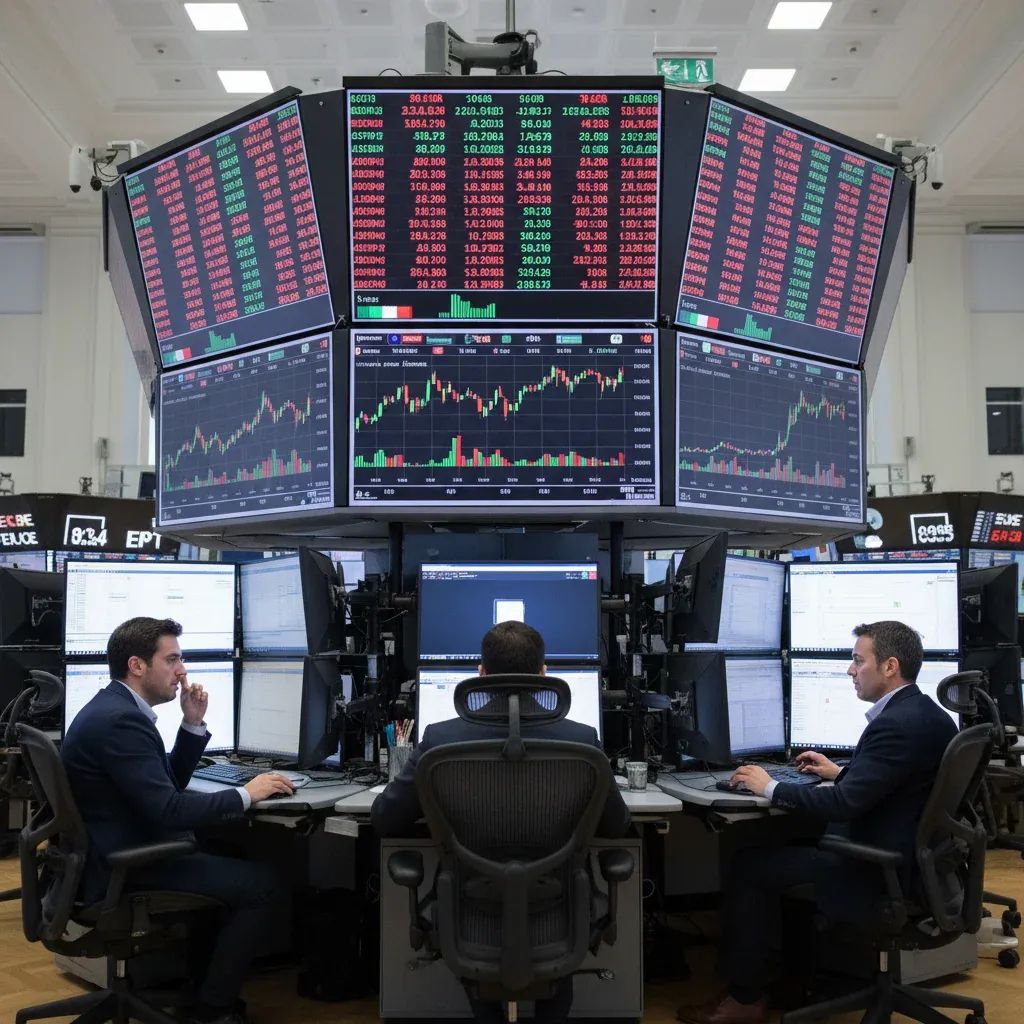
Italy's main stock index slid 1.3% by the close of trading today as European markets absorbed the dual shock of an escalating Iran conflict and surging energy costs, with Italian banking shares bearing the brunt of a sector-wide selloff that saw Madrid and Milan emerge as the session's worst performers.
Why This Matters:
• Energy costs spike: Oil jumped 7% and natural gas climbed 3.5% as Iran's partial closure of the Strait of Hormuz disrupts global petroleum flows.
• Banking sector hit: Monte dei Paschi di Siena fell 3.5%, Mediobanca dropped 3.3%, and Unicredit shed nearly 3% amid broader risk aversion—despite their underlying merger and strategic positioning remaining strong.
• Defense gains ground: Leonardo S.p.A. surged 6% after unveiling strong 2025 earnings and a 21% dividend increase to €0.63 per share.
• Markets on standby: Investors await clarity on Middle East hostilities, with Brent crude hovering near $92 per barrel after earlier peaks this month.
Banking Declines Reflect Market Jitters, Not Crisis
Today's sharp losses across Italy's banking sector are a symptom of geopolitical risk aversion rather than any structural crisis within Italian lenders. Monte dei Paschi di Siena and Mediobanca are progressing toward a landmark merger, a deal designed to generate industrial and financial synergies and create a fully integrated banking group. The announcement drove both stocks higher in early March, though today's session saw profit-taking and caution prevail.
Unicredit, which had climbed substantially from January 2021 through early 2026, also dipped nearly 3% today—less a reflection of internal weakness than of broader market nervousness. The bank remains strategically active, with reports noting its interest in acquiring a stake in MPS to forge Italy's largest banking group. Analysts forecast stable and robust profitability for Italian lenders in 2026, underpinned by credit growth and ongoing sector consolidation.
In short, today's sell-off is a risk-off trade, not a vote of no confidence. Italy's banking sector remains on solid footing, with transformation and consolidation as its central themes.
Leonardo Leads on Strong Earnings and Dividend Upgrade
Amid the gloom, Leonardo S.p.A. stood out as the session's star performer, climbing 6% after the Italy-based defense and aerospace giant reported strong fiscal 2025 results that exceeded expectations. The company posted robust profitability gains year-on-year, while adjusted performance also rose significantly. Revenues expanded, with double-digit growth across major business lines.
New orders surged, driven in part by substantial international contracts. The company's net debt improved significantly, aided by strategic asset transactions. Leonardo's board proposed a dividend of €0.63 per share for fiscal 2025—a 21% increase over the prior year. Payment is scheduled for June 24, 2026, with the ex-dividend date set for June 22. CEO Roberto Cingolani described the results as marking a significant value-creation milestone, and the company has outlined ambitious targets for its 2026–2030 industrial plan, including further dividend growth.
For Italy-based investors and defense-sector watchers, Leonardo's performance underscores the durability of European defense demand amid heightened geopolitical tensions—and offers a tangible contrast to the day's broader market malaise.
Hormuz Standoff Drives Energy Prices—and Market Anxiety
The Iran-U.S.-Israel conflict, which escalated in late February 2026, has impacted global energy supply. Iran's partial closure of the Strait of Hormuz—the chokepoint for a significant portion of global oil and liquefied natural gas—has sent energy prices climbing sharply. Brent crude has traded as high as $120 per barrel this month before settling near $92 today. West Texas Intermediate (WTI) has tracked a similar trajectory.
Production from major regional producers has fallen, and the International Energy Agency (IEA) estimates a substantial global output reduction this month. On March 11, IEA member states agreed to release crude oil from strategic reserves to cushion the impact.
European natural gas futures spiked sharply in early March, climbing to levels not seen in recent months. The timing is particularly challenging for Italy and the rest of Europe, which faces heightened vulnerability to supply disruptions. The loss of significant global LNG supply through Hormuz has left the continent acutely exposed, underscoring the urgency of accelerating domestic clean-energy development.
For Italian households and businesses, this translates to higher heating bills, elevated industrial input costs, and renewed pressure on inflation—just as the economy was gaining traction.
What This Means for Residents
Energy bills and inflation: Expect continued upward pressure on electricity and gas tariffs as long as Hormuz remains partially closed. Industrial sectors reliant on stable energy inputs—manufacturing, logistics, chemicals—face margin compression and potential cost pass-throughs to consumers.
Banking stability: Despite today's declines, Italy's banking sector is not in crisis. The MPS-Mediobanca merger and Unicredit's strategic positioning reflect ongoing consolidation and strength. If you hold Italian bank stocks, treat today's moves as volatility rather than a fundamental shift.
Investment opportunities: Leonardo's dividend hike and strong order book may appeal to income-focused investors seeking exposure to European defense. The stock's 6% gain today signals market confidence in the sector's long-term trajectory.
Geopolitical watch: Markets remain in standby mode, awaiting signals on the duration and scope of the Iran conflict. Any de-escalation could trigger a swift reversal in energy prices and a rebound in risk assets; conversely, further escalation could deepen losses and prolong uncertainty.
Broader Market Snapshot
Beyond Italy, European indices closed mixed to lower. The Euro Stoxx 50 shed 0.5% to finish near 5,766 points, extending losses from the prior session. Germany's DAX 40 managed to recover from an early dip and closed nearly flat at 23,630, making Frankfurt the session's relative outperformer. France's CAC 40 dipped 0.12% to 8,032, while London's FTSE 100 fell 0.4% to 10,312.
Italian sovereign debt remained calm, with the BTP-Bund spread holding steady around 75 basis points. The euro edged down 0.2% to $1.153, while Bitcoin ticked up slightly to $70,000. Gold traded flat just under $5,200 per ounce, as haven demand was balanced by profit-taking.
Inwit, Italy's largest wireless-tower operator, was the session's worst performer among blue chips, sliding 4.3% on no specific news—likely a casualty of the day's broader risk-off tone.
Looking Ahead
The immediate question is how long the Strait of Hormuz disruption persists. Iran's leadership has vowed to maintain its stance and threatened regional escalation. OPEC+ decisions on output adjustments have done little so far to offset the supply shock.
For Italy-based investors, the key variables to watch are energy price trajectories, any breakthroughs in Middle East diplomacy, and the resilience of domestic consumption in the face of higher input costs. The banking sector's consolidation story remains intact, and Leonardo's trajectory suggests that defense and aerospace will continue to benefit from elevated geopolitical risk.
In the meantime, prepare for volatility to remain elevated and for energy costs to weigh on both household budgets and corporate margins until the geopolitical fog lifts.


