
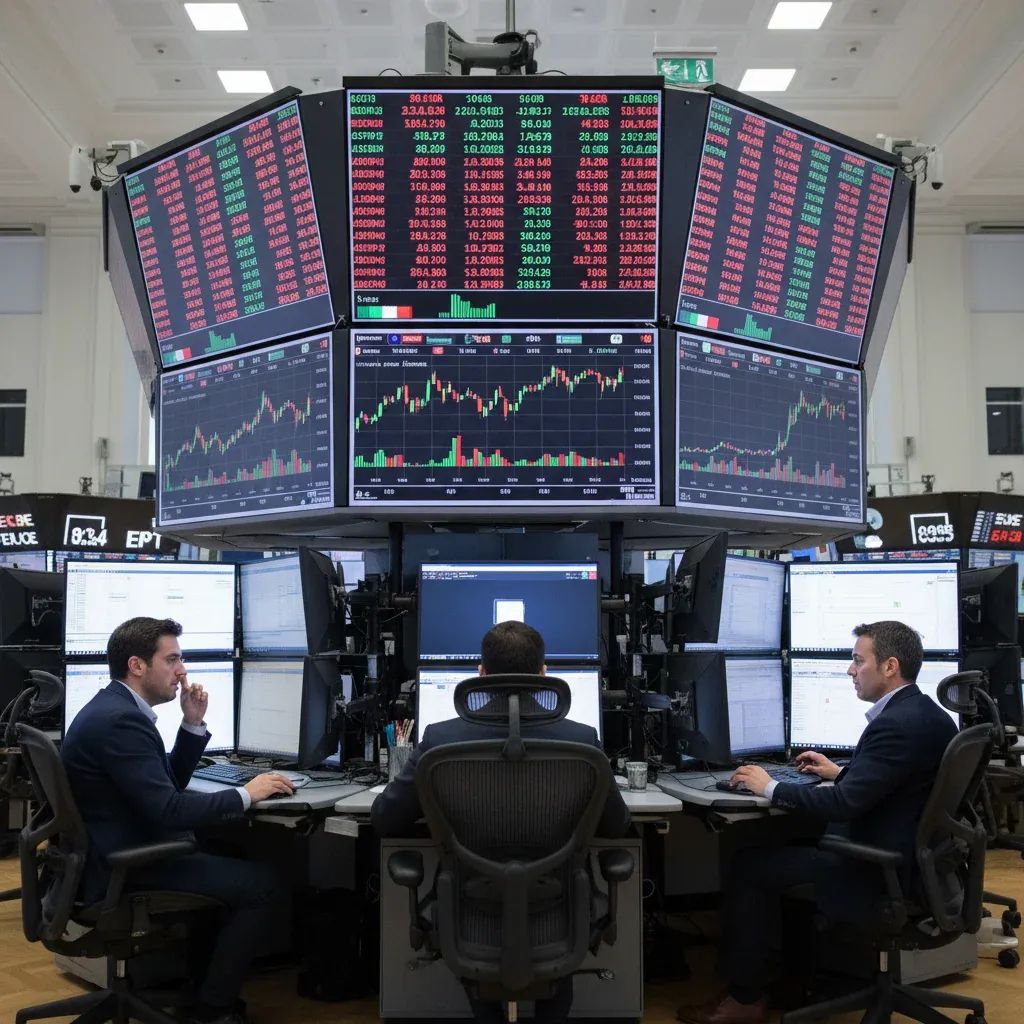
Italy's Borsa Italiana closed at a +0.76% gain, outpacing rival European markets and defying the broader anxiety gripping global investors as peace negotiations between the United States and Iran collapsed for a second time. The FTSE MIB ended the session at 49,664 points, with energy and infrastructure stocks lifting the index even as luxury and defense names tumbled.
Why This Matters
• Energy exposure pays off: Italian energy giants Eni (+3%) and Enel (+2.68%) gained on surging crude prices, directly benefiting portfolios and pension funds with Italian equity exposure.
• Oil at multi-year highs: Brent crude climbed 2.6% to $103.98 per barrel, while WTI rose 2.7% to $97.99, pushing inflation fears and potentially raising living costs across Italy.
• Stalled diplomacy: U.S. President Donald Trump rejected Iran's latest peace proposal on May 10, calling it "totally unacceptable," prolonging the Strait of Hormuz closure that has strangled global oil shipments since late February.
European Markets Show Divergent Reactions to Iran Stalemate
European equity indexes closed in scattered formation, reflecting investor confusion over how to price an escalating but still-contained Middle East crisis. The Stoxx Europe 600 managed a fractional +0.1% advance, while London's FTSE 100 edged up +0.36%, buoyed by BP and Shell gains tied to elevated crude. Frankfurt's DAX nearly flatlined at +0.05%, but Paris's CAC 40 shed 0.69% and Madrid's IBEX 35 dipped 0.17%, weighed down by luxury and automotive sell-offs.
Analysts attribute the muted European response to a combination of war fatigue and hedging strategies. Despite the Strait of Hormuz remaining effectively blockaded, investors are banking on diplomatic breakthroughs or emergency supply releases to prevent a full-blown energy crisis. The blockade has significantly disrupted global oil flows, reflecting the geopolitical tensions between the U.S. and Iran.
Milan's Outperformance Driven by Energy and Diagnostics
Italy's equity benchmark emerged as Europe's top performer, propelled by a narrow cohort of winners. Diasorin, the Italian diagnostics company, surged +5.5% following stronger-than-expected first-quarter earnings and upbeat guidance for the full year, making it the session's star performer. Cable maker Prysmian climbed +3.19%, while oil services firm Saipem added +3.04%, both riding the wave of higher energy capital expenditure expectations.
Telecommunications and utilities also delivered solid gains. Telecom Italia (TIM) rose +1.26%, and Poste Italiane advanced +2.02%, supported by defensive rotations as bond yields ticked higher. The 10-year Italian BTP yield firmed to 3.76%, with the spread over the German Bund holding steady at 73 basis points—a level that signals stable, if elevated, borrowing costs for Rome.
Luxury and Defense Stocks Bear the Brunt
Luxury goods manufacturers faced sharp declines, reflecting concerns that sustained inflation and geopolitical uncertainty will erode consumer discretionary spending. Moncler fell 4.9%, Brunello Cucinelli lost 3.3%, and Ferrari declined 2.9%. The weakness extended across the continent, with the luxury sector down 2.9% on the Stoxx 600.
Defense contractors, paradoxically, also suffered. Leonardo dropped 4.3%, Fincantieri shed 2.8%, and Avio plunged 5.69%, claiming the session's worst performance. The sell-off appears counterintuitive given the ongoing military confrontation, but analysts point to profit-taking after a multi-week rally and fears that budget constraints in European capitals could limit future orders.
What This Means for Residents
For Italians with equity exposure—whether through direct holdings, mutual funds, or workplace pension plans—today's session underscores the portfolio benefits of energy diversification. Eni and Enel together represent a significant weight in the FTSE MIB, and their outperformance has cushioned the blow from weakness elsewhere. However, the flip side is clear: higher oil prices translate directly into costlier gasoline, heating, and electricity for households.
Italy's economy remains acutely sensitive to energy shocks. Sustained elevated oil prices could add pressure to inflation and growth, challenging households and businesses alike. For Italians holding government bonds, the relative stability of the BTP-Bund spread at 73 basis points suggests that markets still view Rome's fiscal position as manageable. That said, persistent inflation and geopolitical risks could test this stability if economic conditions deteriorate.
Oil Rally Intensifies Amid Hormuz Blockade
Crude oil markets rallied sharply as diplomatic efforts collapsed. Brent crude, the global benchmark, jumped 2.6% to $103.98, while U.S. West Texas Intermediate (WTI) climbed 2.7% to $97.99. Both benchmarks have more than doubled from pre-war levels, reflecting the supply disruptions caused by the Strait of Hormuz closure.
The ongoing tensions have removed significant oil supply from global markets, pressuring energy prices higher and creating uncertainty for importers like Italy that depend heavily on affordable energy. Iran has sought negotiations with the United States, but diplomatic efforts have stalled after Washington rejected the latest proposal as "totally unacceptable," according to President Trump.
Natural gas prices also spiked, with Dutch TTF futures rising 3% to €45.49 per megawatt-hour, adding pressure on European utilities and industrial consumers. Gold, a traditional haven asset, edged up 0.4% to $4,735.41 per ounce, reflecting lingering risk aversion.
Currency and Bond Markets Hold Steady
The euro traded nearly flat at $1.1781, showing resilience despite the geopolitical turbulence. Bitcoin gained 0.4% to $81,020, continuing its recent recovery. German 10-year Bund yields rose 2 basis points to 3.03%, tracking broader expectations for monetary policy adjustments, while Italian BTP yields climbed in parallel, keeping the spread stable.
Wall Street Opens Lower, Tracking Oil Surge
U.S. equity markets opened cautiously lower, with the Dow Jones Industrial Average down 0.10% to 49,560.77, the Nasdaq Composite off 0.18% at 26,199.01, and the S&P 500 slipping 0.05% to 7,395.34. The muted declines followed the S&P 500's sixth consecutive weekly gain, suggesting that investors are balancing growth momentum against geopolitical headwinds.
The immediate question for U.S. markets is whether policymakers will tolerate higher inflation driven by energy costs or prioritize growth support, reflecting the broader challenge of navigating stagflation risks in the current environment.
Looking Ahead: Energy Costs and Economic Uncertainty
The ongoing Strait of Hormuz blockade creates significant uncertainty for energy-dependent economies like Italy. Extended disruptions to global oil flows could sustain elevated energy prices, potentially pressuring inflation and economic growth. Italy, with its heavy reliance on imported energy and constrained fiscal position, faces particular exposure to prolonged energy market tensions.
Market participants are closely monitoring diplomatic developments and any potential reopening of the critical shipping route. For now, Italy's equity market is holding up, but the road ahead remains uncertain—and expensive.


