
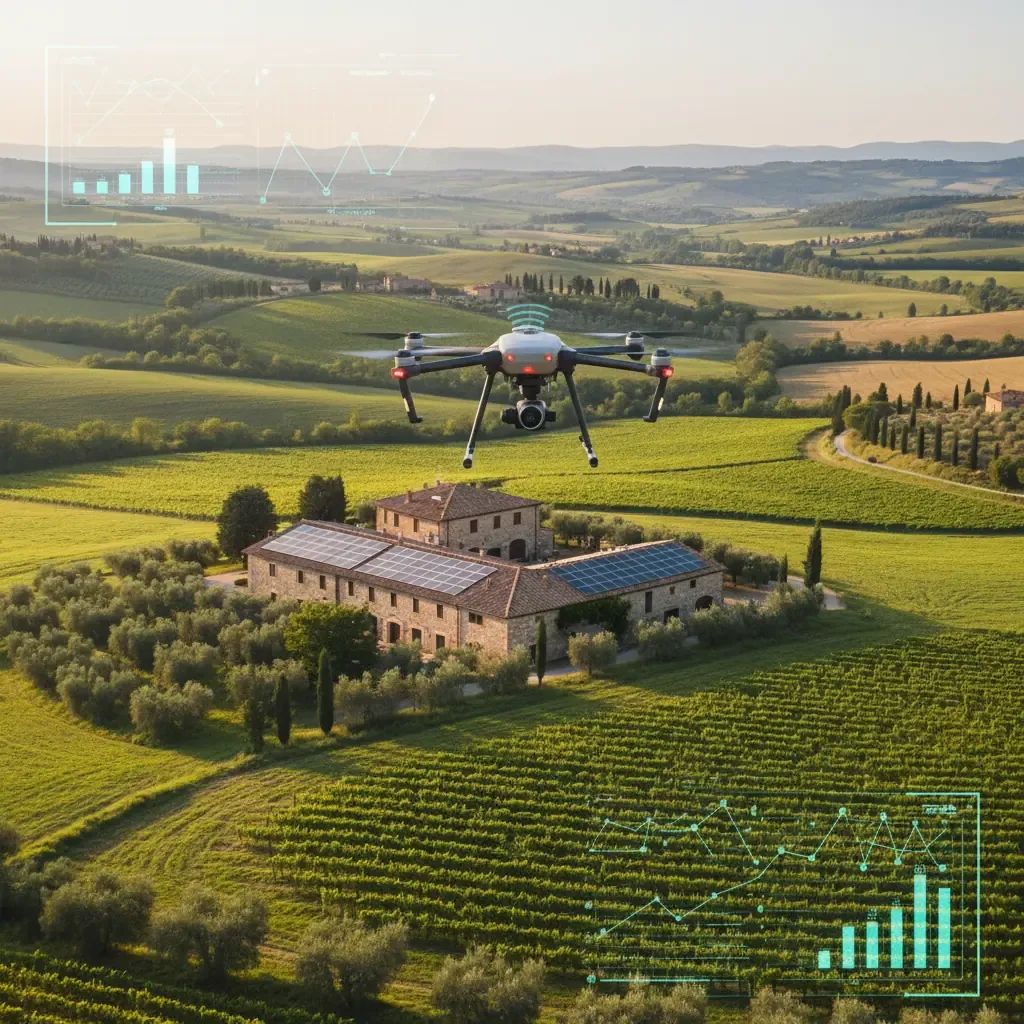
Italy's agricultural sector has reversed a temporary downturn, with the domestic smart farming market hitting €2.5 billion in 2025 — a 9% year-on-year gain that erases the previous year's 8% contraction and restores the industry to its 2023 peak. For farm operators, food processors, and rural investors across the country, this signals a fundamental shift: digital tools are no longer experimental; they are becoming essential infrastructure for staying competitive in an era of climate volatility and shrinking margins.
Why This Matters
• Investment momentum: Software-driven farm management platforms surged 17%, while decision-support systems climbed 26%, outpacing traditional machinery purchases.
• Adoption threshold: 42% of Italian farms now deploy at least one smart technology, yet only 9% qualify as digitally mature, exposing a persistent skills and integration gap.
• New tax break: A 40% tax credit on eligible smart-agriculture equipment purchases applies to transactions between January 1 and December 31, 2026, capped at €1 million per farm.
• AI uptake: While still nascent — 8% of growers and 18% of processors report active use — artificial-intelligence projects in agriculture more than doubled globally in 2025, and Italy is tracking the trend.
Software and Data Drive the Recovery
The Polytechnic University of Milan and University of Brescia Smart AgriFood Observatory — which released its annual findings at a Milan conference this week — attributes the rebound to a pivot from hardware to intelligence. Farm Management Information Systems and Decision Support Systems together accounted for the lion's share of growth, reflecting a market maturing beyond GPS-guided tractors toward predictive analytics and real-time field monitoring. Connected machinery sales rose a modest 2%, and telemetry-plus-control solutions advanced 3%, signaling that growers are now prioritizing the software layer that turns sensor data into actionable insights.
Behind the numbers lies a pragmatic calculus: 70% of adopters rely on big-data analytics, 50% on general software platforms, and 48% on Internet-of-Things devices to fine-tune irrigation schedules, fertilizer applications, and pest-management protocols. These data-driven workflows can cut input costs by as much as 30% and lift yields by up to 35%, according to field trials conducted across 30 pilot farms in 20 European countries.
"The market confirms positive signals, with a recovery in investments and an almost-zero abandonment rate among companies that have already adopted 4.0 solutions, demonstrating the concrete value generated by digitalization," noted Andrea Bacchetti, director of the Smart AgriFood Observatory, underscoring that early adopters rarely revert to analog methods once they experience the operational gains.
What This Means for Residents
For anyone operating a farm, supplying agricultural inputs, or investing in rural land, three practical takeaways emerge:
Tax incentive window: The 2026 Budget Law introduces a 40% tax credit for purchases of new, materially tangible or intangible assets that meet Agriculture 4.0 specifications. Orders placed by December 31, 2026 — or by June 30, 2027 with a 20% down payment logged by year-end 2026 — qualify, up to a €1 million cap per business. The national allocation is tight (€1.4 million to €2.1 million over 2026–2028), so technical-compliance certification and fund availability must be confirmed early.
Digital-maturity ladder: Crossing the threshold from "at least one smart tool" to "digitally mature" requires addressing three friction points: skills shortages, interoperability among disparate platforms, and systematic data valorization. Farmer cooperatives, consortia, and processor-led consortiums are increasingly stepping in to provide training, shared licenses, and aggregated data pools that smaller operations cannot afford solo.
Climate-driven decisions: Extreme-weather frequency is reordering investment priorities. Growers report that predictive models — which integrate satellite imagery, soil sensors, and weather forecasts — now influence planting calendars, varietal selection, and crop-insurance purchasing as much as traditional agronomic advice. The shift is visible in spending patterns: risk-mitigation tools, from hail alerts to disease early-warning dashboards, are among the fastest-growing software categories.
A Patchy Landscape: High Adoption, Low Maturity
While 42% of Italy's farms use at least one smart solution, and 10% of cultivated acreage is managed with digital tools (up from 9.5% in 2024), the Observatory's data reveal a bifurcated reality. Only 9% of agricultural enterprises have reached full digital maturity — defined as integrated data workflows, trained staff, and closed-loop decision-making. At the other end, 57% of farms remain laggards, with 90% of that cohort yet to deploy any connected technology whatsoever.
This disparity maps closely to farm size, crop type, and regional infrastructure. Broadband and ultra-broadband coverage in rural Italy continues to lag, constraining real-time data transmission and cloud-platform access. The National Recovery and Resilience Plan has earmarked funds for fiber rollout, yet many hill and mountain districts still operate on legacy copper lines, effectively sidelining precision-irrigation controllers and drone-based scouting services that depend on constant connectivity.
Producer organizations and agricultural cooperatives are emerging as critical intermediaries. By pooling capital, negotiating volume discounts, and offering collective training, these entities lower the entry barrier for small and medium-sized holdings. Field evidence suggests that farms joining cooperatives are three times more likely to achieve digital maturity within two years than those operating independently.
Artificial Intelligence Moves from Lab to Field
Globally, the number of agricultural AI projects more than doubled in 2025, spanning crop monitoring, automated irrigation, integrated pest management, operational efficiency, and quality-control traceability. In Italy, adoption remains niche but is accelerating: 8% of farmers and 18% of food-processing firms have deployed AI-powered tools, chiefly for image recognition in quality grading, predictive yield modeling, and autonomous weed control.
The economic case is compelling. Farms that integrated AI-driven decision systems report resource savings approaching 30%, yield improvements of up to 35%, and measurably lower environmental footprints. One advanced application — agrivoltaics, which pairs crop production with solar-panel arrays — generates an estimated €90,000 to €110,000 gross energy revenue per hectare annually, opening a secondary income stream while shading crops from heat stress and extreme weather.
From a sustainability standpoint, AI-enabled precision enables sharper targeting of pesticides and fertilizers, cutting nitrate leaching by up to 50% and nitrogen emissions by 28% in organic systems. Biodiversity monitoring modules, increasingly bundled with agrivoltaic installations, track pollinator populations and soil microbiomes, feeding data back into adaptive management protocols.
Barriers and Breakthroughs
Despite momentum, structural obstacles persist. High upfront costs deter smaller operators, especially those without access to patient capital or cooperative financing. Skills gaps remain acute: agronomists trained in soil science may lack the data-literacy needed to interpret machine-learning outputs, while IT specialists rarely possess the agronomic context to translate algorithmic recommendations into field practice.
Interoperability is another friction point. A typical medium-sized farm might use a tractor telematics system from one vendor, a soil-sensor network from another, and a third-party weather service — none of which communicate natively. Data silos proliferate, undermining the integrated view that precision agriculture promises. Industry consortia and the Italian Ministry of Agriculture are promoting open-data standards, but adoption remains voluntary and uneven.
Incentive complexity also clouds the picture. While the new 40% tax credit is generous on paper, the allocation is capped and subject to technical verification. Many farmers report confusion over which assets qualify, what documentation is required, and how to sequence purchases to maximize the benefit. Agricultural extension services and professional advisors are scrambling to decode the fine print before the year-end deadline.
Comparative Context: Italy in the European Frame
Italy ranks fifth among EU member states for smart-agrifood research and innovation funding, trailing heavyweights such as Germany, which commanded 37.8% of European precision-agriculture revenue in 2025. The broader European market for precision agriculture is projected to reach $2.62 billion in 2026 and climb to $4.75 billion by 2031, compounding at 12.64% annually. Guidance systems — autopilot tractors and implement steering — still dominate, holding 43.5% of the market, but drones and unmanned aerial vehicles are growing fastest, at 11.1% CAGR through 2031.
In value-added terms, however, Italy leads the EU, generating €42.4 billion in agricultural value added in 2024, ahead of Spain, France, and Germany. This productivity advantage reflects both favorable climate and high-value crops — wine grapes, olives, specialty vegetables — that benefit disproportionately from precision inputs and quality traceability. The challenge is to translate that output leadership into digital leadership, closing the maturity gap before competitors narrow Italy's margin.
Looking Ahead: Regulatory Catalysts and Market Dynamics
Two regulatory changes will shape adoption through 2027. First, the digital field register becomes mandatory for all farms starting in 2027, requiring electronic logging of inputs, treatments, and harvest data. This compliance obligation will force laggards onto at least basic software platforms, potentially accelerating the transition for the bottom 57%.
Second, the EU Common Agricultural Policy is progressively tying subsidy eligibility to environmental performance indicators — nutrient runoff, carbon sequestration, biodiversity metrics — most of which are impractical to measure without sensor networks and data platforms. Farms that remain analog risk losing access to direct payments, a powerful financial incentive to digitize.
On the supply side, venture capital and corporate investment in Italian agtech startups reached record levels in 2025, with funds targeting AI-driven phenotyping, blockchain traceability, and circular-economy platforms that convert agricultural waste into bioenergy. The circular bioeconomy — exemplified by anaerobic digesters producing biomethane from crop residues — is gaining traction, supported by national guarantees and feed-in tariffs that make the economics work for cooperatives and large estates.
Over 70% of Italian farms indicate they will invest in sustainability-focused practices by the end of 2025 to bolster environmental resilience, while 60% plan to adopt innovative technologies specifically to safeguard product quality. These intentions, if realized, will propel the €2.5 billion market beyond €3 billion within two years, cementing digital agriculture as a permanent feature of the Italian rural landscape.
Practical Steps for Farm Operators
For producers weighing whether and how to invest, industry advisors recommend a staged approach:
• Start with a single, high-ROI use case — precision irrigation in water-stressed zones, variable-rate fertilization on sloped vineyards, or automated quality sorting in packhouses — to build internal confidence and demonstrate value to stakeholders.
• Leverage cooperative structures to share costs, pool data, and access group training. Economies of scale make expensive platforms affordable when distributed across dozens of members.
• Secure technical-compliance certification early for any asset purchase intended to claim the 40% tax credit. The national fund is capped, and approval is granted on a rolling basis; late applicants may find the allocation exhausted.
• Prioritize interoperability when selecting platforms. Favor vendors that support open APIs, standardized data formats, and third-party integrations to avoid lock-in and future migration costs.
• Invest in human capital alongside hardware. Sending a farm manager or agronomist to a week-long data-analytics course often yields higher returns than buying an extra sensor node.
The recovery of Italy's smart-agriculture market to €2.5 billion underscores a sector that, despite fragmentation and infrastructure gaps, recognizes digitalization as the pathway to profitability and resilience. With supportive tax policy, mandatory compliance deadlines, and climate pressures converging, the window for laggards to catch up is narrowing — but for those who act, the rewards in efficiency, sustainability, and market positioning are measurable and immediate.


