
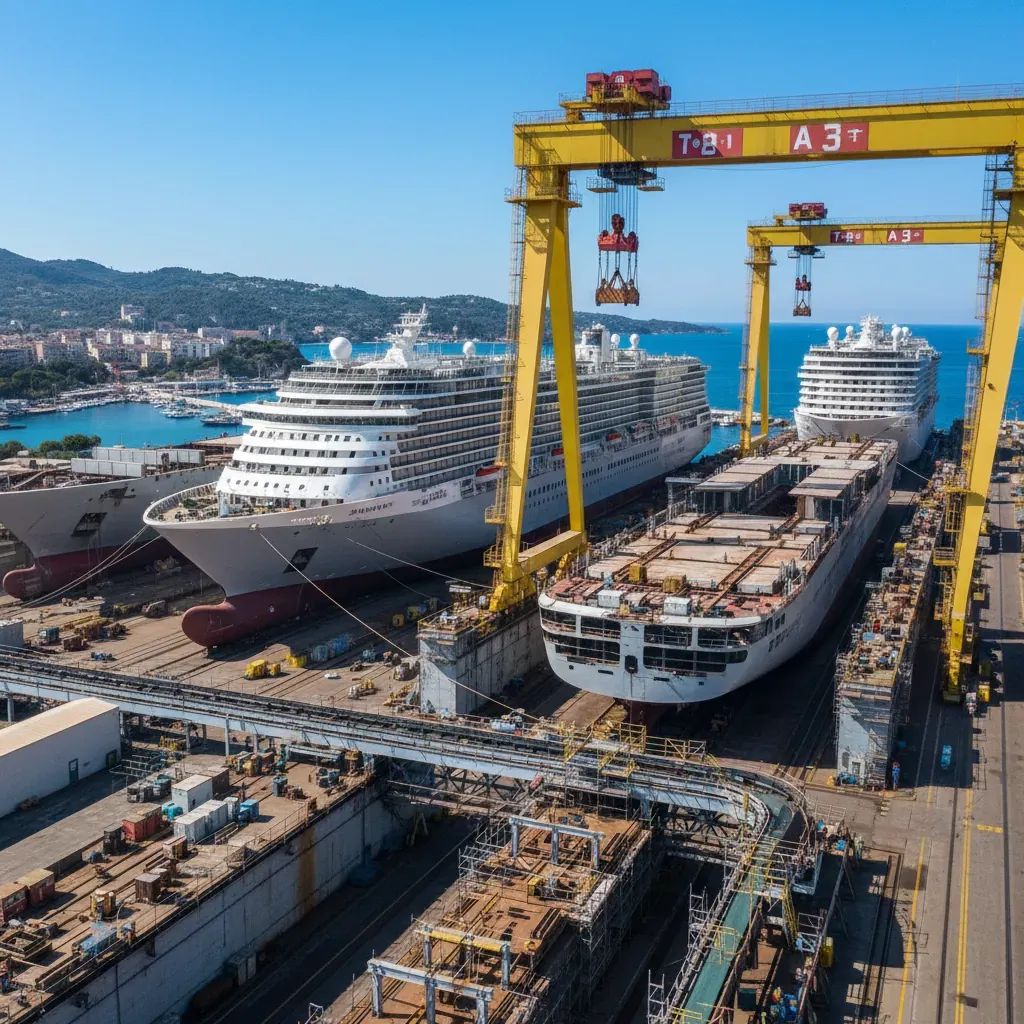
The European Commission has unveiled a comprehensive industrial strategy aimed at preserving Europe's maritime dominance in the face of mounting pressure from Asian competitors, a move that will reshape shipbuilding, port operations, and offshore energy infrastructure across the continent—including Italy's strategically important maritime hubs.
Why This Matters:
• New funding streams: The "Shipyards of the Future" initiative under Horizon Europe will finance cutting-edge technologies like 3D printing, robotics, and underwater drones at Italian and other European shipyards.
• Job creation potential: Focus on high-tech vessel construction—particularly offshore wind support ships and advanced port equipment—targets sectors where Italy has competitive advantages.
• Competitive pressures: China's COSCO Shipping and other Asian giants now control over 20% of global container capacity, forcing Europe to specialize or lose market share.
• Green transition costs: Italy's maritime sector faces mandatory compliance with the EU ETS Maritime system and FuelEU Maritime regulations, requiring substantial investment in alternative fuels.
European Maritime Sector Under Siege
The strategy arrives as Europe's share of the global shipping fleet continues to erode. Mediterranean Shipping Company (MSC), headquartered in Geneva but operating extensively from Italian ports, remains the world's largest container carrier with over 800 vessels and a projected capacity of 7.1M TEU by year-end. Yet the broader European maritime industry faces fierce competition from state-backed Asian shipbuilders and operators who benefit from lower labor costs, streamlined regulations, and aggressive government subsidies.
China has emerged as the dominant force through massive investments in new vessel construction and strategic acquisitions of European port facilities—raising both economic and security concerns in Brussels. Singapore, Dubai, Hong Kong, and Shanghai continue to lure maritime businesses with favorable tax regimes and minimal bureaucracy, advantages that traditional European hubs like Genoa, Rotterdam, and Hamburg struggle to match.
The European Commission's dual strategy—covering both industrial maritime policy and port development—represents a coordinated attempt to counter these structural disadvantages through technological differentiation rather than competing on price alone.
What This Means for Italian Ports and Shipyards
Italy, with its extensive Mediterranean coastline and historic shipbuilding tradition, stands to benefit significantly if the strategy's implementation matches its ambition. The initiative specifically targets ports in Croatia, Greece, Malta, Cyprus, Spain, and Italy for infrastructure upgrades focused on shore-side electrification, green operational protocols, and ammonia bunkering facilities.
Italian shipyards such as Fincantieri—which has committed to net-zero operations by 2035—are already positioning themselves for the high-tech segments emphasized by the new strategy. The company plans to deliver its first highly efficient LNG-powered vessel by 2025 and a zero-emission harbor ship equipped with dual-fuel engines, fuel cells, and batteries by 2030.
The Liguria region, home to Genoa's shipbuilding cluster, has been designated as a lead participant in the Alliance for Alternative Fuel Propulsion Systems in Shipbuilding, alongside regions in Portugal, Greece, Bulgaria, Spain, and Ukraine. This partnership will accelerate development of methanol and green ammonia propulsion systems, technologies where Italian engineering firms have existing expertise.
Smaller Italian ports in the Adriatic—including Dubrovnik (which is receiving funding for new moorings) and facilities along the Adriatic corridor—will gain improved connectivity infrastructure through the Connecting Europe Facility (CEF) program, enhancing their role in European supply chains.
Technology Push: Beyond Conventional Shipbuilding
The centerpiece of the industrial strategy is the European Alliance for Maritime Industrial Value Chains, designed to integrate shipowners, shipyards, and equipment manufacturers into coordinated innovation networks. Rather than competing solely with Asian mass production, Europe is betting on specialization in high-margin, technology-intensive segments.
Priority areas include:
• Offshore wind support vessels: As North Sea and Mediterranean offshore wind farms expand, demand for specialized installation and maintenance ships creates opportunities for European yards with advanced positioning and heavy-lift capabilities.
• Underwater drones and autonomous systems: Naval defense applications and subsea infrastructure inspection represent growing markets where Italian robotics expertise can translate into maritime applications.
• Advanced port equipment: Automated container handling systems, green crane technology, and AI-driven logistics platforms offer differentiation from conventional Chinese port equipment.
The "Shipyards of the Future" research call under Horizon Europe will fund pilot projects testing innovative manufacturing processes in real shipyard environments, with successful technologies earmarked for rapid dissemination across the EU. This explicitly targets small and medium-sized yards that lack the capital for independent R&D investments—a significant consideration for Italy's fragmented shipbuilding landscape beyond the Fincantieri conglomerate.
Decarbonization: Mandatory Transition or Competitive Advantage?
Europe's aggressive climate regulations—particularly the Fit for 55 package and the extension of the Emissions Trading System (ETS) to maritime transport—impose costs that Asian competitors don't yet face. The strategy attempts to transform this regulatory burden into a competitive moat by accelerating adoption of clean technologies.
Italian operators have already begun field-testing key decarbonization pathways:
Biofuels: The d'Amico Group successfully tested B30 biofuel blends on an LR1 product tanker, achieving significant CO₂ reductions without compromising engine performance or increasing NOx emissions. Navigazione Laghi went further, running pure HVO (hydrotreated vegetable oil) and recording a 6.3% reduction in direct exhaust CO₂ and up to 80% reduction on a well-to-wake basis, plus a 24% decrease in particulate matter.
Ammonia propulsion: While still experimental for commercial deployment, WinGD has completed factory acceptance testing for its X52DF-A-1.0 two-stroke ammonia engine, demonstrating stable performance with NOx and N₂O emissions well below conventional diesel levels. The European ENGIMMONIA project is refining ammonia combustion technology for commercial viability, though infrastructure gaps—particularly the absence of ammonia bunkering networks—remain a barrier for smaller vessels under 50-60 meters.
Carbon capture systems: Wärtsilä launched a commercial maritime carbon capture system following successful testing aboard the tanker Clipper Eris, achieving 70% emissions reduction. Italian engineering firm Ecospray, in partnership with the universities of Genoa and Turin, has developed three distinct carbon capture technologies using amines, calcium hydroxide, and molten carbonate fuel cells, with shipboard trials conducted in 2022.
Shore power and port-side solutions: The strategy includes substantial funding for cold ironing (shore-side electrical connection) infrastructure at Italian ports, allowing berthed ships to shut down auxiliary engines—a technology with proven environmental benefits but still modest adoption rates in Italy compared to northern European ports.
The China Question and Strategic Autonomy
Beneath the technical specifications and funding mechanisms lies a strategic calculation: Chinese state-owned enterprises have steadily acquired stakes in European port infrastructure, including terminals in Genoa, Piraeus, and Valencia. While these investments brought capital, they also created dependencies that Brussels now views through a security lens.
The strategy's emphasis on dual-use infrastructure—facilities serving both civilian and military purposes—reflects heightened attention to maritime defense capabilities. Finland, Estonia, and Sweden are receiving support for multi-purpose icebreakers, while Baltic ports in Poland, Sweden, and Finland are upgrading facilities explicitly designed for dual civilian-military use.
For Italy, with its central Mediterranean position and NATO commitments, the dual-use dimension translates to potential upgrades at naval facilities in La Spezia and Taranto that could serve commercial innovation pipelines while maintaining defense readiness.
Bureaucratic Simplification: The Unspoken Challenge
While the strategy promises technological leaps, industry observers note that regulatory complexity remains a persistent European weakness. Asian shipping hubs thrive partly because they process registrations, permits, and customs procedures with minimal friction. The Commission pledged to streamline administrative formalities, particularly around EU ETS Maritime and FuelEU Maritime monitoring frameworks—a necessity if European ports are to retain their competitive position beyond the most regulated routes.
Italian maritime businesses have long complained about layered bureaucracy spanning national, regional, and EU authorities. Whether the new strategy delivers meaningful simplification or merely adds another policy layer will determine its practical impact on Italian shipowners and port operators.
Financing the Transition
Access to capital represents a critical bottleneck, especially for small and medium enterprises that dominate Italy's maritime service sector. The strategy emphasizes both public funding (through CEF, Horizon Europe, and national programs) and mobilization of private investment, but details on coordination mechanisms remain sparse.
The Alliance for Renewable and Low-Carbon Fuels Value Chains is developing projects both within and outside the EU—including an e-methanol facility in Pataias, Portugal—that could supply Italian ships with green fuels, but infrastructure investment timelines lag behind regulatory deadlines.
Italian yards and operators face a timing squeeze: ETS Maritime penalties begin accumulating now, while alternative fuel infrastructure and affordable zero-emission vessels remain years away from commercial availability at scale. The strategy's success will hinge on whether financing programs bridge this gap or force operators to absorb transitional costs that Asian competitors avoid.


