
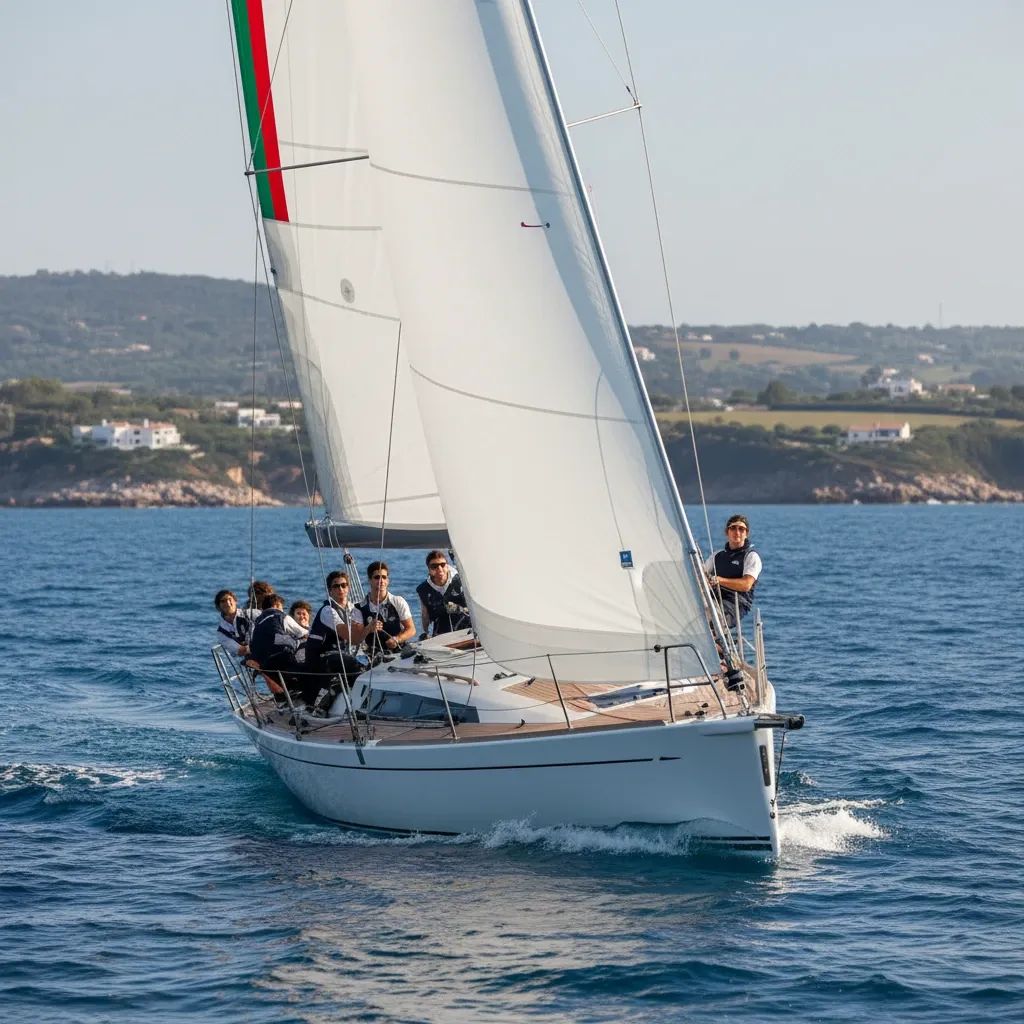
The Italian Naval League (Lega Navale Italiana) has wrapped up a groundbreaking restorative justice program that uses confiscated crime boats to steer at-risk youth away from the courts and back into society—a five-month sailing curriculum that merged judicial accountability with open-water training along the coastline between Fiumicino and Civitavecchia.
Why This Matters
• Proven success rate: Italy's "messa alla prova" (probation trial) system for minors reports strong completion rates, with Justice Department data indicating effectiveness in supporting social reintegration and reducing recidivism.
• Asset repurposing: Thirty-one boats once used for migrant smuggling and drug trafficking now serve as floating classrooms under the "Mare di Legalità" (Sea of Legality) fleet.
• Expanding model: The Ministry of Justice's Juvenile and Community Justice Department has partnered with the Italian Naval League for a decade, with this latest cohort finishing in January 2026.
The Vessel That Became a Courtroom
Six teenagers under judicial supervision spent six day sails and one overnight passage aboard Spyros, a Bavaria 44 sailboat seized from criminal networks and reassigned by the state to the Fiumicino chapter of the Italian Naval League. The boat carries the name of General Carlo Alberto Dalla Chiesa, the carabiniere commander assassinated by the Sicilian Mafia on September 3, 1982, turning a symbol of illicit commerce into a memorial and a rehabilitation tool.
Each craft in the Mare di Legalità fleet honors a victim of organized crime or terrorism. Italy has experienced significant losses to Mafia violence over decades, and the league works with victim advocacy organizations to identify appropriate names for newly confiscated vessels entering service.
What This Means for Residents
For Italian families navigating the juvenile justice system, messa alla prova (MAP) offers an alternative exit ramp: courts suspend criminal proceedings while social workers design an individualized program—school attendance, vocational placements, community service, victim restitution, or, in this instance, nautical education. If the youth meets the terms, the charge is extinguished without a conviction record, preserving future employment and mobility prospects across the European Union.
The data from the Juvenile Justice Department show a rising volume of MAP orders year on year, reflecting judicial confidence in the model's rehabilitative power.
Sailing as Social Reintegration
Between September 2025 and January 2026, the "A ciascuno la sua rotta" (To Each Their Own Course) initiative gave participants hands-on lessons in navigation, sail trim, and weather routing under the supervision of certified instructors. The weekend voyage to Civitavecchia, hosted by the Marina Riva di Traiano, required round-the-clock watches, galley duty, and emergency-drill discipline—tasks that translate into teamwork, accountability, and rule-following in a setting stripped of the distractions and peer pressures that often mark urban life.
"Being part of a crew is extraordinarily difficult today, especially for young people who struggle to see themselves as part of a whole," explained Renato Carafa, project coordinator and president of the Italian Naval League's Rome University delegation. "Aboard a boat you respect defined rules and timetables, and you realize that following the rules is not an oppressive weight but the instrument that frees you to chart your own course and reach the goals you've set—even when you have to revise your plans."
Carafa noted that many participants experienced emotions they had never felt before: open-water anxiety, the satisfaction of a clean tack under full sail, the shared relief when a squall passes. The sea becomes a neutral proving ground—indifferent to socioeconomic background, prior offenses, or family reputation—where capability and cooperation earn respect, not posturing or bravado.
A Decade of Judicial Partnership
The year 2026 marks ten years of formal collaboration between the Italian Naval League and the Ministry of Justice, during which confiscated assets have been systematically channeled into social programs. The fleet has grown from a handful of craft in 2016 to 31 operational boats today, deployed for programs serving minors in MAP and other youth rehabilitation initiatives.
Vessels are deployed by various Italian Naval League sections along Italy's 7,600-kilometer coastline and receive an official dedication ceremony during which the vessel's assignment is commemorated. A November 2024 presidential regulation governs the assignment, maintenance, insurance, and program criteria for the fleet, ensuring transparency and accountability in asset reuse.
From Criminal Tool to Public Good
Each sailboat passes through a judicial confiscation process under Italy's anti-Mafia legislation, is refurbished by Italian Naval League volunteers, and receives formal recognition of its new purpose in service to the state. The boats' provenance—smuggling rings, narcotics networks, human-trafficking syndicates—becomes part of the teaching narrative. Instructors walk cadets through the vessel's history, underscoring that the same hull once used to break the law now enforces it, a physical embodiment of the state's power to reclaim and repurpose.
Broader Implications for Youth Justice
Italy's juvenile justice model diverges sharply from the adult system: no formal conviction attaches if MAP is completed successfully, the proceedings remain confidential, and the emphasis rests on personality development and social reintegration rather than deterrence or punishment. MAP programs can last from six months to three years, depending on the offense severity and the minor's progress, with periodic reviews by magistrates and social workers.
Success rates have climbed steadily as programs incorporate experiential education—sailing, outdoor education, digital-skills workshops—that traditional probation lacks. Justice Department reports suggest that immersive, competence-building activities foster genuine behavioral change more effectively than passive community-service hours.
For Italy residents concerned about recidivism and public safety, the Mare di Legalità fleet represents a fiscally efficient use of seized assets: boats that would otherwise deteriorate in impound lots or be auctioned off now generate social capital, engage volunteers, and operate at marginal cost beyond insurance and dock fees.
Scaling the Model
The Italian Naval League's network spans more than 230 local sections along Italy's coastline, each eligible to host confiscated vessels if they meet infrastructure, staffing, and insurance requirements. Current capacity constraints—limited berths, instructor availability, seasonal weather—mean that demand from judicial authorities outstrips supply; youth courts across Italy have reportedly requested additional slots.
Expansion hinges on continued asset seizures (the pipeline remains robust given ongoing Mafia prosecutions) and government funding for retrofits and training. The Ministry of the Interior maintains a registry of eligible purposes and names to ensure that every vessel entering service aligns with public interest and victim commemoration goals.
Measuring Impact Beyond Statistics
Program coordinators emphasize qualitative shifts: participants who return to enroll in vocational nautical courses, forge mentorships with volunteer skippers, or bring younger siblings to open-day events. Several alumni have earned commercial skipper licenses and now work in Italy's charter and ferry sectors, a career pathway that MAP coordinators actively promote through partnerships with maritime employers.
The six young people who completed "A ciascuno la sua rotta" in January received certificates of participation signed by representatives of the Italian Naval League and the Juvenile Social Services Office of Rome. Those certificates carry weight: they document skills (celestial navigation, VHF radio protocol, man-overboard drills), verify hours, and signal to future employers or educational institutions that the holder possesses discipline, teamwork aptitude, and redemptive intent.
The Cultural Dimension
Naming vessels in memory of those lost to organized crime serves a dual function: it personalizes abstract concepts of justice and accountability for teenagers, and it offers a tangible form of public memory. The Italian Naval League works with victim advocacy organizations and families to ensure appropriate commemorations.
This pedagogical approach dovetails with Italy's broader civic-education reforms, which mandate that secondary schools integrate citizenship, legality, and anti-corruption curricula into their syllabi. The Mare di Legalità initiative supports these educational goals by providing experiential learning opportunities.
Looking Ahead
The ten-year milestone in 2026 has prompted the Ministry of Justice and the Italian Naval League to evaluate the impact of MAP sailing programs on youth outcomes. The fleet continues to grow—31 boats as of this month—with additional craft undergoing refurbishment in various Italian ports. Each represents a crime disrupted, an asset recovered, and a cohort of young people offered the chance to, as the program's title suggests, choose their own course.


