
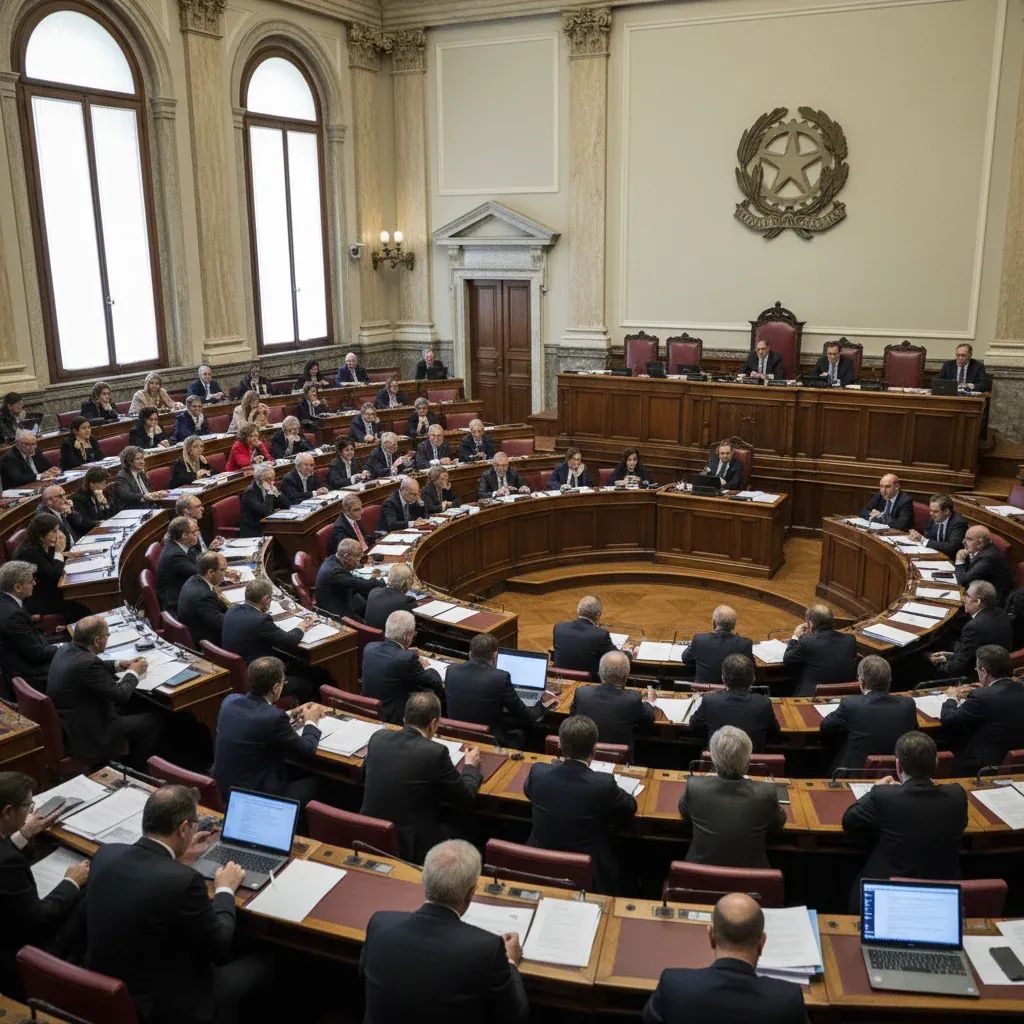
Opposition senators in Italy's Senate have issued an ultimatum over legislative gridlock surrounding the reform of RAI, the nation's public broadcaster: either the Budget Committee releases its overdue opinion on the reform bill, or they will no longer guarantee smooth operation of the committee's work. The standoff, now in its eighth month, has turned a technical legislative hurdle into a political pressure point that could disrupt the broader parliamentary agenda.
Why This Matters:
• Governance at stake: The reform seeks to align RAI with European Union media independence standards, potentially reshaping how the broadcaster's leadership is appointed for years to come.
• European deadline: Italy is under pressure to comply with the European Media Freedom Act, which took effect last August and requires member states to insulate public broadcasters from government influence.
• Political leverage: Opposition parties are threatening to obstruct Budget Committee proceedings unless the reform advances, a tactic that could stall other government priorities.
• Timeline crunch: The government hopes to appoint new RAI executives this year under reformed rules, but the legislative impasse threatens that schedule.
Eight-Month Stalemate Over Broadcasting Reform
The confrontation stems from a revised reform text adopted by a restricted committee of the Senate's Environment and Public Works Commission on September 17, 2025. That draft, which consolidated multiple proposals into a unified bill (S. 611), was supposed to move toward a full committee vote on 37 pending amendments. Instead, it has languished while awaiting a mandatory budget opinion from the Senate Budget Committee, chaired by Nicola Calandrini of the ruling Fratelli d'Italia party.
Opposition senators — representing the Democratic Party (PD), Five Star Movement (M5s), Green and Left Alliance (AVS), Italia Viva, and the Autonomies group — sent formal letters to both Calandrini and Claudio Fazzone, the Forza Italia senator who chairs the substantive commission, demanding action. "After September 17, nothing has happened," the joint statement reads. "Despite repeated requests, the Budget Committee has not issued its opinion."
PD Senator Beatrice Lorenzin, a prominent opposition voice, made the threat explicit: without concrete progress, opposition lawmakers will no longer ensure orderly proceedings in the Budget Committee. Such a move could include procedural motions, extended debate, or other parliamentary tactics that slow legislative business.
What the Reform Actually Changes
At the heart of the blocked legislation is a fundamental reworking of RAI's governance structure, driven largely by the European Media Freedom Act (EMFA) that came into force across the EU on August 8, 2025. That regulation mandates that public service media in member states operate independently of government interference, particularly in the appointment of senior executives and board members.
The reform proposal, originally drafted by Senator Maurizio Gasparri and refined through committee work, seeks to eliminate the Italian government's traditional power to appoint RAI's board of directors. Under current law — specifically Law 220 of 2015 — the executive branch retains significant influence over the broadcaster's leadership. The new text would shift that authority, though precise mechanisms remain under negotiation.
Other key elements of the reform include extending the tenure of board members from 3 to 5 years, establishing clearer financial guarantees for RAI's operations, defining new rules for the broadcaster's subsidiary companies, and delineating the powers of the board president versus the managing director. These changes aim to provide stability and shield editorial decisions from short-term political pressures.
The reform has already encountered internal resistance. The Ministry of Economy and Finance (MEF) issued a negative opinion on aspects of the proposal, a signal that even within the governing coalition there is disagreement over how much autonomy RAI should enjoy. The Budget Committee's delay in delivering its formal assessment is widely interpreted as reflecting this internal tension.
Impact on Residents and Media Consumers
For Italians, the reform carries implications beyond parliamentary procedure. RAI operates three national television channels, numerous radio stations, and a digital platform, funded primarily through an annual television license fee of approximately €90 per household. The broadcaster's editorial independence — or lack thereof — directly affects the quality and impartiality of news coverage millions of Italians rely on daily.
If the reform passes, future RAI leadership would theoretically be insulated from the government in power at any given moment. This could lead to more balanced coverage during election cycles and reduce perceptions of state propaganda. Conversely, critics worry that shifting appointment authority to Parliament, rather than the executive, may simply redistribute political patronage rather than eliminate it.
The proposed 5-year board tenure is particularly consequential: if the reform is enacted this year and new directors are appointed, they would serve until 2031 — well beyond the next general election scheduled for 2027. That timeline has fueled opposition suspicions that the current government is engineering a mechanism to maintain influence over RAI even if it loses power.
The European Dimension
Italy's reform debate is part of a broader recalibration across the EU. The EMFA was designed in response to concerns about media pluralism and government overreach in several member states. Countries like Poland and Hungary have faced scrutiny over state control of public broadcasters; Italy's governance model, while less extreme, has long been criticized for politicization.
The Italian opposition has repeatedly argued that Law 220/2015 is now outdated and incompatible with EMFA requirements. Senator Daniele Manca (PD) has called for Economy Minister Giancarlo Giorgetti to personally report to the Budget Committee if the ministry's opinion is not delivered within a week, underscoring the urgency opposition lawmakers feel.
Under Secretary for Economy Sandra Savino has acknowledged the delay and promised to relay the opposition's concerns to her ministry, but no specific timeline has been provided for the release of the MEF's formal assessment.
What Happens Next
The immediate question is whether the Budget Committee will issue its opinion in the coming days or weeks, unlocking the reform for further debate and amendment votes. If the opposition makes good on its threat to disrupt Budget Committee operations, the government could face complications advancing other priorities, including budget adjustments and financial legislation.
Should the reform clear the Senate, it would still require approval from the Chamber of Deputies, Italy's lower house, before becoming law. Given the complexity and the political stakes, observers are skeptical that the government's stated goal of passage by summer is achievable.
For now, the reform remains stalled, caught between European compliance mandates, domestic political jockeying, and unresolved questions about how much autonomy a publicly funded broadcaster should enjoy in a parliamentary democracy. The standoff in the Senate Budget Committee is less a technical delay than a reflection of deeper disagreements over power, media, and governance in contemporary Italy.


