
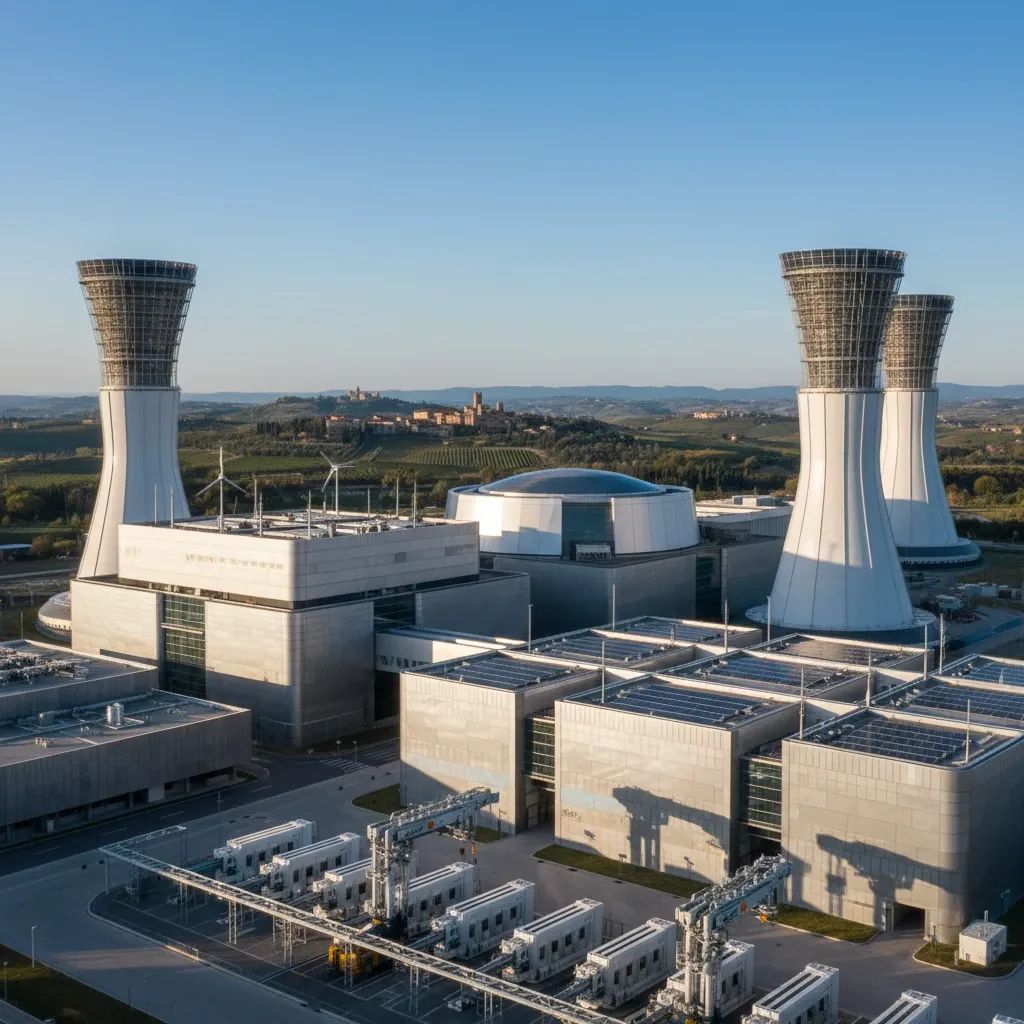
The Italy Ministry of Environment and Energy Security has launched a comprehensive three-year nuclear research program worth millions of euros, just as one of the country's most powerful industrial voices called for an urgent pivot away from renewable-only energy policy—a rare moment of alignment between government strategy and manufacturing demands that could reshape Italy's energy future by the mid-2030s.
Why This Matters:
• Timeline acceleration: Italy aims to have operational Small Modular Reactors (SMRs) by 2032–2033, with private investment permitted from January 2027.
• Legislative framework: Parliament is expected to pass enabling nuclear legislation by summer 2026, with implementation decrees finalized by year-end.
• Industrial competitiveness: Energy costs in Italy remain significantly higher than European competitors, threatening manufacturing viability.
• National capacity target: The government projects 8–16 GW of nuclear capacity by 2050, covering 11%–22% of electricity demand.
The Industrial Reality Behind the Nuclear Push
Emma Marcegaglia, president and CEO of Marcegaglia Holding—one of Europe's largest steel and metal processing groups—delivered a blunt assessment during a Qn media group energy forum. The industrialist warned that Italy's manufacturing base cannot survive on renewable energy alone, despite concurrent investments her own company is making in solar and wind.
"We need to return to nuclear, and I say this very clearly," Marcegaglia stated. "We must do it now that safe technologies exist, including the so-called small reactors." She emphasized that while her firm continues expanding renewable capacity, the intermittency problem remains unsolved: when sun, light, and wind are absent, so is the power supply.
Her position carries weight beyond rhetoric. Marcegaglia Holding recently signed a 10-year agreement with French utility EDF to supply nuclear power to its steel plant in Fos-sur-Mer, France—a facility designed to cut CO2 emissions by 80% through nuclear and renewable integration. The move signals that Italy's largest industrial players are already hedging energy strategies across borders while waiting for domestic nuclear infrastructure.
The broader Italian steel federation (Federacciai) has formalized this stance through a five-way memorandum with French partners, including Edison (EDF's Italian subsidiary), to explore joint investments in SMR technology specifically for industrial applications.
What the Government Program Delivers
The Nuclear Research Program (PRN), announced this week and administered by ENEA (the Italy National Agency for New Technologies, Energy and Sustainable Economic Development) with support from the National Research Council (CNR) and Consorzio RFX, represents the operational backbone for Italy's nuclear re-entry.
The program concentrates on three technology tracks: Small Modular Reactors (third-generation advanced), Advanced Modular Reactors (fourth-generation, including lead-cooled fast reactors), and nuclear fusion research—though fusion remains a longer-term prospect unlikely to contribute meaningfully before mid-century.
A notable non-energy component addresses radiopharmaceutical production, aerospace applications, and hydrogen generation using nuclear heat—sectors where Italy has maintained specialized expertise despite abandoning nuclear power generation after the 1987 referendum.
Crucially, the program allocates funding for 20 doctoral scholarships launching in the 2026/2027 academic year, co-financed with Italian universities. These positions target nuclear engineering, advanced materials, reactor physics, automation systems, and—tellingly—social acceptance of nuclear energy. Universities must submit co-funding applications by May 15, 2026.
Separately, the government has committed €7.5M for public information campaigns through 2026, acknowledging that building social license remains as critical as building reactors in a country where two referendums have rejected nuclear power.
Regulatory Timeline and Private Investment Window
The legislative pathway now moves through Parliament, with a delegated law on sustainable nuclear energy expected to clear both chambers by summer 2026. Implementation decrees should follow by December, creating the legal architecture for Italy's entire civil nuclear supply chain—from reactor licensing to waste management protocols.
This timeline deliberately opens private investment opportunities starting January 1, 2027. A consortium including Ansaldo Nucleare, startup Newcleo, and utility Enel is already designing a dedicated company to construct atomic generation facilities, positioning for immediate licensing applications once the regulatory framework activates.
Italy's updated National Integrated Energy and Climate Plan (PNIEC) incorporates these nuclear targets explicitly, projecting installed capacity between 8 GW and 16 GW by 2050. At the upper end, this would represent roughly one-fifth of projected electricity demand—substantially higher than symbolic contributions but far short of France's 70% nuclear share.
The government emphasizes SMRs as the preferred technology due to shorter construction cycles (5–7 years versus 10+ years for conventional reactors), lower upfront capital requirements, and modularity that allows phased capacity expansion. ENEA's EAGLES-300 project—a lead-cooled fast reactor design—has gained recognition from the European Industrial Alliance on SMRs as among the continent's most advanced indigenous concepts.
The Opposition's Economic Counter-Argument
Environmental groups and the Five Star Movement maintain fierce resistance, framing nuclear reintroduction as economically irrational and politically tone-deaf given referendum history.
Greenpeace Italy and Legambiente argue that nuclear power costs exceed renewable alternatives when full lifecycle expenses are calculated. They cite international construction data showing average delays of 6–10 years beyond planned timelines, with each additional year adding billions in financing costs. Documentation submitted to Parliament suggests SMRs would increase total decarbonization costs compared to renewable-only scenarios.
The Five Star Movement explicitly rejects nuclear energy, positioning renewables, national energy efficiency programs, and energy cooperatives as the only viable path. They note Italy remains under EU infraction procedures for failing to designate a national radioactive waste repository—a gap that undermines any credible nuclear deployment plan.
Current decommissioning of Italy's legacy nuclear facilities costs an average €3 per household annually in electricity bills, a figure opponents extrapolate into much larger future liabilities if new reactors are built.
Critics also highlight technical incompatibility between baseload nuclear generation and variable renewables. Nuclear economics favor continuous maximum output; reducing reactor utilization during high renewable generation periods dramatically increases per-kilowatt-hour costs, making the plants economically unworkable unless they displace renewables rather than complement them.
What This Means for Residents and Investors
For industrial consumers, the nuclear timeline offers potential medium-term relief from Europe's highest electricity costs—but not before 2033 at earliest, and realistically closer to 2035 for meaningful capacity. Companies with energy-intensive operations face continued cost pressures through the remainder of this decade.
Residential electricity bills will absorb research program costs and preparatory infrastructure investment before any nuclear kilowatt-hour reaches the grid. The offset comes later if projections of stable, lower-cost baseload power materialize—a bet on 2030s economics using 2026 capital.
For international investors, Italy's nuclear restart presents opportunities across the supply chain, from reactor components (where Ansaldo Nucleare retains specialized capabilities) to engineering services and fuel cycle management. However, the regulatory framework remains incomplete, and site selection processes have not begun—early-stage risks remain substantial.
The skills shortage the doctoral scholarship program attempts to address reflects decades of brain drain after nuclear abandonment. Rebuilding indigenous expertise will determine whether Italy can genuinely develop domestic nuclear capacity or becomes dependent on foreign turnkey solutions.
Italy's membership in the European Alliance for Nuclear Energy alongside France, Poland, and others positions the country within a continental nuclear supply chain rather than isolated national development—potentially accelerating deployment but reducing sovereignty over strategic energy infrastructure.
The Marcegaglia intervention crystallizes the central tension: Italy's manufacturing competitiveness depends on energy costs falling below current levels, renewables alone cannot guarantee dispatchable baseload power, yet nuclear requires a decade-plus commitment with uncertain public support and substantial upfront costs. The government is now wagering that 2026 represents the narrow window where technological maturity, climate imperatives, and industrial necessity converge to make nuclear politically viable for the first time in 40 years.


