
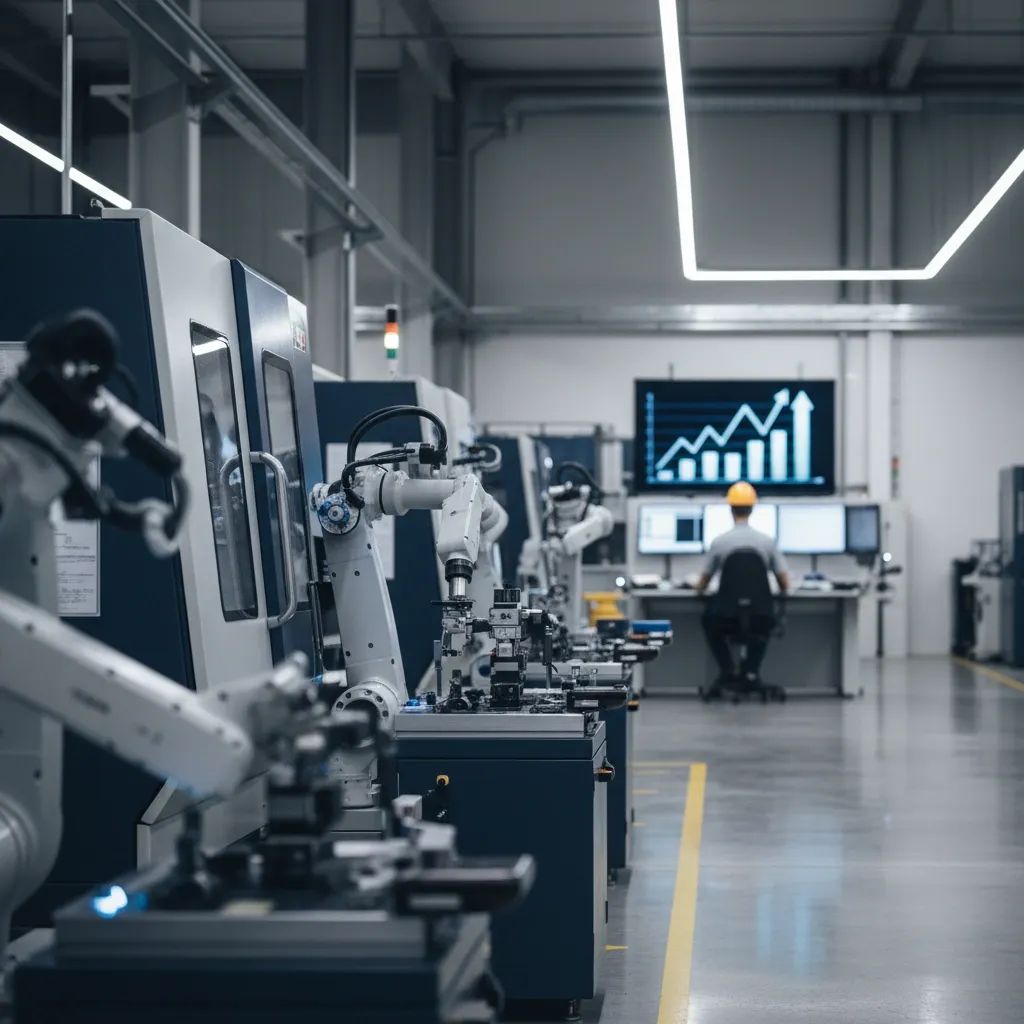
Italy's National Institute of Statistics (Istat) has released figures confirming that industrial output climbed 0.7% month-on-month in March, with a year-on-year rise of 1.5% when adjusted for calendar effects, signaling a second consecutive month of recovery for the nation's manufacturing sector—though the broader first-quarter picture remains subdued.
Why This Matters:
• Capital goods are driving expansion, up 2.1% in March and 5.8% year-on-year, reflecting renewed investment in machinery and equipment.
• Consumer goods continue sliding, down 0.4% monthly and marking four straight months of contraction, raising questions about domestic demand resilience.
• First-quarter production still fell 0.2% versus the final three months of 2025, indicating Italy's manufacturing base has yet to regain full momentum.
Capital Goods Lead the Charge
The March data, released today by Istat, underscores a bifurcated recovery. Capital goods—machinery, industrial equipment, and transport vehicles—posted the sharpest gains, climbing 2.1% from February and 5.8% compared to March 2025. This segment has become the engine of Italy's industrial upturn, bolstered by investments tied to the country's National Recovery and Resilience Plan (PNRR) and ongoing digitalization and green transition projects.
Intermediate goods, which include components and raw materials used in further production, edged up 0.3% monthly and 0.5% annually, suggesting moderate but stable activity across supply chains. However, energy production slumped 1.2% in March from February and 3.1% year-on-year, reflecting both seasonal factors and the lingering impact of volatile global energy markets tied to geopolitical tensions in the Middle East.
Consumer Goods Struggle Amid Spending Caution
The consumer goods sector contracted 0.4% in March, its fourth consecutive monthly decline, and fell 1.9% compared to the same month in 2025. This persistent weakness stands in stark contrast to resilient retail sales data, which showed a 3.7% annual value increase in March, driven partly by favorable Easter timing and a gradual recovery in household purchasing power.
The discrepancy suggests Italian manufacturers of consumer products are facing structural pressures: elevated input costs, cautious restocking by retailers, and competitive pressure from imports. Nearly 9 out of 10 Italian households have adopted spending containment strategies, according to recent consumer surveys, and 17% of families report severe economic strain across all spending categories. While retail sales volumes rose 2.1% year-on-year, much of that growth came through e-commerce (+11.2%) rather than traditional channels, further complicating the outlook for domestic production.
Transport, Electronics, and Extraction Stand Out
Breaking down the figures by industrial sector, transport equipment manufacturing surged 11.2% year-on-year in March, the strongest performance of any major category. This reflects ongoing orders for rail equipment, aerospace components, and a tentative recovery in the automotive supply chain—though the car sector itself remains under pressure from the electric vehicle transition and rising costs.
Extraction activities climbed 6.7% annually, buoyed by mineral and energy commodity demand, while computer, electronics, and optical product manufacturing rose 6.1%, underscoring Italy's niche competitiveness in high-tech components and precision instruments.
On the downside, chemical manufacturing dropped 7.8% year-on-year, weighed down by high energy input costs and sluggish demand from key export markets. Energy supply (electricity, gas, steam) fell 4.0%, and other manufacturing, including machinery repair and installation, declined 2.4%, reflecting weakness in maintenance and retrofitting activity.
What This Means for Investors and Business Owners
For those tracking Italy's manufacturing competitiveness, the March data offers cautious optimism but no reason for complacency. The 0.2% quarterly contraction in industrial output during Q1 2026 places Italy behind France, which posted 1% monthly growth in March, and Spain, which saw 1.8% annual growth in the same month. Germany's industrial output, by contrast, contracted nearly 1% in Q1 and fell 2.8% year-on-year in March, suggesting Italy is holding its own within a weakening European industrial landscape.
The divergence between capital goods expansion and consumer goods contraction points to a two-speed economy: one track driven by investment, infrastructure, and export-oriented sectors (transport, electronics, pharmaceuticals), and another weighed down by weak domestic consumption and energy-intensive industries struggling with cost pressures.
Italy's export exposure to non-EU markets (48.2%) is higher than that of Germany, France, or Spain, making the country more vulnerable to global trade tensions and tariff risks—but also more positioned to benefit from demand growth in emerging markets. Sectors such as pharmaceuticals, electromechanics, and electronics are forecast to grow by an average 2.2% annually through 2027, supported by PNRR funding and corporate investment in automation and sustainability.
Broader Economic Context and Outlook
Istat noted that the March rebound was "driven by the positive dynamics of capital goods," while acknowledging that "consumer goods have shown monthly declines for four months." The institute's tone reflects cautious relief rather than celebration: industrial activity is stabilizing, but structural headwinds—inflation volatility, energy costs, and uncertain European demand—remain unresolved.
Looking ahead, analysts expect Italian manufacturing to grow at a modest 1% to 1.2% annually in 2026-2027, with GDP expansion in the 0.4% to 0.7% range for 2026. Much will depend on the trajectory of Germany's recovery, the stability of energy prices, and the effectiveness of EU cohesion and investment policies in sustaining cross-border demand.
Sectors tied to renewable energy infrastructure, rail transport, digital services, and pharmaceuticals are expected to outperform, while textiles, fashion, and energy-intensive chemicals face continued pressure. For businesses operating in Italy, the data reinforces the importance of diversifying supply chains, investing in energy efficiency, and targeting export markets beyond the EU, where competitive advantages in quality and specialization can offset cost disadvantages.
The Road Ahead
Italy's industrial sector is emerging from a difficult winter, but the path forward is uneven. The capital goods surge signals confidence among firms willing to invest in productivity and innovation, while the consumer goods slump reflects the lingering caution of households still adjusting to elevated living costs. With Q1 2026 marking a slight contraction despite March's uptick, the coming months will test whether this recovery can broaden beyond investment-driven sectors and regain traction across the full industrial base.
For now, the message is clear: Italy's manufacturing resilience hinges on external demand, energy cost stability, and the strategic deployment of recovery funds—not on a return to pre-pandemic consumption patterns.


