
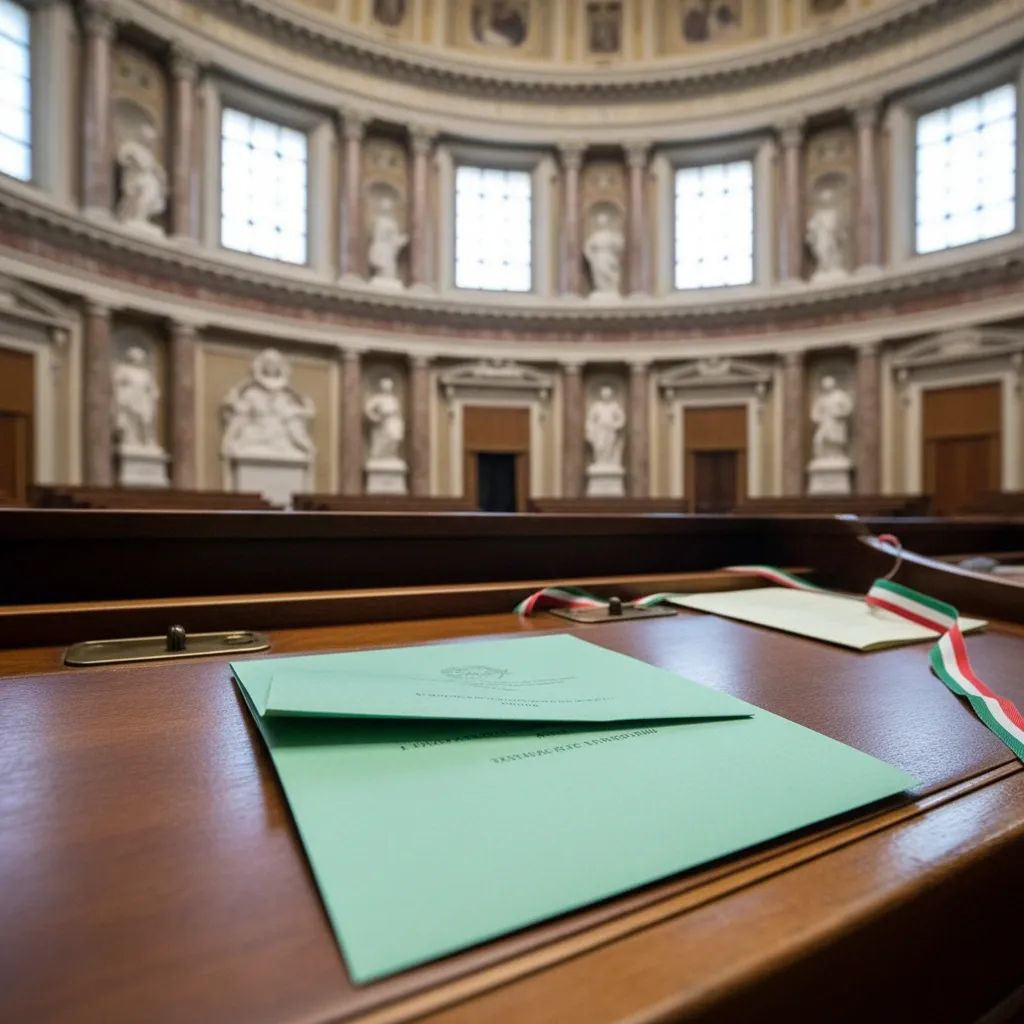
Italy's Constitutional Court has set in motion what could be the most consequential judicial reform in a generation, with voters now deciding whether to permanently split the country's judicial and prosecutorial branches. By 19:00 on the first day of polling, turnout reached 38.9%, a figure that — while appearing modest — carries full legal weight because no quorum is required for this confirmatory constitutional referendum.
Why This Matters
• No minimum turnout threshold: The reform will pass or fail based solely on the majority of valid votes cast, regardless of how many Italians show up.
• Seven constitutional articles are on the line, reshaping how judges and prosecutors are trained, assigned, and disciplined.
• Career separation is irreversible: If approved, magistrates will choose between judging and prosecuting from day one, with no switching allowed.
• Voting continues Monday, March 23, 2026, from 07:00 to 15:00—final results expected by late evening.
Quick Guide for Residents Who Haven't Voted Yet
• When: Monday, March 23, 2026, 07:00-15:00 (polls close at 15:00)
• Where: Your designated polling station (same location as general elections)
• What to bring: ID and voting card if you have it
• Results: Official results announced Monday evening after polls close
The Structural Overhaul at Stake
The reform, often labeled the "Nordio Reform" after Justice Minister Carlo Nordio, targets Articles 87, 102, 104, 105, 106, 107, and 110 of the Italian Constitution. At its core lies a radical rethinking of the magistracy's architecture: separating giudici (judges) from pubblici ministeri (prosecutors) into two distinct career tracks from the moment candidates enter the judiciary.
Understanding the Current System vs. the Proposed Change
Currently, Italy operates under a unified magistracy model. Judges and prosecutors belong to the same professional body, share the same training, and can transition between roles during their careers. Think of it this way: a magistrate could spend five years as a prosecutor building a case against a crime boss, then later become a judge who might review that same case from the bench.
Proponents of the reform argue this system blurs the line between impartial adjudication and adversarial prosecution, creating conflicts of interest and undermining public trust. Critics counter that unity safeguards judicial independence from political interference and ensures magistrates understand both sides of the courtroom.
What Changes If the Reform Passes
The proposed changes go further than simple separation. The Consiglio Superiore della Magistratura (CSM), Italy's powerful self-governing judicial council, would be split into two separate bodies—one overseeing judges, the other managing prosecutors. Both would retain a majority of magistrate members, with the President of the Republic presiding over each, and would include the First President and Chief Prosecutor of the Court of Cassation by default.
Perhaps most controversially, the reform introduces sorteggio—lottery-based selection—to pick two-thirds of the magistrate members for each council. Imagine it like drawing names from a hat, rather than having internal political factions choose who governs them. The remaining third, composed of law professors and lawyers with at least 15 years of experience, would be drawn by lot from a list elected by Parliament in joint session. Advocates say this reduces the influence of internal factions and political currents within the judiciary; opponents warn it could weaken accountability and professional merit.
Finally, the reform establishes an Alta Corte Disciplinare, a constitutional-rank court dedicated exclusively to disciplinary proceedings against magistrates. This court, also magistrate-majority in composition, would strip disciplinary authority from the two new CSMs, theoretically insulating punishment decisions from internal politics.
What This Means for Residents
For the average Italian, the implications are less about immediate courtroom experience and more about the long-term functioning of justice.
Practical Timeline and Impact on Your Legal Matters
If the reform passes, expect structural delays over the next 3-5 years as the judiciary reorganizes itself: new recruitment tracks, retraining programs, and administrative reshuffling.
Important clarification for those in active legal proceedings: Cases already in progress will continue under existing rules with their current judges and prosecutors. Only newly filed cases after implementation will operate within the bifurcated system. If you're currently involved in litigation or under investigation, this change will not affect your case's legal framework or assigned magistrates.
Will It Solve Italy's Court Problems?
The reform does not promise faster trials or lighter caseloads, two chronic pain points for Italy's notoriously sluggish courts. What it does offer is a theoretical check on prosecutorial overreach—by removing the possibility that a prosecutor could later become a judge in a related case, or that both functions answer to a single governing body. Whether this translates into tangible improvements in fairness, efficiency, or public confidence remains the central question dividing political camps.
For expatriates and foreign investors, the referendum signals Italy's ongoing wrestle with the balance between judicial independence and accountability. A "Yes" vote aligns Italy more closely with adversarial legal models common in Anglo-Saxon jurisdictions; a "No" preserves the European continental tradition of a unified magistracy.
The Political Battleground
Italy's center-right coalition—comprising Fratelli d'Italia, Lega, Forza Italia, and Noi Moderati—has campaigned aggressively for "Sì." Prime Minister Giorgia Meloni has repeatedly stated that the referendum's outcome will not destabilize her government, framing the vote as a matter of principle rather than political survival. Justice Minister Nordio, architect of the reform, has portrayed it as a fulfillment of long-standing center-right commitments to judicial accountability.
On the opposition benches, the center-left has coalesced around "No." The Partito Democratico (PD), Movimento 5 Stelle (M5S), and Alleanza Verdi e Sinistra (AVS) argue the reform is a thinly veiled attempt to subordinate magistrates to executive control. PD leader Elly Schlein and M5S chief Giuseppe Conte have warned that splitting the CSM could enable political appointments and weaken prosecutors investigating corruption.
Two notable outliers: Azione, led by Carlo Calenda, broke ranks with the opposition to endorse "Sì," citing the need for structural modernization. +Europa also backed the reform. Meanwhile, Italia Viva opted for neutrality, leaving members free to vote their conscience.
The CGIL, Italy's largest trade union confederation, issued a formal recommendation to vote "No," emphasizing defense of judicial autonomy and the constitutional balance of powers.
Historical Context: Italy's Constitutional Referenda
This is only the fifth constitutional referendum in the history of the Italian Republic. Unlike abrogative referenda—which require a 50% turnout quorum to be valid—constitutional referenda hinge solely on the majority of votes cast. In simpler terms: your vote counts regardless of total turnout.
The last constitutional referendum, held in September 2020, approved a reduction in the number of parliamentarians—from 630 to 400 deputies and 315 to 200 senators—with a resounding 69.9% "Yes" vote. Before that, the December 2016 referendum on the Renzi-Boschi reform sought to abolish bicameralism but was rejected by 59.12% despite high voter participation.
The pattern is clear: Italians are selective about constitutional change, and political backing does not guarantee success.
Turnout Dynamics and What They Signal
The 14.9% turnout by midday Sunday represented a modest improvement over past two-day constitutional referenda at the same hour. By 19:00 Sunday, participation had climbed to 38.9%, with Emilia-Romagna leading the country at over 46%.
For context: the absence of a quorum requirement removes any strategic incentive for either campaign to encourage or suppress turnout artificially. High turnout doesn't guarantee a "Yes" or "No" outcome—what matters is which camp's supporters actually vote.
Among the 51.4 million eligible voters—including 5.5 million Italians abroad—Monday represents the final voting window. Historically, Monday afternoon drives a final surge as working people cast their ballots after work or take time during their break.
Public Voices on the Reform
Riccardo Magi of +Europa, speaking outside his Rome polling station, lamented what he called a "poor campaign" focused more on partisan politics than substantive debate about the seven constitutional articles.
Puglia Governor Antonio Decaro, voting in Bari, expressed regret that the referendum "has become a partisan political battle in recent months" rather than a serious discussion over constitutional substance.
These concerns reflect a broader sentiment among observers that the public debate has sometimes lost sight of the technical details that will actually matter if the reform passes.
What Happens Next
Polls close Monday, March 23, 2026 at 15:00, with official results expected by late evening. If "Sì" prevails, the constitutional law will be promulgated and enter into force, triggering years of implementation. If "No" wins, the reform dies, and the text is nullified as if it never passed Parliament.
Either way, the vote represents a rare moment of direct citizen input on the architecture of the Italian state—one that will shape the relationship between judges, prosecutors, and political power for decades to come.


