
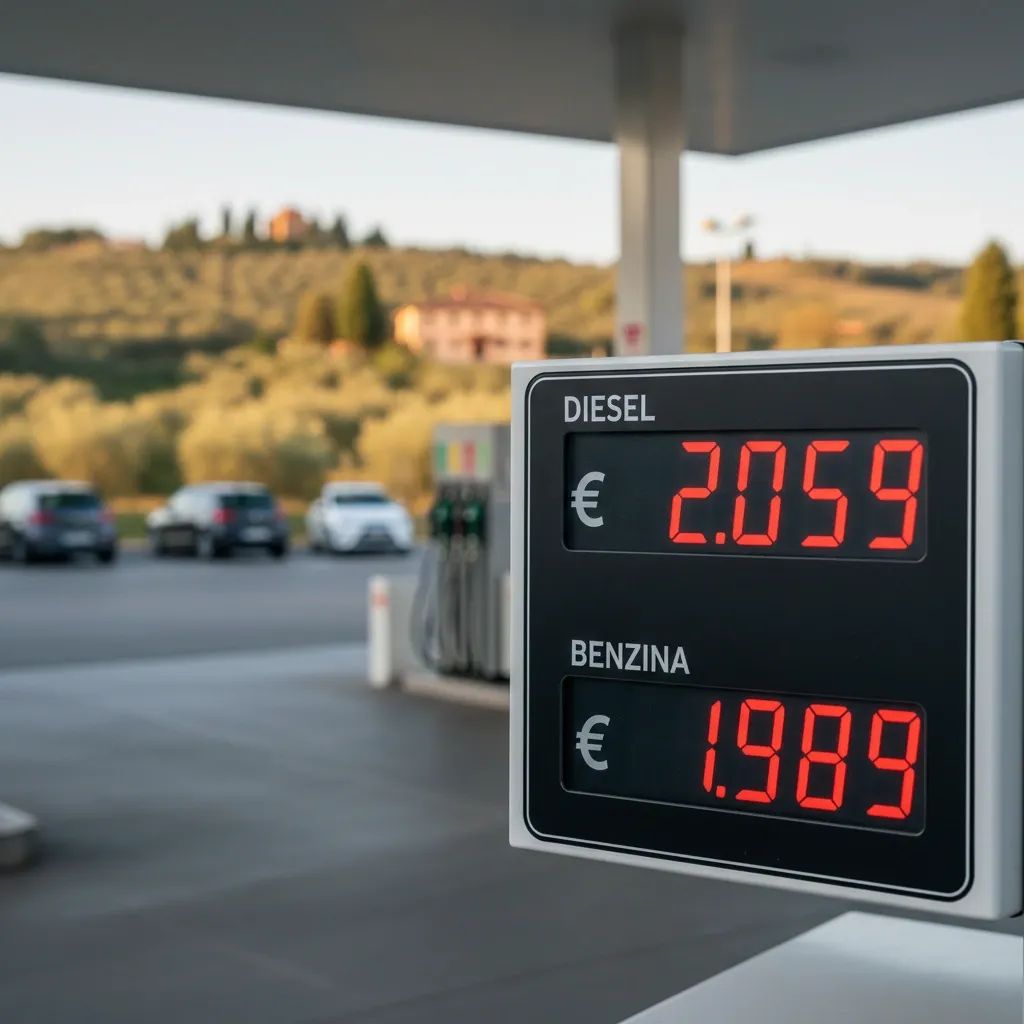
In March 2026, the Italy Ministry of Enterprises and Made in Italy confirmed renewed upward pressure on pump prices, as diesel crept above the €2.00 per liter threshold in several regions—signaling that a 20-day excise tax cut introduced less than a week earlier was already losing ground to volatile international oil markets.
Why This Matters
• Diesel now exceeds €2.00/liter in Campania (€1.995), Calabria (€1.994), and Molise (€1.990).
• Highway stations charge even more: Self-service diesel averages €2.05, up 1 cent overnight.
• The 25-cent discount is shrinking fast: Pump prices have fallen only €0.12–€0.15, not the expected €0.25, due to crude oil rallies.
• Small trucking firms face an annual cost spike of €12,350 per vehicle, according to the CGIA business association in Mestre.
Fuel Prices Climb Despite Temporary Tax Relief
National average pump prices on the morning of 23 March 2026 stood at €1.985 per liter for diesel (+0.8 cents from the previous day) and €1.722 for gasoline (+0.5 cents), according to official Ministry data processed by Codacons, one of Italy's largest consumer-rights organizations. On highways, self-service diesel jumped to €2.055 and gasoline to €1.788.
The government's emergency decree—enacted on 19 March 2026 and valid through 7 April 2026—cut excise duties by €0.244 per liter (inclusive of VAT) on gasoline and diesel, and by €0.12 per kilogram on LPG. Yet real-world savings have fallen short. Comparing current prices to the 18 March baseline, diesel has dropped only €0.127 per liter and gasoline by €0.15, meaning drivers are recouping barely half the intended benefit.
Staffetta Quotidiana, an industry newsletter that tracks approximately 20,000 fuel stations, recorded similar trends: self-service gasoline climbed to €1.719 and diesel to €1.979 on the morning of 22 March 2026. The data underscores a pattern of creeping daily increases that erode the temporary reprieve almost as quickly as it was granted.
Regional Disparities Widen
Price gaps between Italy's northern and southern regions remain stark. Marche enjoys the country's most competitive diesel rate at €1.969 per liter, followed by Friuli Venezia Giulia and Tuscany (both €1.970). In contrast, three southern regions—Campania, Calabria, and Molise—have breached or approached the €2.00 psychological barrier, a level last seen during acute supply shocks.
The Unione Nazionale Consumatori (UNC) observed that 22 March 2026 marked the end of a brief three-day downward trend. "Diesel rose everywhere today," said Massimiliano Dona, UNC president. "Gasoline climbed across all regions except the highway network and Molise, where it edged down by a microscopic 0.1 cent."
Why the Discount Is Vanishing
Codacons attributes the erosion to two factors: surging industrial fuel prices driven by Middle East tensions and structural anomalies in regional distribution networks. Only 2.7% of stations had failed to pass on the excise cut by the latest survey date, ruling out widespread non-compliance.
Instead, international Brent crude quotes have rallied sharply since late February 2026, reversing months of relative stability. Italy imports the bulk of its refined products, and spot-market volatility filters through the supply chain within days. A €0.05 jump in Rotterdam refinery prices translates, after logistics and margins, to roughly €0.03–€0.04 at Italian pumps.
With the excise holiday expiring 7 April 2026—just 15 days away at the time of this reporting—consumer groups warn the net benefit may evaporate entirely. "We were the only ones to flag that 20 days would prove insufficient," Codacons stated. "The data, unfortunately, prove us right. An extension is now unavoidable until the runaway escalation stops."
What This Means for Transport & Small Business
The CGIA of Mestre, a guild representing artisans and micro-enterprises, calculates that truckers operating vehicles under 7.5 tonnes will pay an extra €172 per tank relative to late December 2025—equivalent to €12,350 more per year per vehicle. Since diesel accounts for roughly 30% of operating costs in the haulage sector, the squeeze on margins is immediate and severe.
"It's not just long-haul truckers," CGIA warned. "Taxi drivers, coach operators, and private-hire (NCC) services are all hit." Electric-vehicle charging costs have also jumped approximately 43% year-on-year, from €70 to €100 per session, offering no easy refuge.
Italy counts some 68,500 road-haulage firms and 31,500 taxi and NCC licensees nationwide. Many are single-vehicle owner-operators with no ability to hedge fuel exposure or renegotiate contracts quickly enough to recover the additional outlay. The government's decree includes a tax credit for freight companies covering incremental fuel expenditure in March, April, and May 2026 (relative to February), but the credit is capped at €100 M and applies only to eligible heavy vehicles.
Government Eyes Highway Concessionaires
Edoardo Rixi, Deputy Minister of Transport and a member of the governing Lega party, announced that the Ministry will soon approach motorway concessionaires—private operators of Italy's tolled highway network—to request a "small sacrifice" on fuel margins. Highway stations typically charge €0.25–€0.30 more per liter than ordinary forecourts, a premium justified by higher rent and logistical costs but that critics argue is excessive during national emergencies.
"In moments like these, the country must show unity and cohesion," Rixi said in a statement. "We delivered concrete support via the excise cut and other measures in the fuel decree, following consultations with the haulage sector led by Ministers Salvini and Giorgetti. Now we expect the private sector to contribute."
Whether concessionaires will comply remains uncertain; the request carries moral weight but no legal compulsion at present.
European Context: Italy Not Alone
A 16 March 2026 snapshot by the European Commission showed diesel averaging €1.950 across the EU-27 and €1.983 in the euro zone. Italy's €2.03 placed it fifth-most expensive. The Netherlands topped the league at €2.255 for diesel and €2.172 for gasoline, while Slovenia enjoyed the bloc's cheapest rates: €1.435 for gasoline and €1.462 for diesel.
Several member states have enacted their own interventions:
• Hungary imposed a hard price cap around €1.50 per liter.
• Croatia reintroduced retail ceilings of €1.50 for gasoline and €1.55 for diesel.
• Greece announced a cap on fuel-retail profit margins.
• Portugal and Austria are both cutting excise duties temporarily.
• France deployed 500 inspectors to audit stations for unjustified price hikes.
CGIA's analysis argues that national measures alone cannot stabilize prices over the medium term. "We need EU-level action that lets individual countries reduce energy taxes sustainably without breaching fiscal rules," the association said, pointing to the bloc's minimum-excise directive as a constraint on unilateral tax cuts.
Outlook: Pressure Mounts for Extension
With less than three weeks remaining before the excise reduction expires in April 2026, political debate is intensifying. Consumer advocates, trucking unions, and business associations all stress that a brief respite will prove counterproductive if prices snap back immediately afterward. Markets, meanwhile, remain hostage to geopolitical developments—particularly shipping disruptions in the Strait of Hormuz—that lie entirely beyond Rome's control.
The Ministry of Enterprises has reinforced its price-monitoring unit, the Garante per la sorveglianza dei prezzi, and ordered oil companies to publish daily recommended prices for the next three months, with fines for non-compliance. Yet enforcement can only constrain speculation at the margins; it cannot override the forces driving crude benchmarks higher.
For now, Italian motorists and transport operators in March 2026 brace for a tug-of-war between temporary tax relief and relentless upstream cost pressure—one in which the latter appears to be winning.


