
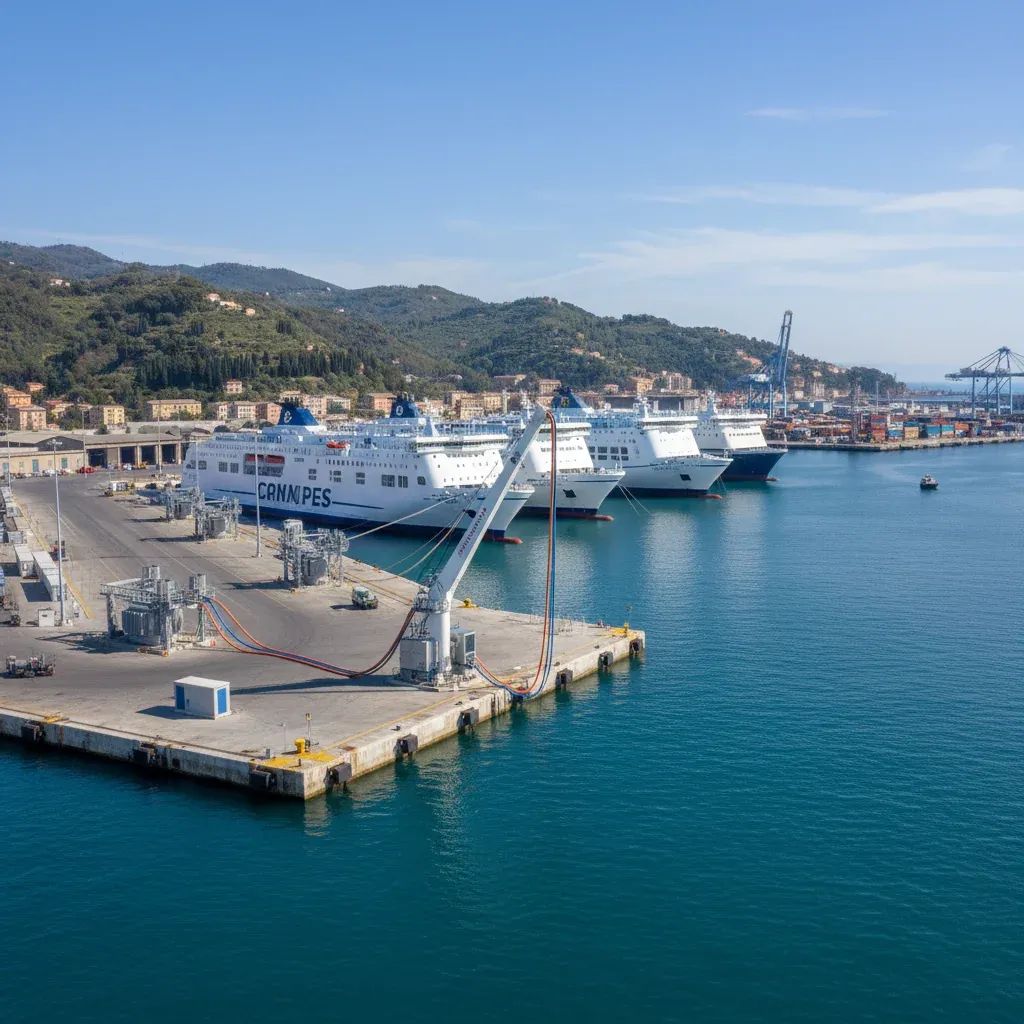
The Italian ferry fleet has become the leading source of maritime CO2 emissions in Europe, spewing 2.4 million tonnes of carbon dioxide annually — more than many medium-sized nations — while the country's four largest ports anchor themselves firmly in the top 10 for environmental impact. Yet Italy also holds a paradoxical distinction: over half its ferries are technically ready for full electric conversion right now, making it the continent's best-positioned candidate for rapid maritime decarbonization.
Why This Matters:
• Italy tops Europe for ferry-generated greenhouse gas emissions, with 75% originating from domestic routes and port stays.
• Genova (5th), Livorno (7th), Palermo (8th), and Civitavecchia (9th) rank among Europe's 10 most polluting ferry ports.
• By 2035, 67% of Italy's 167 ferries could operate on batteries alone; another 10% could run hybrid systems, reshaping coastal air quality.
• March 2026 deadline looms for €700M in PNRR-funded shore power projects across Italian ports.
A Comparison That Stings
A fleet of just over 1,000 ferries operating across European waters disgorges 13.4 million tonnes of CO2 annually, equivalent to the exhaust output of 6.6 million passenger cars. According to Transport & Environment (T&E), the Brussels-based federation driving transport decarbonization policy, that comparison underscores how maritime passenger services have long evaded the scrutiny applied to road vehicles.
Within this continental picture, Italy commands an unwelcome leadership position. The country's 167-strong ferry fleet — one of Europe's largest — accounts for 2.4 million tonnes of emissions. Three-quarters of that pollution arises from domestic routes and dockside idling, a pattern that concentrates toxic sulfur oxides and particulate matter in densely populated coastal cities from Liguria to Sicily.
Barcelona leads all European ports for absolute CO2 volume from ferries, while Dublin registers the highest sulfur oxide readings. But Italy's concentration of four ports in the top 10 reflects both the scale of its ferry network and the intensity of Mediterranean traffic, particularly on short-hop island connections where diesel engines churn continuously.
The Mediterranean's Polluted Crossroads
The Mediterranean basin registers the continent's heaviest ferry emissions in absolute terms, driven by domestic routes in Italy, Spain, and Greece. Unlike long-haul shipping, where vessels spend extended periods at open sea, Mediterranean ferries operate on tight schedules with frequent port calls, maximizing both fuel burn and urban exposure to exhaust plumes.
Italy's geography compounds the issue. The country's extensive coastline, major islands (Sicily, Sardinia), and smaller archipelagos (Aeolian, Pontine, Tuscan) sustain a dense web of short- and medium-range ferry services. Many routes span 20 to 80 kilometers — distances that align almost perfectly with the operational envelope of battery-electric propulsion.
The average European ferry is 26 years old, meaning most vessels predate modern emission controls and fuel-efficiency standards. Renewal of the fleet has become urgent not just for environmental reasons but also for economic ones: older ships consume dramatically more fuel per nautical mile, eroding operator margins as carbon pricing mechanisms tighten.
What the 2026 Regulatory Shift Means for Italy
Starting this year, the EU Emissions Trading System (ETS) for maritime transport covers 100% of emissions from intra-EU voyages. Operators of ferries above 5,000 gross tonnage must now surrender carbon allowances for every tonne of CO2 produced, directly linking emissions to operating costs. The system phases in gradually, but by 2030 the EU's target is a 55% reduction in greenhouse gases versus 1990 levels, with net-zero mandated by 2050.
For Italian ferry companies, the ETS creates a financial incentive to accelerate fleet modernization. Each tonne of CO2 carries a market price that fluctuates but has trended upward, transforming what was once an externality into a line item on the balance sheet.
Separately, the Mediterranean will see an Emissions Control Area (ECA) regime expand in the North-East Atlantic from 2027, mandating ultra-low-sulfur marine fuel. While Italy's waters are not yet designated as an ECA, the regulatory direction is unmistakable: high-sulfur bunker fuel is being phased out across European seas.
Shore Power: Italy's €700M Infrastructure Sprint
The centerpiece of Italy's port-side decarbonization effort is cold ironing, a system that allows docked vessels to shut down auxiliary diesel generators and plug into the terrestrial electricity grid. The Piano Nazionale di Ripresa e Resilienza (PNRR) allocated over €700M for shore power installations across the country's major ports, with a March 31, 2026 completion deadline for most projects.
Progress varies by location:
Genova is furthest along. Foundation work for transformer cabins is complete, and the first live tests are scheduled for this month. At full capacity, the port will deliver 60 MW of shore power, enough to electrify all cruise ships and ferries simultaneously. Future phases envision a smart grid fed by renewable sources.
Livorno has begun construction of a substation and three conversion cabins serving ferry, cruise, and container terminals. The Tuscan port authority expects the system operational within 12 months of August 2025, making it one of Europe's most advanced facilities, per T&E's latest assessment.
Palermo launched its cold ironing project using PNRR funds, targeting reductions in both air pollution and noise. The work includes a complete overhaul of the port's electrical network to handle the load.
Civitavecchia broke ground in February 2025 on an €81M project to electrify nine berths: three for large cruise ships, four for Ro-Ro and Ro-Pax vessels, and two multipurpose docks. Completion is slated for June 2026. The port also installed five public EV charging stations in 2018, signaling early commitment to electrification.
The Full-Electric Potential: 51% Convertible Today
T&E's technical analysis reveals that 51% of Italy's ferry fleet could operate on battery power alone today, based on route length, frequency, and charging windows. An additional 26% could run hybrid configurations, combining batteries with small auxiliary engines for backup or peak demand.
By 2035, if battery costs continue their downward trajectory, 67% of Italian ferries could be economically viable as full-electric vessels, and 77% as hybrid or full-electric. That represents the highest conversion potential in Europe, a function of Italy's short average route distances and predictable schedules.
Currently, converting a ferry to electric or hybrid propulsion is economically favorable in one of every four cases (26%), according to T&E. That ratio will improve as battery prices fall and carbon permit costs rise, creating a crossover point where green vessels outcompete diesel incumbents on total cost of ownership.
Early examples are emerging. In March 2025, two electric ferries entered service on Lago d'Iseo, each equipped with 750 kWh batteries and twin 100 kW motors. Similar vessels are planned for public services on the Po River in Torino and at Ravenna, though construction contracts went to German and Finnish shipyards, highlighting a gap in Italian electric maritime manufacturing capacity.
What This Means for Residents
Air Quality in Port Cities: Cold ironing eliminates dockside emissions, which is critical for densely populated urban ports like Genova, Palermo, and Civitavecchia. Sulfur oxides and particulate matter from idling ferries contribute to respiratory illness; shore power cuts that exposure to near zero.
Noise Reduction: Auxiliary diesel generators produce continuous low-frequency noise. Electrified berths allow ferries to operate silently in port, improving livability in waterfront neighborhoods.
Ticket Prices: In the short term, ETS compliance costs may flow through to passengers as fare increases. Over the medium term, electric ferries promise lower operating costs (electricity is cheaper than marine diesel, maintenance is simpler), which could stabilize or reduce ticket prices on high-volume routes.
Route Reliability: Newer electric and hybrid vessels are less prone to mechanical failure than aging diesel fleets, potentially improving schedule adherence on critical island links.
Job Market: Shipyard conversions and shore power installations create specialized technical jobs, but the shift also requires retraining for marine engineers accustomed to combustion systems.
The Business Case and the Holdouts
Large operators have begun to move. Gruppo Grimaldi commissioned 48 new-generation vessels between 2018 and 2025, worth approximately $5 billion, incorporating solar panels, cold ironing compatibility, and preparations for ammonia fuel. Intesa Sanpaolo backed three of these ships with green loans, signaling financial-sector support for the transition.
Yet comprehensive investment data for 2025–2026 remains fragmented. No single Italian ferry company has publicly committed to a fleet-wide electrification program on a timeline matching T&E's technical assessment. Bureaucratic delays have also hampered electric-motor incentives announced for 2025, limiting uptake among smaller operators.
The charging infrastructure bottleneck is the primary obstacle. While 57% of European ports require only sub-5 MW charging points, Italian hubs like Genova demand far higher capacities, necessitating grid upgrades and transformer installations that take years to plan and execute. The PNRR timeline is aggressive; whether all projects meet the March 2026 cutoff will determine how quickly the fleet can convert.
What Comes Next
If shore power installations come online as scheduled, Italy will have the physical infrastructure to support widespread ferry electrification by mid-2026. The next step is fleet renewal, a capital-intensive process that depends on access to green financing, regulatory certainty on carbon pricing, and shipyard capacity.
The current window is narrow. Ferries have 25- to 30-year service lives; vessels ordered today will define Italy's maritime emissions profile through the 2050s. T&E's analysis suggests that delaying decisions beyond 2027 risks locking in another generation of fossil-fuel dependency, even as the regulatory and economic environment shifts decisively toward zero-emission propulsion.
For coastal residents, the choice is stark: either Italy leverages its technical readiness and converts the fleet rapidly, reaping air quality and cost benefits, or it clings to aging diesel vessels, paying escalating carbon costs while breathing dirtier air. The infrastructure is being built. The question is whether the ships will follow.


