
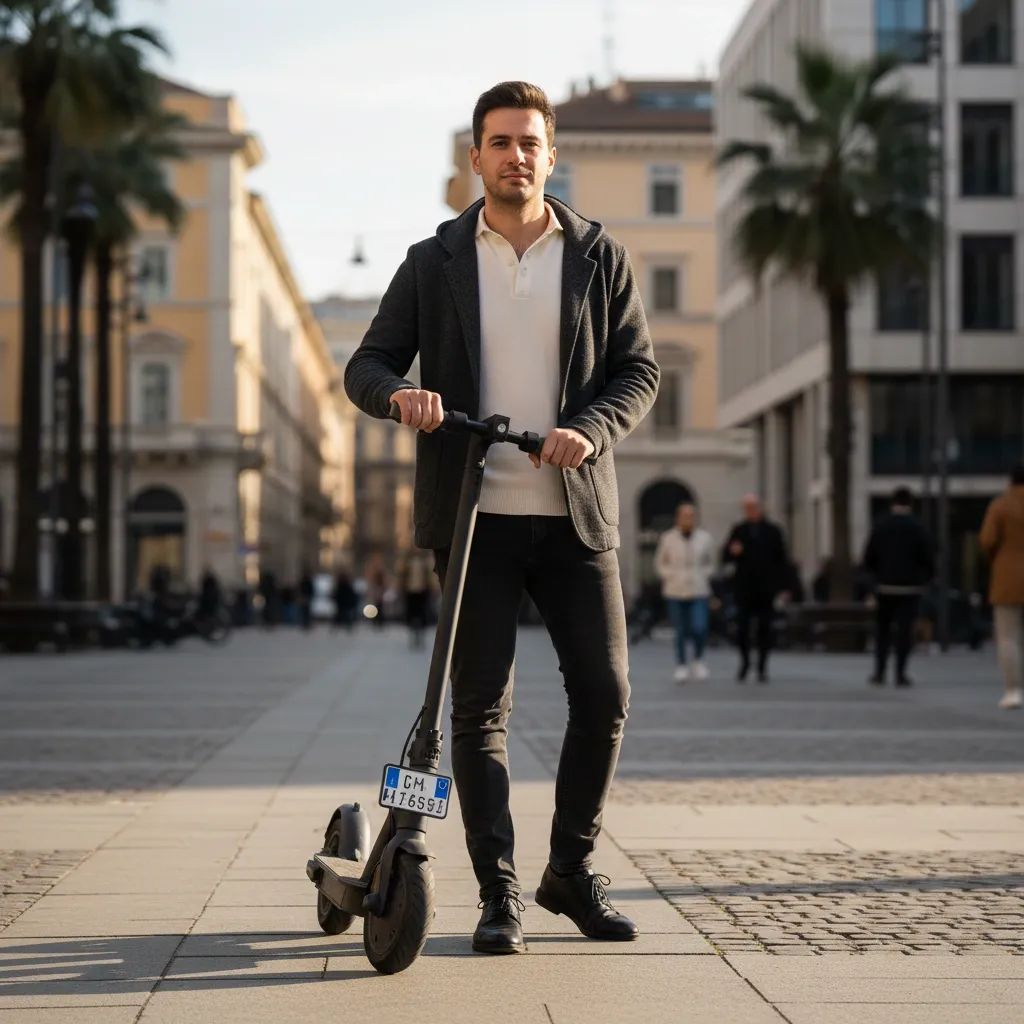
The Italy Ministry of Transport has set a hard deadline of May 16 for all electric scooter owners to affix a mandatory identification sticker to their vehicles—or face fines reaching €400. But a flood of applications has overwhelmed the system, and consumer group Assoutenti warns that tens of thousands risk penalties not because of negligence, but because the infrastructure can't keep pace with demand.
Why This Matters
• Deadline pressure: Anyone riding without the "targhino" after May 16 faces fines between €100 and €400; repeat offenders can have their scooter confiscated.
• Cost burden: The sticker itself costs around €35 if you handle it yourself, or up to €80 via an agency—and that's before mandatory insurance kicks in on July 16.
• System bottleneck: Appointments to collect stickers at Italy Motorization offices are scarce, and it's unclear whether applicants who file on time but receive their sticker late will be penalized.
A Sticker, Not a License Plate—But Just as Binding
Unlike a traditional vehicle plate, the targhino is a 5×6 cm adhesive label tied to the owner, not the scooter. That means if you swap machines, you can transfer the sticker. The Italy Portale dell'Automobilista handles applications, which require SPID or a digital ID card. Once approved, owners must book an appointment to collect the physical sticker at a Motorization office, then affix it permanently to the rear fender or steering column—oriented vertically and clearly legible.
The regulation is part of a broader push to bring e-scooters under the same accountability framework as mopeds and motorcycles. Since 2023, when crashes involving e-scooters jumped nearly 15% to 3,365 incidents—resulting in 21 deaths—lawmakers have moved to mandate helmets, turn signals, brake lights, and now identification.
The Appointment Crisis
Here's where the system is breaking down. After submitting the application and paying via PagoPA—a total of approximately €8.66 for the sticker, €10.20 in Motorization fees, and €16 in stamp duty—applicants must schedule a pickup. But with hundreds of thousands of scooters on the road and a two-month window to comply, appointment slots have become scarce.
On April 14, the Italy Ministry of Transport issued Directive 110, attempting to ease congestion: applicants who filed by May 16 can now collect their sticker without an appointment at designated counters (Sportello 8) on Mondays, Wednesdays, and Fridays between 08:30 and 11:30. The Portale dell'Automobilista is also urging users who booked late-May or June slots to cancel and rebook earlier—or use the walk-in option.
Yet Assoutenti argues the ministry hasn't clarified the most critical question: What happens if you applied before the deadline but the sticker arrives after? Consumer advocates are calling for a grace period or proof-of-application exemption to shield compliant citizens from sanctions during the administrative backlog.
What This Means for Residents
If you own an e-scooter and haven't started the process, here's your action plan:
Apply immediately via the Portale dell'Automobilista. You'll need SPID or CIE, proof of purchase, and payment via PagoPA.
Check walk-in eligibility: If you submit by May 16, you can skip the appointment bottleneck and collect your sticker at Sportello 8.
Keep proof of submission: Screenshots of your application confirmation and payment receipt may be your only defense if you're stopped before the sticker arrives.
Budget for insurance: From July 16, liability coverage (RC) becomes mandatory, with annual premiums estimated between €40 and €100.
The sticker is just the first wave. By mid-July, every scooter must carry third-party liability insurance, mirroring the regime for motorcycles. Insurers are still finalizing policies, but early quotes suggest €60 to €80 for basic coverage—a recurring annual cost that will redefine the economics of micro-mobility in Italy.
Broader Safety Crackdown
The targhino requirement is one piece of a comprehensive regulatory overhaul. Since January, helmets are compulsory for all riders, not just those under 18. Scooters must be equipped with turn indicators and brake lights, and the maximum speed remains 20 km/h, dropping to 6 km/h in pedestrian zones. Riding on sidewalks, rural roads, tunnels, or even bike lanes is now prohibited.
These rules align Italy more closely with neighbors like Germany, which has required insurance plates since 2019, and Spain, which has introduced similar identification and insurance requirements. France imposes insurance but no physical tag. The United Kingdom remains an outlier, treating private e-scooters as unlicensed motor vehicles and banning them outright from public roads outside pilot rental schemes.
The Bureaucratic Squeeze
Italy's scooter owners are caught in a familiar trap: a well-intentioned safety regime undermined by execution. The technology to issue digital or mail-order stickers exists—Spain's VMP system, for instance, allows online delivery—but Italy's Motorization apparatus remains tethered to in-person procedures. The April 14 directive was a concession to reality, not a solution.
For now, the Italy Ministry of Transport insists the system is coping. "Motorization is continuously monitoring availability and progressively expanding appointment capacity," the Portale dell'Automobilista states. But with no formal amnesty for applicants stuck in the queue, riders face a Kafkaesque scenario: they've done everything the law asks, yet remain vulnerable to fines because the state can't process their paperwork in time.
Numbers Behind the Narrative
While exact registration data isn't yet public, indirect indicators suggest the scale. In 2023, over 3,300 accidents involved e-scooters, implying a fleet in the tens of thousands—possibly exceeding 200,000 units nationwide. If even half file before the deadline, Motorization offices face a tsunami of walk-ins and pickups. The €35 to €80 sticker fee, multiplied across this base, represents a multi-million euro revenue stream—yet the ministry appears to have underestimated logistical demand.
The insurance obligation will offer clearer numbers. Once policies go live in mid-July, the Italy Insurance Supervisory Authority (IVASS), the national regulator, will track active contracts, giving the first accurate census of compliant scooters. Until then, riders and officials alike are navigating blind.
A Test of Micro-Mobility's Future
E-scooters promised a greener, nimbler alternative to cars in congested Italian cities. But the targhino fiasco underscores the tension between innovation and regulation. The Italy Cabinet wants accountability—traceability for hit-and-runs, insurance for victims, helmets to cut fatalities. Yet the rollout has amplified the very friction that drove users to scooters in the first place: bureaucracy, cost, and uncertainty.
If the system stabilizes and compliance becomes routine, the targhino could prove a model for the rest of Europe. If it collapses into a patchwork of fines, exemptions, and legal challenges, it will serve as a cautionary tale—proof that good policy needs good logistics. For Italy's estimated 200,000+ e-scooter owners, the next week will determine whether they're pioneers of sustainable transport or caught in a system unable to process their paperwork in time.


