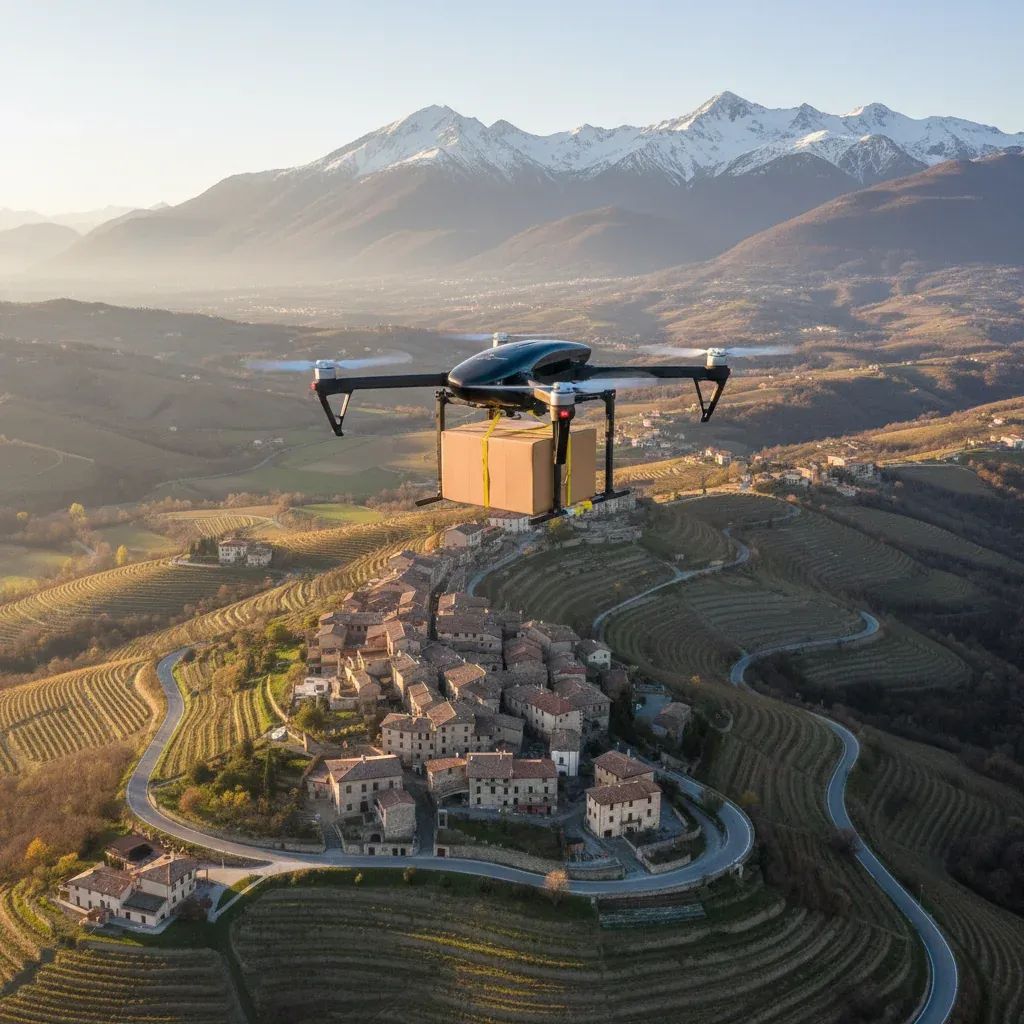
Italy's transport and logistics sector is rapidly pivoting toward an aerial future, where cargo and eventually passengers will travel by drone—a development that could reshape delivery economics, particularly in regions where conventional transport infrastructure struggles. The shift represents not a replacement of traditional methods, but an integration that leverages existing hubs and networks to unlock new efficiencies.
Why This Matters
• Regulatory transition: As of January 1, 2026, Italy fully adopted EU drone regulations, replacing national exemptions with a unified risk-based framework requiring costly fleet upgrades for many operators.
• Market acceleration: Italy's professional drone market hit €168M in 2025 (up 5%), with projections pointing to €1.46B by 2030 across advanced air mobility.
• Operational reality check: Only 9% of cargo drone projects globally are fully operational; 54% remain experimental, underscoring the gap between ambition and deployment.
The Numbers Behind the Aerial Push
Data presented by Federtrasporto (the transport arm of Italy's industrial confederation Confindustria) in collaboration with Freight Leader Council reveals a global landscape of 656 active drone projects. Of these, 74% focus on freight (485 initiatives) while 26% target passenger transport (171 projects). Within the cargo segment, 56% handle general consumer goods and 44% involve medical supplies—a split that highlights the sector's dual focus on commercial logistics and urgent healthcare delivery.
The Politecnico di Milano's 2025 Observatory on Drones and Advanced Air Mobility report, unveiled at the Federtrasporto gathering, paints a picture of cautious experimentation. For freight operations, 54% are in trial phases, 34% are at the announcement stage, and just 9% have achieved full commercial status. Passenger transport lags further: 65% of projects remain announcements, with only 35% in active testing.
Geographic distribution tells its own story. 58% of initiatives concentrate on urban environments, where last-mile congestion and pollution concerns drive demand, while 42% serve extra-urban zones—rural areas, mountainous terrain, and islands where traditional delivery is either prohibitively expensive or logistically impractical.
Medical Supply Chains Lead the Charge
Healthcare logistics has emerged as the proving ground for drone delivery in Italy. Medical drones primarily carry diagnostic equipment (37%), pharmaceuticals (32%), and biological samples and blood products (23%). Crucially, 72% of these operations focus on the final kilometer, delivering time-sensitive materials from hospitals to remote clinics or from distribution centers to underserved areas.
Real-world trials are multiplying. In Abruzzo, drones have flown urgent medications from Avezzano hospital to the mountain village of Collelongo as part of the U-ELCOME project, targeting isolated communities in the Sirente-Velino Regional Natural Park. Tuscany's ASL Toscana Nord Ovest is building an integrated aerial health logistics network designed to slash delivery times from hours to minutes and optimize personnel deployment. Similar experiments are underway in Lombardy (connecting Varese's Circolo hospital to Malpensa airport), Veneto (hydrogen-powered drones at Padova airport), and across Campania, Puglia, and Sicily for hospital-to-pharmacy links in isolated locales.
The healthcare advantage is clear: when a rural clinic needs a rare blood type or a chemotherapy drug with a narrow temperature window, a drone can cover terrain impassable by road or bridge closures in a fraction of the time. This capability proved its value during flood emergencies and winter snowstorms, when ground transport failed.
What This Means for Operators and Businesses
The regulatory landscape shifted decisively at the start of 2026. Italy's ENAC (Civil Aviation Authority) now enforces the full EASA (European Union Aviation Safety Agency) framework, eliminating the national workarounds that once gave Italian operators flexibility. The old distinction between "recreational" and "professional" use has vanished, replaced by a risk-based categorization: Open (low risk), Specific (medium risk requiring authorization), and Certified (high risk, akin to manned aviation).
Most logistics operations fall into the Specific category, demanding either a SORA (Specific Operations Risk Assessment) or adherence to standardized European scenarios (EU-STS). Drones must now carry CE class markings—C0 through C4 for Open operations, C5 or C6 for Specific scenarios. Older machines lacking these certifications face severe operational limits or outright grounding.
For operators in restricted airspace—such as the ATM-09 zones around airports—the burden is steeper. Previously, Italian national standards allowed workarounds; the EU-STS framework mandates C5 or C6 certified aircraft for these areas. Companies using legacy equipment face a choice: invest €8,000 to €15,000 per drone for compliant models, retrofit existing units with safety kits (parachutes, flight terminators) at added cost and reduced payload, or halt operations. Charging stations for larger fleets can run €50,000 or more, and annual insurance and compliance costs hover around $4,000 per operator.
Italy now counts over 148,000 registered remotely piloted aircraft and 185,000 licensed operators, a substantial increase that reflects both the sector's growth and the tightening regulatory net. Pilot certifications (A1/A3 and A2 ratings) remain valid but must align with the new European standards, and registration on platforms like D-Flight is mandatory for nearly all commercial activity.
Economic Promise Versus Practical Barriers
The cost equation for drone delivery is nuanced. Urban routes under 10 km carrying parcels below 5 kg can cut delivery expenses 40% to 60% compared to traditional couriers, with drone costs averaging $0.25 to $0.35 per kilometer versus $1.10 for vans or trucks. Electric drones incur just $0.18 in energy per trip, compared to $7.50 for combustion-engine vehicles. A single drone operator can oversee multiple aircraft simultaneously, slashing labor costs—drone technicians earn roughly $14 per hour, a 65% saving over traditional drivers at $26 per hour.
Yet the upfront investment remains daunting. Beyond aircraft acquisition, companies must budget for navigation software, routing optimization tools, pilot training, and regulatory compliance—easily exceeding €100,000 for a small fleet. In the early stages, per-delivery costs can run up to 30 times higher than conventional methods in non-optimized scenarios, though this gap is expected to narrow to 15 times as technology matures and economies of scale kick in.
For distances beyond 20 km or payloads exceeding 5 kg, traditional trucks and vans retain the edge. Drones also struggle with adverse weather, limited battery autonomy (a persistent technological bottleneck), and the need for landing and charging infrastructure that barely exists outside major metropolitan areas.
Italian Innovators in the Field
Several Italy-based companies are pushing the envelope. Drone Docks, a startup from Varese, has patented an automated docking system that allows aircraft to pick up and drop off parcels without landing, enabling fully autonomous operation to yachts, alpine refuges, and other hard-to-reach destinations. The company claims its technology can halve delivery costs while operating seven days a week and significantly reducing urban traffic.
ALTA Drone Delivery offers nationwide services emphasizing sustainability, safety, and speed, targeting rural, maritime, and urban zones as well as just-in-time industrial logistics. The company positions itself as a complement to existing supply chains, particularly for critical components in manufacturing and emergency relief.
Leonardo, Italy's aerospace giant, partnered with Poste Italiane and the startup FlyingBasket on the "Sumeri Moderni" project, testing an electric FB3 VTOL cargo drone with 100 kg payload capacity for middle-mile deliveries (15 to 50 km) between postal sorting centers in Turin. The objective is to develop scalable aerial logistics capable of moving hundreds of kilograms, bridging the gap between regional hubs and local distribution points.
Beyond Italy's borders, Italian-built cargo drones have logged over 600 flights servicing offshore wind farms in the United Kingdom, ferrying tools and parts to turbine platforms and cutting maintenance times and costs drastically compared to helicopter or crane alternatives.
Infrastructure and Urban Air Mobility
Italy inaugurated its first vertiport in Rome in 2023, designed to support commercial air taxi services between Fiumicino airport and the city center, initially targeted for the 2025 Jubilee. Milan is developing a complementary network. ENAC coordinates the AURORA project, a distributed national testbed for evaluating navigation technologies for unmanned aerial systems in the context of Urban Air Mobility (UAM).
These facilities represent the physical backbone of a future where aerial transport is routine. Yet only 3% of Italy's drone mobility projects are fully operational, with 57% still experimental. The transition from pilot programs to commercial-scale deployment hinges on resolving battery range, weather resilience, and integration with existing air traffic management—collectively known as U-space, a traffic control ecosystem for unmanned aircraft that remains under construction.
Impact on Residents, Businesses, and Investors
For individuals living in Italy, drone logistics promises faster delivery of e-commerce parcels, medicines, and emergency supplies, particularly in the South, mountainous regions, and islands where postal service is slower and more expensive. Rural residents and those in peripheral areas stand to benefit most, gaining access to goods and services previously out of reach or subject to multi-day delays.
Businesses, especially in logistics, healthcare, and industrial maintenance, face both opportunity and disruption. Early adopters can capture market share and reduce operating costs, but laggards risk obsolescence as competitors embrace aerial delivery. Investors are eyeing a market projected to reach €1.46 billion by 2030, driven by regulatory maturity, infrastructure buildout, and corporate adoption.
Privacy and noise concerns linger. Drones equipped with cameras raise surveillance fears, prompting calls for strict data protection enforcement. Acoustic pollution from frequent flights over residential areas remains contentious, and municipalities are beginning to draft local ordinances to manage flight paths and operating hours.
Job impacts are mixed. While traditional delivery driver roles may contract, demand is rising for drone technicians, certified pilots, navigation software engineers, and maintenance specialists. Industry projections suggest thousands of new positions will emerge, though reskilling and training programs will be essential to avoid displacement.
The Path Forward
Paolo Colombo, president of Federtrasporto, framed the challenge succinctly at the recent conference: "Drones are an integration of transport modes. We must leverage the infrastructure and hubs we already have, networking them to develop concrete operational cases and identify solid business models."
That pragmatism reflects the industry consensus. Drones will not replace trucks, trains, ships, or planes; they will fill gaps, handle niche routes, and accelerate time-sensitive deliveries. The question is no longer if aerial logistics will scale, but how quickly Italy can navigate the regulatory, technological, and infrastructural hurdles.
The Dronitaly 2026 conference (March 11–13 in Bologna) will serve as a key forum for industry players, researchers, and regulators to align on next steps, forge partnerships, and showcase operational successes. As the sector matures, the fusion of traditional transport networks with aerial capabilities could redefine Italy's competitive position in European logistics, transforming a country long challenged by mountainous terrain and fragmented infrastructure into a testbed for the future of freight.