
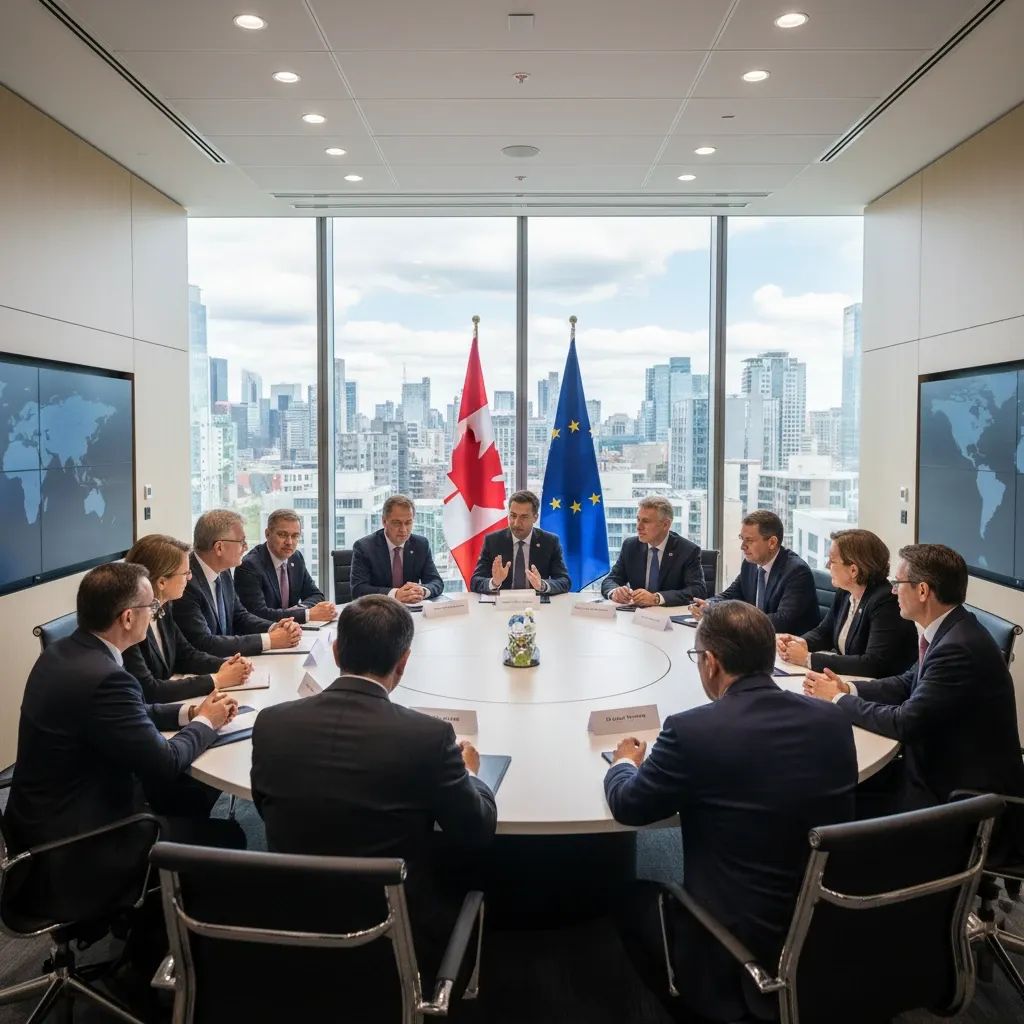
The Democratic Party (PD) of Italy is making a deliberate push to anchor the country within a reconfigured global progressive alliance, one that increasingly looks to Europe—rather than the United States—as the center of gravity for defending democratic norms and international law. On May 9, PD secretary Elly Schlein addressed the Global Progress Action Summit in Toronto, where she met with former U.S. President Barack Obama and Mark Carney, the Canadian Prime Minister (who became PM in 2025, after his tenure as Governor of the Bank of Canada). The meeting framed the moment as a critical juncture for those who refuse to accept a world order dictated by "the strongest and the richest."
Why This Matters
• Strategic Pivot: Italy's center-left is aligning with a Canada-EU-UK axis that seeks to diversify away from over-reliance on Washington, particularly amid renewed questions about U.S. commitment to NATO and multilateral institutions.
• Diplomatic Signal: Schlein's meeting with Carney—who has publicly stated that the international order "will be rebuilt from Europe"—signals PD's endorsement of a Euro-centric reconstruction of global governance.
• Domestic Stakes: The positioning sets up a stark contrast with Italy's current government, which the PD accuses of insufficient investment in renewable energy, inadequate cooperation budgets, and ambiguous stances on conflicts in Ukraine and the Middle East.
A Summit Built for Uncertain Times
The Global Progress Action Summit, co-hosted by the Center for American Progress Action Fund and the Canadian think tank Canada 2020 at Toronto's Fairmont Royal York Hotel, convened political leaders and policy experts from across the globe. This year's agenda centered on defending peace, combating authoritarianism, curbing corruption, and ensuring democracies deliver tangible results for citizens. A specific session addressed the responsibility of governments to tackle the digital crisis affecting youth.
For Schlein, this marks her second consecutive appearance at the summit, following last year's edition in London. Her intervention on Saturday came shortly before Carney's closing remarks, underscoring the alignment between the PD and the Canadian premier's vision. "Someone is trying to dismantle the international order and replace international law with the law of the strongest and the richest," Schlein told reporters. "It's a shared concern, and it's important to be here with so many other progressive and democratic forces from around the world."
Carney's Vision and the European Anchor
The encounter with Mark Carney holds particular weight. During recent discussions in the South Caucasus, including his engagement in Armenia on regional security matters, Carney has articulated a geopolitical future in which Europe assumes a central role in reconstructing an international order based on rules, especially as confidence in U.S. reliability wavers. His remarks in recent weeks have emphasized a strategic bloc anchored by Canada, the European Union, the United Kingdom, Australia, and other democracies that share commitments to the rule of law and democratic governance.
Schlein explicitly thanked Carney for his comments regarding the international order, noting that "it will be rebuilt, and it will be rebuilt starting from Europe." This formulation represents a departure from the post-World War II model in which American leadership and institutions like NATO, the UN, the World Bank, and the IMF were the primary guarantors of stability. While Barack Obama has historically celebrated that order as a triumph of U.S.-led cooperation, Carney's current framing suggests a multipolar recalibration in which Europe is not a beneficiary but the architect.
For Italy's Democratic Party, this is more than symbolic positioning. The PD is affiliated with the Party of European Socialists (PES)—a Europe-wide coalition of center-left parties—and sits in the Progressive Alliance of Socialists and Democrats group in the European Parliament. Schlein has repeatedly emphasized the need for a united European response to right-wing forces that, in her view, "fuel wars, social inequalities, and the destabilization of democracies."
Italy's Progressive Foreign Policy in 2026
The PD's global positioning reflects a broader set of foreign policy commitments that diverge sharply from those of Italy's current government. On Ukraine, the party supports continued assistance and Ukraine's path toward EU membership, insisting on adherence to international law. On the Middle East, the PD has condemned actions that drag the region into chaos and advocates for the recognition of a Palestinian state alongside Israel, while criticizing Israeli Prime Minister Benjamin Netanyahu's policies.
The party's foreign affairs chief, Peppe Provenzano, has invoked Italy's constitutional principle that "repudiates war as a means of resolving international disputes," urging the government not to back unilateral military actions. Schlein herself has described statements by Donald Trump regarding potential U.S. troop withdrawals from Europe as "unreliable," linking his policies to those of Netanyahu and warning of increased disorder and instability.
On climate and energy, the PD criticizes the current Italian government for failing to invest adequately in renewable energy and for relying on nuclear rhetoric without concrete action. The party frames investment in renewables and energy efficiency as both an environmental imperative and a strategic response to geopolitical instability, particularly in light of Europe's energy vulnerability. "There is no planet B," Schlein has said, urging a "double transformation, both green and digital."
Building a Global Progressive Network
Schlein's participation in the Toronto summit is part of a deliberate effort to construct an international progressive network capable of countering nationalist and sovereigntist movements. The PD is active in the Global Progressive Mobilisation, a coalition of center-left parties and movements that coordinates strategies across borders. At the summit, Schlein emphasized the need to "put peace, dialogue, and cooperation back at the center."
The meeting with Obama—who has long defended the liberal international order and the institutions created after World War II—offers symbolic continuity, even as the geopolitical architecture shifts. Obama's historical framing of U.S. involvement in European reconstruction through the Marshall Plan and NATO underscores the post-1945 settlement. The May 2026 Toronto summit reflects a current strategic reassessment: whether that order can be sustained or must be rebuilt with different leadership and a European core.
What This Means for Italy
For residents of Italy, the PD's positioning at the Toronto summit has several concrete implications.
First, on defense and NATO: The party supports deeper European defense integration through the proposed European Defense Fund and autonomous military capacity. This could directly affect Italy's role at NATO bases on Italian territory—the PD advocates for stronger European coordination within NATO, reducing sole reliance on U.S. strategic decisions. Under a PD government, Italy might pursue greater involvement in EU defense initiatives alongside existing NATO commitments.
Second, on economic ties and trade: A shift toward the "Canada-EU-UK axis" could reshape Italy's commercial priorities. The PD supports prioritizing EU trade agreements and renewable energy partnerships over transactional U.S. deals. This affects Italian industries dependent on export markets and companies seeking to align energy strategies with European green standards rather than alternatives from outside the bloc.
Third, on energy and climate policy: The PD's emphasis on renewable energy investment directly counters current government policies. For Italian households and businesses, this signals potential support for EU carbon pricing mechanisms, expanded solar and wind development, and reduced dependence on non-EU energy sources. This aligns Italy with European climate commitments and Mediterranean security interests by reducing vulnerability to external energy shocks.
Fourth, on development cooperation and Mediterranean strategy: The PD emphasizes soft power, development aid, and investment in the Mediterranean region. This could increase Italy's engagement in North Africa and the Middle East through EU channels rather than bilateral arrangements, affecting trade, migration policy, and regional stability efforts in which Italy has direct interests.
The party supports the concept of European strategic autonomy—a federal vision that would strengthen the bloc's capacity to act independently in foreign policy, making Italy less dependent on external powers for security decisions.
A Moment of Reckoning
The Global Progress Action Summit in Toronto represents a convergence of progressive parties around a strategic recalibration at a time when post-Cold War assumptions are under strain. For the Democratic Party of Italy, the summit is both a statement of values and a strategic positioning: advancing the view that the international order must be rebuilt through a coalition of democracies with Europe at its core, rather than through any single hegemon.
Whether that vision can be realized—and whether it resonates with Italian voters—will depend on the PD's ability to translate this global diplomatic engagement into specific domestic policies, and to convince the electorate that multilateralism and European integration provide concrete benefits for peace, prosperity, and security in an uncertain world.


