
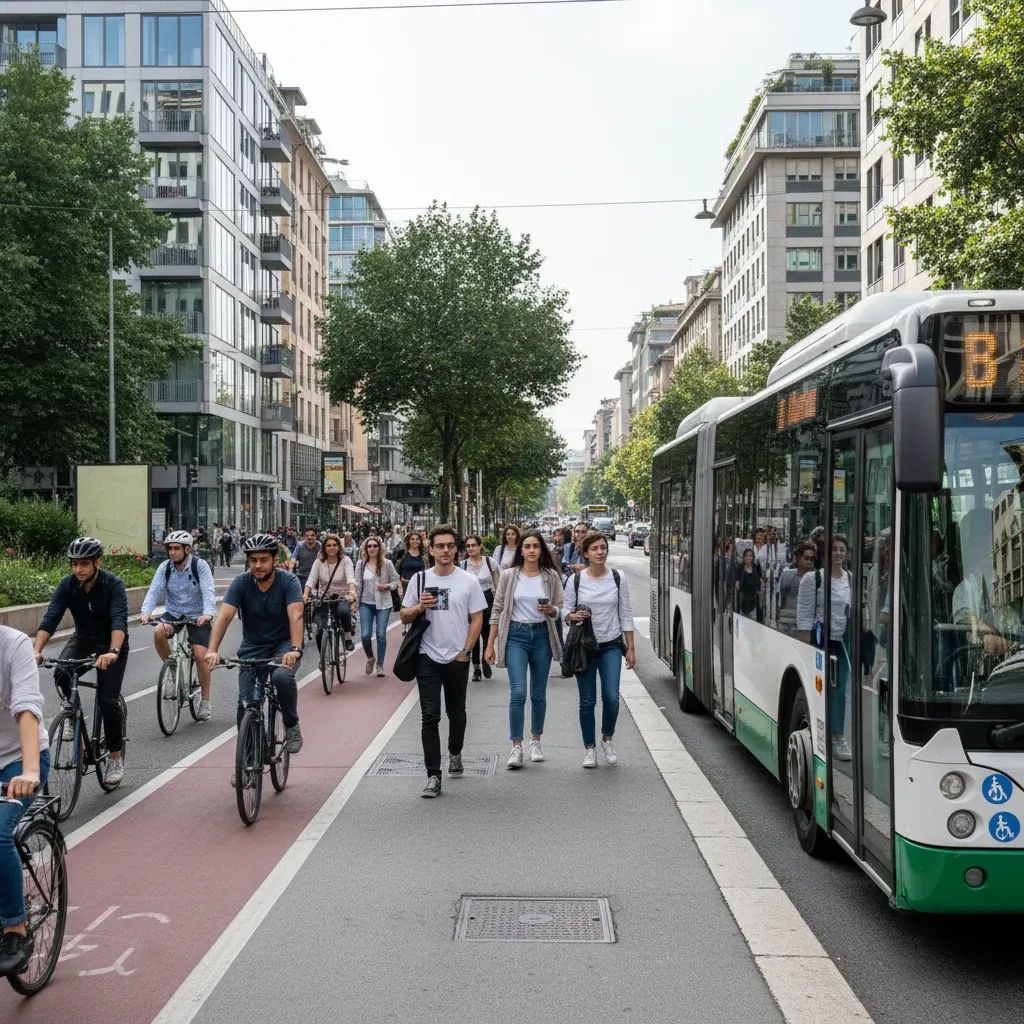
The Italian Ministry of Infrastructure and Transport has confirmed a significant behavioral shift among residents: sustainable mobility now accounts for 34.7% of all trips in 2025, up from just 27.6% a decade ago. That translates to more than one in three daily journeys being completed on foot, by bicycle, or via public transit—a threshold that marks Italy's most substantial progress toward decarbonization since the pandemic accelerated remote work adoption.
Why This Matters:
• Italians are traveling 35.4% fewer kilometers per day than in 2015, dropping from 36.1 km to just 23.3 km—a direct result of hybrid work and localized routines.
• Cars still dominate at 60.8% of all trips, but that figure is shrinking as public transit climbs to 8.9% and cycling surges to 5.2%.
• 40 million people move daily for work, school, or errands, generating 102.7 million trips—yet total trip volume has declined 4.1% since 2015.
The Shift Behind the Numbers
According to Consumers' Forum, an independent entity representing consumer associations, industry groups, and service providers, the mobility landscape has undergone a structural transformation. While the private automobile remains the default choice for six out of ten journeys—down from 63.1% in 2024—walking accounts for 20.6% of trips, and cycling/micromobility has grown to 5.2%, a 27% year-over-year increase.
The most striking trend, however, is not what residents are using, but how much less they're moving. Daily distance traveled per capita has plummeted by more than a third since 2015, a phenomenon largely attributed to the entrenchment of smart working and hybrid employment models. Data from the Polytechnic University of Milan's Smart Working Observatory shows 3.75 million Italians working remotely at least part-time in 2025, up 5% from the prior year. This eliminates or reduces commuting frequency, particularly in metropolitan areas where congestion and transit costs have historically been pain points.
Where the Green Gains Are Happening
Public transit ridership has rebounded modestly, rising from 8.0% to 8.9% of all trips between 2024 and the first half of 2025. High-speed rail has been a standout performer: Frecce services exceeded 2019 passenger volumes by 2%, while Intercity trains saw a 20% surge. Air travel also grew 20%, reflecting demand for long-distance connections. Yet local public transport (TPL) remains the weakest link, with service quality and coverage lagging far behind European peers.
Urban trips dominate the mobility mix: 81.3% of all journeys are shorter than 10 km, up from 78.3% in 2024. This hyper-local pattern reflects both the normalization of neighborhood-based routines—grocery runs, school drop-offs, leisure—and the persistent inadequacy of regional transit infrastructure. In southern and central cities, TPL usage is up to eight times lower than in comparable European hubs like Prague or Madrid.
What This Means for Residents
If you live in Italy, these statistics translate to tangible shifts in daily life:
• You're likely driving less per trip, even if you still own a car. The national vehicle fleet stands at 41.3 million cars (more than 70 per 100 inhabitants, the highest rate in Europe), but average monthly household spending on automobiles—€334 in 2024—suggests Italians are maintaining ownership while reducing usage intensity.
• Cycling infrastructure is expanding, particularly in northern cities. The National Recovery and Resilience Plan (PNRR) has allocated funds for 11 km of new metro lines, 85 km of tram routes, and 120 km of trolleybus corridors to be completed by the end of 2026.
• Mobility-as-a-Service (MaaS) pilots are rolling out in 13 metropolitan capitals, aiming to integrate buses, trains, car-sharing, and micromobility into a single digital platform—though intermodal usage remains marginal for now.
The Ministry of Environment and Energy Security (MASE) has committed €500 M to municipalities with populations over 50,000 and air quality issues (PM10, nitrogen oxides), targeting mobility management, shared transit, and urban logistics. Nine Italian cities—Milan, Rome, Bologna, Florence, Turin, Bergamo, Padua, Parma, and Prato—have earned the European Commission's "Mission City" label, unlocking additional funding to achieve climate neutrality by 2030.
Why Italy Still Lags Europe
Despite incremental gains, Italy's mobility profile reveals stubborn obstacles:
• Chronic underfunding: The National Transport Fund has lost €4 B in real value over five years due to inflation and inconsistent budgeting. Meanwhile, 87% of infrastructure spending through 2038 is earmarked for megaprojects like the Strait of Messina Bridge, diverting resources from urban and regional lines that have been shuttered for over a decade.
• Obsolete rolling stock: Many regional trains and city buses are decades old. The PNRR's €3.64 B for fleet renewal (including hydrogen and electric units) aims to address this, but procurement and delivery timelines extend into 2026.
• Low-quality service perception: Satisfaction with public transit is significantly lower in Italy than in northern European capitals, discouraging modal shift. Almost four in ten Italians report being "forced to depend" on their car due to inadequate alternatives.
• North-South disparity: TPL coverage and frequency in the Mezzogiorno are far below northern standards, reinforcing car dependency in regions where economic pressures already limit mobility options.
• Electric vehicle uptake is sluggish: Despite regional incentives for EV purchases and scrapping schemes, Italy's EV market penetration trails France, Germany, and the Netherlands. The Ministry of Infrastructure has allocated €13 M for 2025 to subsidize alternative-fuel commercial vehicles (methane, LNG, hybrid, electric), with an additional €9.3 B from 2026 to 2032 for public mobility services and proximity hubs in underserved areas.
The Freight and Logistics Angle
While passenger mobility garners headlines, Italy's freight sector is undergoing parallel transformation. In Q3 2025, heavy vehicle traffic rose 1% on the ANAS network and 2% on toll highways, with a cumulative 7% increase since 2019. Air freight grew 3% year-over-year, and 19% since 2019. The Italian freight and logistics market is projected to reach $117.61 B in 2025 and $121.88 B in 2026, with road haulage commanding 52.74% of total revenue.
Yet the sector faces headwinds: driver shortages, aging workforces, and elevated operating costs are squeezing profitability. Industry forecasts for 2026 anticipate near-zero GDP growth, prompting consolidation toward larger operators with stronger balance sheets. The Ministry's €13 M subsidy for alternative-fuel trucks and innovative trailers for intermodal transport is a modest intervention in a market requiring structural reform.
The Road to 2026 and Beyond
Italy's trajectory toward greener mobility hinges on execution, not ambition. The PNRR's 2026 deadline looms large: all funded projects—metro extensions, bus fleets, MaaS platforms—must be operational by year-end. The €23.8 B earmarked for sustainable infrastructure represents the country's largest-ever commitment to decarbonizing transport, but bureaucratic delays, multitiered governance, and political wrangling have historically stalled implementation.
For residents, the immediate outlook is incremental improvement: more bike lanes, cleaner buses, marginally better TPL frequency in select cities. The 34.7% sustainable mobility rate is a hard-won achievement, yet it underscores how far Italy remains from peers like the Netherlands (where cycling alone accounts for 27% of trips) or Austria (where public transit serves over 20% of journeys).
The €9.3 B mobility fund (2026-2032) signals long-term intent, but whether Italians can credibly reduce car dependency depends on whether service quality and geographic equity catch up to funding announcements. Until then, the average resident will continue to own a car—and use it for six out of ten trips—while slowly, grudgingly, walking, cycling, or boarding a bus for the remainder.


