
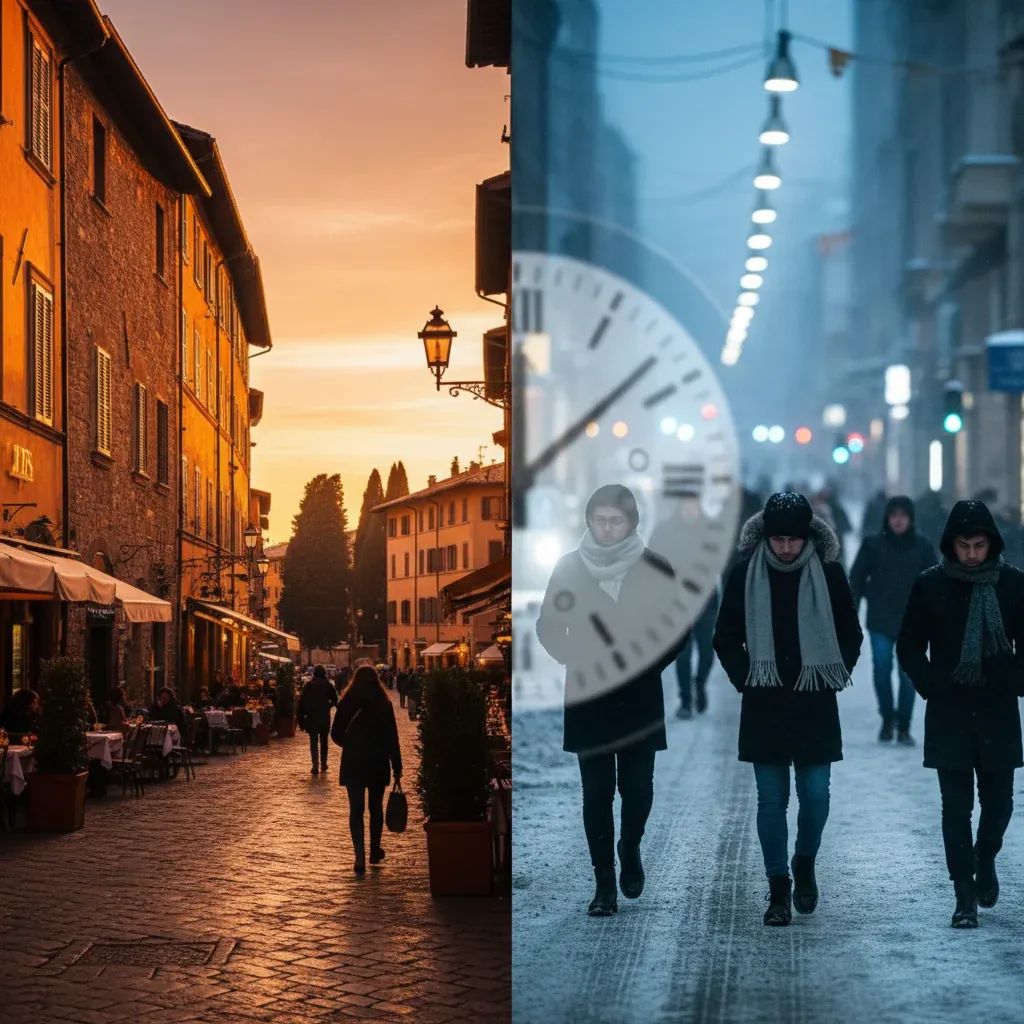
The Italian Chamber of Deputies has launched a formal inquiry into making daylight saving time permanent, a policy shift that could eliminate the biannual clock changes and reshape daily life for millions of residents across the peninsula. The decision, approved by the Productive Activities, Commerce and Tourism Commission (Commission X), sets in motion a six-month evaluation process that will culminate in a legislative proposal by June 30.
Why This Matters
• Energy savings: Data from Terna, Italy's transmission system operator, shows daylight saving time generated €2.3B in household savings between 2004 and 2025 through reduced electricity consumption.
• CO2 reductions: Environmental advocates estimate 160,000-200,000 fewer tonnes of carbon emissions annually, equivalent to planting between 2M and 6M trees.
• Health concerns: Medical experts warn permanent daylight saving could affect circadian rhythms and workplace productivity, with particular concern about winter mornings becoming darker.
• European gridlock: Italy cannot act unilaterally—any change depends on coordinated EU decisions to avoid creating a patchwork of conflicting time zones across internal borders.
What Drove the Parliamentary Investigation
The inquiry stems from a citizen-backed campaign organized by the Italian Society of Environmental Medicine (SIMA), consumer advocacy group Consumerismo No Profit, and Lega deputy Andrea Barabotti. The initiative collected over 352,000 signatures demanding an end to the seasonal clock ritual that sees Italians adjust their watches twice yearly.
This movement echoes broader European frustration. In 2018, the European Commission conducted a continent-wide consultation that attracted 4.6M respondents—an unprecedented level of civic engagement for an EU policy question. A striking 84% supported abolishing the clock change altogether, though preferences split between permanent summer time (the majority position) and permanent winter time.
The European Parliament responded in 2019 with a directive granting member states autonomy to choose their preferred time regime. Yet the proposal collapsed at the Council of the European Union, where divergent national interests and the COVID-19 pandemic froze negotiations. Southern states like Italy, France, and Spain generally favor extended evening daylight, while Nordic countries such as Finland and Poland lean toward winter time aligned with natural solar patterns.
The Economic Case for Extended Daylight
Proponents point to substantial financial and environmental benefits. According to Terna's official figures, keeping clocks forward during the traditional daylight saving months has prevented 12B kWh of electricity consumption since 2004. Translated into household budgets, this represents approximately €2.3B in cumulative savings—roughly the equivalent of three months' rent in Rome for every Italian family when averaged over two decades.
The energy argument rests on simple logic: longer evening daylight reduces artificial lighting demand during peak hours when businesses, restaurants, and households simultaneously draw power. Studies submitted to European authorities suggest that maintaining summer hours year-round could amplify these savings and simplify cross-border transport logistics.
Environmental groups add a climate dimension. SIMA calculates that extended daylight hours contribute to reducing Italy's annual carbon footprint. For a country struggling to meet EU emissions targets, such gains carry political weight.
Tourism and retail sectors see commercial upside in brighter afternoons and evenings. Trade associations have historically backed measures that extend shopping hours and outdoor dining seasons, viewing permanent daylight saving as a subtle economic stimulus requiring no government expenditure.
Medical and Scientific Considerations
The inquiry mandate specifically calls for "objective evaluation" of potential drawbacks—a recognition that not all stakeholders embrace the change. Sleep researchers and chronobiology specialists have raised concerns that permanent summer time could have physiological effects, particularly regarding morning light exposure patterns during winter months.
The concern centers on winter darkness. Medical experts warn that advancing clocks permanently could push winter sunrises later, potentially affecting circadian rhythm regulation in the population. Disruption of these rhythms is associated with health considerations in scientific literature.
Another consideration involves energy consumption modeling. While summer daylight clearly reduces evening lighting demand, the effectiveness of extending the model into winter requires further analysis. Households and offices still require illumination during morning peak hours—precisely when heating systems also strain the grid. The inquiry will examine whether winter savings could vary depending on regional latitude and weather patterns.
What the Inquiry Will Examine
The Chamber commission has outlined a comprehensive research agenda through June. Investigators will summon representatives from:
• Independent regulatory authorities and Terna for updated energy consumption modeling
• European Commission and European Parliament officials to clarify the stalled directive's status
• Industry federations including Confindustria, Confcommercio, and Confartigianato to assess productivity and labor impacts
• Consumer protection organizations to evaluate household effects
• Academic researchers specializing in chronobiology, public health, and behavioral economics
The commission will also consider gathering real-world data to address uncertainties about seasonal variations in energy consumption and public adaptation.
Critically, the inquiry will weigh regulatory coordination with neighboring states. Italy shares land borders with France, Switzerland, Austria, and Slovenia. If Rome adopts permanent summer time while neighboring countries maintain seasonal changes, cross-border commuters, freight schedules, and broadcast programming could face disruption. The 2019 EU directive envisioned synchronized decisions to preserve the functioning of the single market—a goal that remains elusive.
What This Means for Residents
For now, nothing changes. Italians will continue setting clocks forward in late March and back in late October under existing rules. But the formal investigation signals growing political momentum for reform, particularly if the June findings favor permanent daylight saving.
Should the commission recommend legislation and Parliament approve it, implementation would likely require EU clearance or at minimum coordination with France and other key trading partners.
In practical terms, permanent summer time would mean:
• Brighter evenings year-round: Extended evening daylight throughout the year, including winter months.
• Later winter sunrises: Winter mornings would have later sunrises compared to current seasonal time patterns.
• Simplified scheduling: No need to adjust clocks, update devices, or mentally recalibrate twice annually—a minor but widely appreciated convenience.
• Potential energy adjustments: The exact household impact depends on final modeling by Terna and other analysts.
The health implications are subjects the inquiry will examine. Families with young children and shift workers may experience adjustment considerations if winter morning light patterns change. Conversely, eliminating the autumn transition could have various effects on different population groups.
The Broader European Context
Italy's inquiry unfolds against a backdrop of continent-wide indecision. No EU member state has unilaterally abandoned seasonal clock changes since the 2019 directive stalled, partly due to legal ambiguity about whether existing EU regulations permit individual action. The Council's failure to advance the proposal leaves countries in limbo, able to debate but unable to implement without risking internal market violations.
Southern European nations face a unique calculus. Mediterranean climates and tourism-dependent economies arguably benefit from extended evening daylight. Yet the EU's consensus-driven governance structure requires coordinated decision-making across member states.
The Italian inquiry may therefore serve dual purposes: generating domestic policy options while contributing to broader EU discussions on this issue. If Rome produces compelling evidence regarding economic and environmental factors, it could inform the broader European debate.
Whether Italians will ultimately experience perpetual summer time—or continue the twice-yearly ritual indefinitely—remains an open question. The next three months of expert testimony, data analysis, and political deliberation through June will determine whether the 352,000 signatures translate into legislative reality or another consideration on Italy's policy agenda.


