
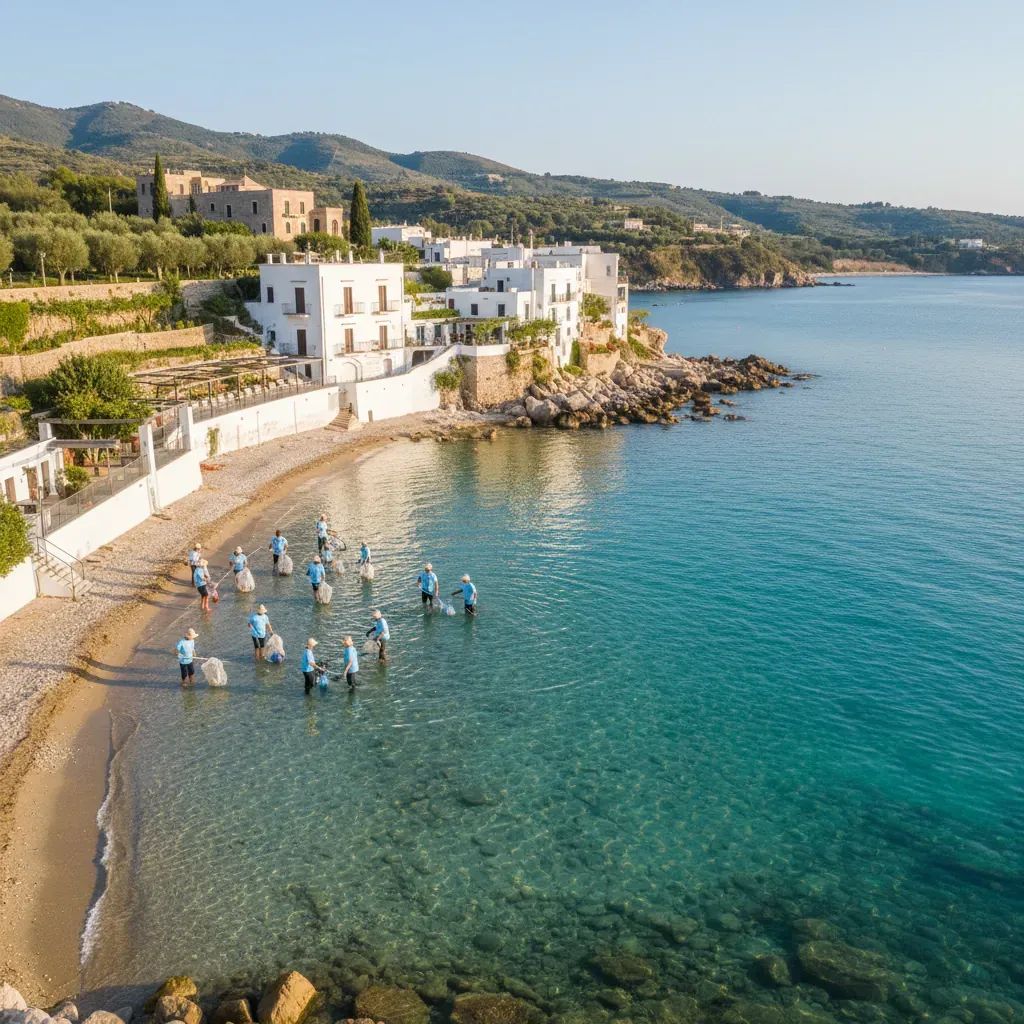
The Italian Ministry of Environment and Energy Security has officially backed the 2026 "Plastic Free Municipalities" awards, a recognition program that now covers 141 local councils across Italy—nearly triple the 49 municipalities recognized just four years ago. The ceremony, held yesterday at Rome's Teatro Olimpico, marked the fifth edition of an initiative that has quietly become a benchmark for environmental governance at the local level.
For residents and investors assessing Italy's commitment to sustainable infrastructure, these awards provide concrete proof that municipal-level action is accelerating. The recognition program, managed by Plastic Free Onlus—a volunteer organization founded in 2019—has now formalized partnerships with over 500 Italian municipalities and mobilized more than 250,000 volunteers who have collectively removed 5 million kilograms of plastic waste from Italian territory.
Why This Matters
• Top-tier municipalities receive the "three turtle" badge, a designation that signals robust anti-littering enforcement, plastic reduction ordinances, and active waste management—factors that impact public health, tourism appeal, and local property values.
• 24 municipalities in Abruzzo led all regions in 2026, followed by 20 in Sicily and 12 each in Lombardy and Veneto—revealing where environmental enforcement is strongest.
• Major cities now included: Rome, Milan, Turin, Bari, Verona, and Ancona received recognition for the first time, indicating that even Italy's largest urban centers are implementing measurable plastic reduction policies.
• Stricter evaluation criteria: Municipalities are assessed on 20 benchmarks, including deployment of surveillance cameras to catch illegal dumping, elimination of single-use plastics in public buildings, and collaboration with environmental NGOs.
The Three-Turtle Standard
Eleven municipalities achieved the program's highest honor—the three-turtle designation—for 2026. These include Aglientu (Sardinia), Agropoli, Bacoli, Cesa, and Pomigliano d'Arco (Campania), Bussi sul Tirino (Abruzzo), Camporotondo Etneo (Sicily), Castro (Apulia), Ferrara (Emilia-Romagna), Termoli (Molise), and Tortora (Calabria).
The evaluation framework is divided into four pillars: enforcement against environmental misconduct, territory-wide virtuous initiatives, urban waste management efficiency, and partnership with Plastic Free Onlus. Municipalities that deploy photo-trap cameras for illegal dumping, impose meaningful fines, and maintain environmental police units score higher on the enforcement pillar. Those that ban single-use plastics in municipal facilities, organize citizen education campaigns, and collaborate on beach and river cleanups gain points on the initiative front.
Bacoli, a coastal town in Campania, has now earned recognition for five consecutive years, establishing itself as a model for sustained environmental policy. The municipality has installed water purifiers in schools, distributed reusable bottles to students, and maintained a zero-tolerance policy for plastic waste on its beaches—a critical factor for its tourism-driven economy.
Regional Leaders and Capital City Breakthroughs
Abruzzo dominated the 2026 awards with 24 recognized municipalities, a sharp increase from 16 in 2025. This surge reflects coordinated regional policy, including stricter enforcement of Italy's anti-littering statutes and the deployment of municipal environmental guards. Sicily followed with 20 municipalities, while Lombardy and Veneto each secured 12. Campania and Apulia rounded out the top performers with 11 and 10 municipalities, respectively.
The inclusion of Italy's largest urban centers represents a shift in the program's reach. Rome's first-ever recognition signals that the capital has implemented enforceable plastic reduction measures across its sprawling territory. Milan, Turin, Bari, Verona, Ancona, and Pescara also made the list, demonstrating that Italy's major metropolitan areas are now integrating plastic-free policies into their waste management frameworks.
Other notable municipalities include Bergamo, Caltanissetta, Cremona, Cuneo, Enna, Latina, Olbia, Oristano, Pavia, Pisa, Ragusa, Rovigo, Teramo, and Vicenza. In Apulia, municipalities such as Gioia del Colle, Mola di Bari, Monopoli, Ceglie Messapica, Fasano, Avetrana, Castellaneta, and Manduria joined Castro in the recognition tier.
What This Means for Residents
For Italians living in or considering relocation to these municipalities, the Plastic Free designation carries practical implications. Recognized councils tend to enforce stricter penalties for illegal waste disposal—fines for littering can reach several hundred euros—and maintain cleaner public spaces, which correlate with higher property values and improved quality of life.
Municipalities with top ratings also benefit from enhanced public infrastructure: water purifiers in schools reduce reliance on bottled water, and plastic-free public events eliminate waste from festivals and markets. For families, this translates to reduced exposure to microplastics in local water sources and coastal areas.
From an investor perspective, municipalities with sustained environmental credentials present lower regulatory risk. Properties in towns like Bacoli, Ferrara, and Aglientu are less likely to face future restrictions tied to environmental degradation and may benefit from increased tourism as travelers prioritize eco-conscious destinations.
The Volunteer Network and Measurable Impact
Plastic Free Onlus has built a volunteer base exceeding 250,000 individuals, who have conducted nearly 10,000 cleanup operations since the organization's founding. These efforts have removed approximately 5,000 metric tons of waste from Italian beaches, rivers, agricultural zones, and urban centers. The organization has also reached 118,975 students through school programs, transforming 38 educational institutions into "Plastic Free Schools" through the installation of water purifiers and distribution of reusable bottles.
In addition to waste removal, the group has contributed to marine conservation, rescuing 165 sea turtles and supporting the hatching of over 1,000 more along Italy's coasts. The turtle motif, central to the awards program, reflects this dual focus on terrestrial waste management and marine ecosystem protection.
Luca De Gaetano, founder and president of Plastic Free Onlus, emphasized the scale of growth: "In 2022, only 49 municipalities participated. Now, in 2026, we have 141—a 15% increase from last year alone. But the real measure of success is the 5 million kilograms of plastic removed from our environment, made possible by the commitment of local administrations and the daily efforts of a quarter-million volunteers."
European Context and Comparative Benchmarks
Italy's municipality-level recognition program mirrors broader European Union initiatives aimed at incentivizing sustainable urban governance. The European Green Capital Award, established in 2008, grants €600,000 to cities over 100,000 inhabitants that demonstrate leadership in environmental, social, and economic sustainability. The European Green Leaf Award targets cities between 20,000 and 100,000 residents, offering up to €200,000 in funding for green growth projects.
The EU's New European Bauhaus Prize extends recognition to municipalities under 20,000 inhabitants, with awards up to €30,000 for projects that integrate ecological transition with cultural and aesthetic value. Italy's Plastic Free program operates independently but aligns with these EU frameworks, providing a localized mechanism for measuring and rewarding environmental performance.
The program also benefits from institutional backing: the European Parliament, the Italian Senate and Chamber of Deputies, and the Italian Ministry of Environment and Energy Security all provided patronage for the 2026 ceremony. Minister Gilberto Pichetto Fratin highlighted the central role of local government in combating plastic pollution, framing the awards as a tool for scaling successful policies across Italy's 7,904 municipalities.
The Path Forward
The 15% year-over-year growth in participating municipalities suggests that Italy's local councils are responding to both citizen pressure and regulatory expectations. The formalization of 20-criteria assessments—including waste management efficiency, enforcement mechanisms, and public education campaigns—provides a replicable model for other European nations seeking to quantify municipal sustainability.
For residents in recognized municipalities, the designation offers assurance that local government is actively enforcing environmental standards. For those in non-participating areas, the awards serve as a benchmark for advocacy, highlighting what proactive municipal policy can achieve. As the program enters its sixth year, the challenge will be maintaining momentum and ensuring that recognition translates into sustained, long-term environmental improvement rather than one-time initiatives designed to secure awards.


