
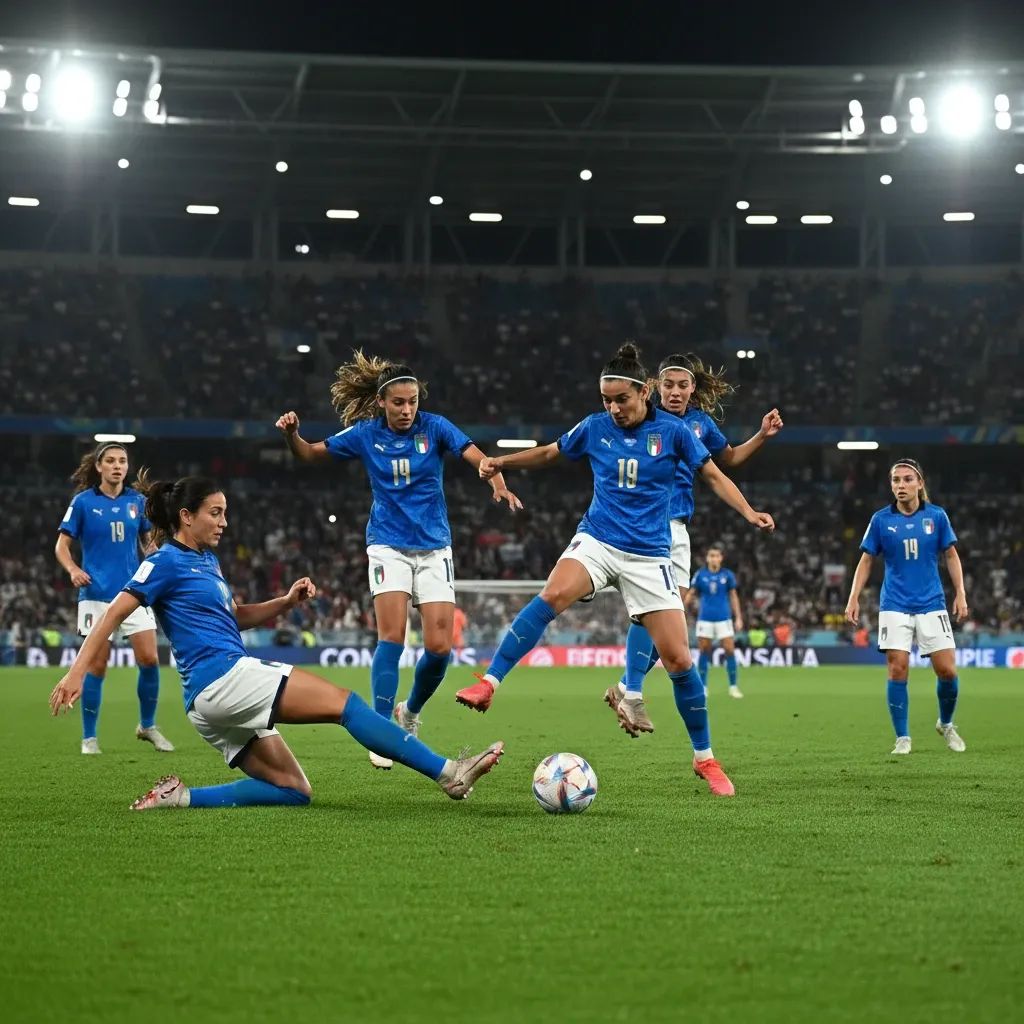
Italian football fans hoping for a backdoor entry to the 2026 World Cup can forget it, according to former FIFA Board member Evelina Christillin. Speaking on Rai Radio1's "Un Giorno da Pecora," Christillin made clear that even if Iran withdraws or faces exclusion, any substitute would almost certainly come from Asia—with Iraq and the United Arab Emirates leading the list of candidates.
Why This Stings for Italian Football
The reality is harsh for supporters of the Azzurri. Italy missed the last two World Cups—a first in 60 years in 2018, then again in 2022 after losing to North Macedonia in the qualifying playoff. A last-minute slot opening up in 2026 would have offered a glimmer of redemption, but FIFA's rules and geographic logic make that scenario virtually impossible.
What makes this especially painful is the perception of unfairness: Italy, a four-time World Cup champion with a far higher FIFA ranking than most Asian nations, has no realistic path back because continental balance trumps sporting merit in FIFA's decision-making. For Italian football, it reinforces an uncomfortable truth—missing consecutive World Cups now means rebuilding for 2030 qualifying, not hoping for second chances.
How FIFA's Replacement Rules Actually Work
Contrary to popular belief, there is no automatic substitute waiting in the wings. Article 6.7 of the 2026 World Cup regulations grants FIFA sweeping authority: if a member association withdraws or is excluded, FIFA "shall decide the matter at its sole discretion and take any action it deems necessary," including substituting another association.
The regulation imposes financial penalties scaled to timing. A withdrawal more than 30 days before the opening match triggers a minimum fine of 250,000 Swiss francs (approximately €275,000). If the pullout occurs within 30 days, the penalty doubles to 500,000 francs. Additionally, the withdrawing federation must reimburse all FIFA preparation funds—estimated at €1.4M for Iran—and forfeits participation bonuses worth at least €8.3M for the group stage alone. The federation also risks exclusion from 2030 World Cup qualifying.
Historical precedent is sparse but instructive. Yugoslavia was replaced in 1994 amid Balkan conflict, and Russia was expelled in 2022 following the Ukraine invasion. In neither case did FIFA apply a transparent, rules-based selection process for substitutes.
Why Iran's Participation Remains Uncertain
Iran's presence at the tournament hosted by the United States, Mexico, and Canada is increasingly uncertain due to geopolitical tensions. The Islamic Republic of Iran Football Federation has publicly acknowledged the difficulty of participating, with federation president Mehdi Taj stating it is hard to "look toward the World Cup with hope" amid escalating tensions with Washington and Tel Aviv.
The draw placed Iran's group stage matches in Inglewood, California and Seattle—cities with significant diaspora populations and potential security concerns. While the U.S. government has promised limited exemptions to its travel ban for athletes and coaching staff, logistical and political obstacles remain formidable.
Unlike the 2006 suspension when FIFA itself banned Iran for government interference in football administration, the current risk stems from external geopolitical factors rather than regulatory violations. No active FIFA sanctions currently prevent Iran's participation, but the tournament's location in the United States has transformed qualification into a diplomatic minefield.
Why an Asian Replacement Makes Sense
Christillin, who served on the FIFA Council and knows its internal dynamics intimately, emphasized that maintaining continental balance always takes priority. Maintaining continental balance is paramount: the 2026 tournament allocated 8 direct slots to Asia, plus one intercontinental playoff berth. If Iran exits, replacing it with a European side would distort the carefully negotiated geographic quotas that underpin FIFA's political legitimacy among its 211 member associations.
Iraq appears the strongest candidate. The nation advanced to the AFC intercontinental playoff, where it will face a team from another confederation for a final World Cup berth. If Iraq loses that playoff and Iran subsequently withdraws, FIFA could logically redirect the Asian slot to Baghdad. The United Arab Emirates, another established Gulf power with prior World Cup experience, represents a secondary option.
What Comes Next for Italian Football
For Italy, the message is unambiguous: the 2022 playoff defeat to North Macedonia has closed the door to this World Cup cycle. The Italian Football Federation (FIGC) must now focus entirely on 2030 qualifying, where the Azzurri will compete in a European group alongside other former champions seeking redemption.
In Italy, this reality has prompted serious reflection. The Italian sports press has emphasized the need to rebuild rather than wait for miracles, and Series A clubs are aware that national team redemption—not this cycle, but the next—will require both tactical innovation and development of emerging talent. The Azzurri cannot afford another miss. For Italian football supporters and analysts, the lesson is clear: World Cup qualification is earned through qualifying campaigns, not awarded through FIFA discretion.
The Timing and Discretion Question
Any Iranian decision would need to materialize well before the June 2026 kickoff to allow for orderly substitution. If the withdrawal occurs after the tournament begins, FIFA regulations mandate 3-0 forfeit victories for opponents rather than mid-tournament replacement. The financial penalties and reputational damage would be severe, but the sporting outcome would be straightforward.
Conversely, an early withdrawal—say, three to six months before the opening match—would give FIFA time to organize a replacement process. The closer to the tournament, the more chaotic and arbitrary the solution becomes. In any scenario, FIFA President Gianni Infantino and the FIFA Council will prioritize preserving geographic and political balance over reopening European grievances or making exceptions for higher-ranked teams.


