
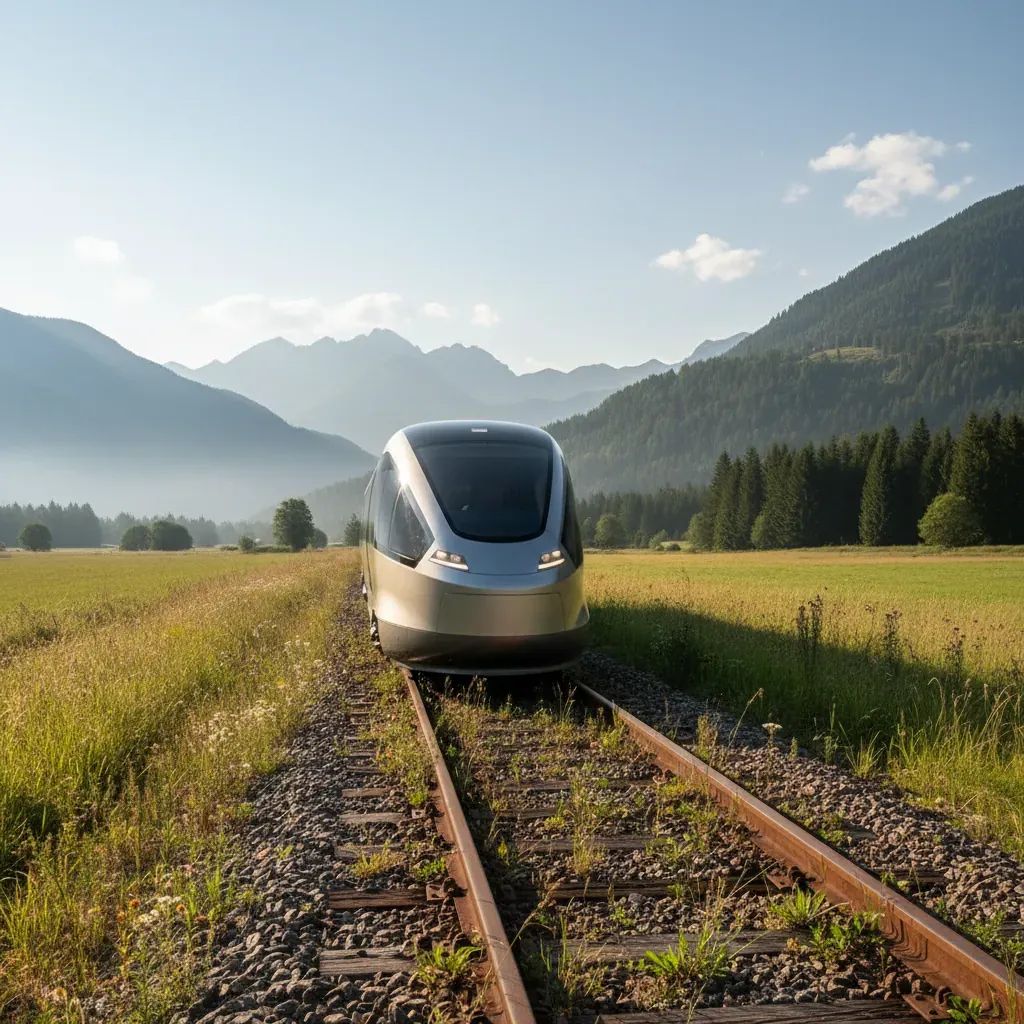
Regional authorities in northern Italy have approved experimental testing of what may be the world's first autonomous rail taxi, a compact electric vehicle designed to revive thousands of kilometers of abandoned single-track railway lines scattered across the country. The prototype, capable of carrying 6 passengers at speeds up to 100 km/h, was publicly unveiled in Trento in April 2026 and is currently in early-stage trials on a 130-meter test line in northern Italy.
Why This Matters
• Abandoned infrastructure revival: Italy has between 5,000 and 7,180 km of disused railway lines, potentially cutting transport costs in underserved regions.
• On-demand service via app: The system operates like Uber for trains—book 24/7, no fixed schedules, potentially lower fares than traditional rail.
• Dual-direction capability: Two vehicles can travel opposite directions on the same single-track width, dramatically increasing capacity without new construction.
The Old-Meets-New Partnership Behind REVO#1
The project is the product of an unlikely alliance between RailEvo, a Trentino-based startup founded in 2023, and Valente S.p.A., a rail manufacturer in operation since 1919. The startup side comes courtesy of Federico Bernabei, an engineer, and Nicola Mosca, a tech-sector entrepreneur who saw potential in Italy's vast network of mothballed single-track lines. The industrial muscle arrived when 81-year-old Alberto Menoncello and his son Luca, who rescued Valente from near-bankruptcy, decided to invest in what they call "giving second chances to mono-track routes."
The collaboration centers on a patented vertical deviation system that allows the rail taxi to ascend to elevated intermediate stations for passenger stops without blocking other vehicles on the main line. This innovation, developed with technical support from Fondazione Bruno Kessler, is designed to eliminate the traditional bottleneck of single-track railways, where trains must wait at passing loops.
By May 2025, RailEvo had built a fully automated 1:5 scale model infrastructure at the Polo Meccatronica hub of Trentino Sviluppo in Rovereto. The full-scale prototype, equipped with specialized axles and control electronics, was completed and publicly demonstrated in spring 2026. Regional transport authorities are currently conducting technical and feasibility verification on the test section in Trento Nord.
What This Means for Residents (In Theory)
For Italians living in rural or semi-urban areas, the potential implications are significant—if the prototype proves viable. The country's rail network is approximately 60% single-track, totaling around 1,289 km of completely disused lines. Many of these routes serve regions facing depopulation risk, where conventional train service is economically unviable.
RailEvo's system is designed to consume significantly less energy per kilometer than electric cars, according to company projections, and requires minimal infrastructure modification. The existing track bed needs only adaptation, not replacement—a critical cost advantage when considering the €10M-plus per kilometer typically required for new rail construction.
The on-demand model theoretically eliminates the need for fixed timetables, potentially making rail viable for routes with as few as 100 daily passengers—far below the threshold for traditional service. In concept, users would book via smartphone app, and the autonomous vehicle would arrive within minutes, operating around the clock. However, these operational details remain speculative until commercial trials demonstrate viability.
The European Context
Italy is not alone in confronting the challenge of underutilized rail. At the European level, there are approximately 900 single-track lines, with roughly one-quarter transporting at least 5,000 passengers daily, according to Mosca's 2023 research. More tellingly, a study from the same year identified 13,000 km of unused single-track lines across the continent.
Other European countries are already experimenting with similar approaches. In North Rhine-Westphalia, Germany, the MONOCAB OWL project is deploying driverless monorail cabins for up to six passengers on abandoned tracks, with test operations scheduled for 2028 and full implementation by 2032. Spain's Vías Verdes program has converted 3,500 km of disused rail into greenways since 1993, though these serve recreational cycling rather than transport.
Belgium's RAVeL network and the Trans Pennine Trail in the United Kingdom follow similar recreational models, while Estonia and Latvia have jointly developed the 716-km Green Railway project for non-motorized tourism. France's Promenade plantée in Paris—a 4.5-km elevated park built on a railway viaduct—inspired similar projects worldwide but does not address the mobility gap RailEvo targets.
The Italian Rail Revival Opportunity
Rete Ferroviaria Italiana (RFI) estimates that 1,177 km of dismantled lines are suitable for social uses or soft mobility, while the FS Italiane Group owns approximately 1,450 km of disused tracks. Excluding 185 km already converted to tourist railways, 1,265 km remain available for reconversion—690 km owned by RFI and 575 km by FS.
A 2024 report titled "Futuro Sospeso" by the Alliance for Soft Mobility (AMODO) identified 38 lines totaling 1,200 km that could be reopened for passenger transport, as they remain in good condition. RailEvo's approach could complement—or compete with—the current trend of converting these routes into cycle paths and greenways, which have already claimed over 1,000 km of track bed, with 500 km successfully transformed by the FS Group.
The economic argument is straightforward: greenways serve tourism and recreation, but they do not move commuters or connect isolated villages to regional job centers. A rail taxi system, by contrast, would preserve the transport function while requiring far less investment than conventional rail reopening—assuming the technology proves operationally and economically viable.
Safety and Autonomy
The cooperative traffic management system developed with Fondazione Bruno Kessler is central to RailEvo's safety claims. Unlike traditional rail, where human error accounts for the majority of accidents, the autonomous vehicles are designed to communicate continuously to coordinate passing, merging, and station stops. The system incorporates obstacle detection and dynamic speed adjustment, with redundant sensors and fail-safe protocols in theory.
However, no formal assessment of the technology has been published by regulatory bodies, and no commercial operating license has been issued. The regulatory pathway for autonomous rail remains untested in Italy, raising questions about certification standards, insurance, and liability frameworks that must be established before wider deployment.
For residents considering the system as a future commuting option, key unknowns remain: ticket pricing, station density, service frequency, and timeline to any commercial operation. RailEvo has stated that operational costs would theoretically be lower than conventional trains, but has not disclosed fare structures or confirmed which routes would receive priority for deployment if the prototype succeeds.
What Comes Next
The Trento Nord experimental line will serve as the proving ground through 2026. If technical performance meets safety benchmarks during these early trials, regional and national authorities could consider authorizing pilot operations on a longer route, potentially in the Trentino-Alto Adige region, where provincial authorities have shown interest in mobility innovations for alpine valleys.
The project has received backing from the European Regional Development Fund, suggesting that Brussels sees potential in the model for other regions facing similar challenges. Spain, Portugal, and Greece all have extensive single-track networks with low utilization, making them logical candidates for replication if the prototype proves successful.
For now, the system remains firmly in the prototype and testing phase—an ambitious bet that Italy's vast inventory of dormant rail can be transformed from a planning challenge into a mobility asset. Whether it advances beyond the test track will depend on regulatory approval, financing decisions, technical performance validation, and political commitment to prioritizing connectivity in regions the market has historically underserved.


