
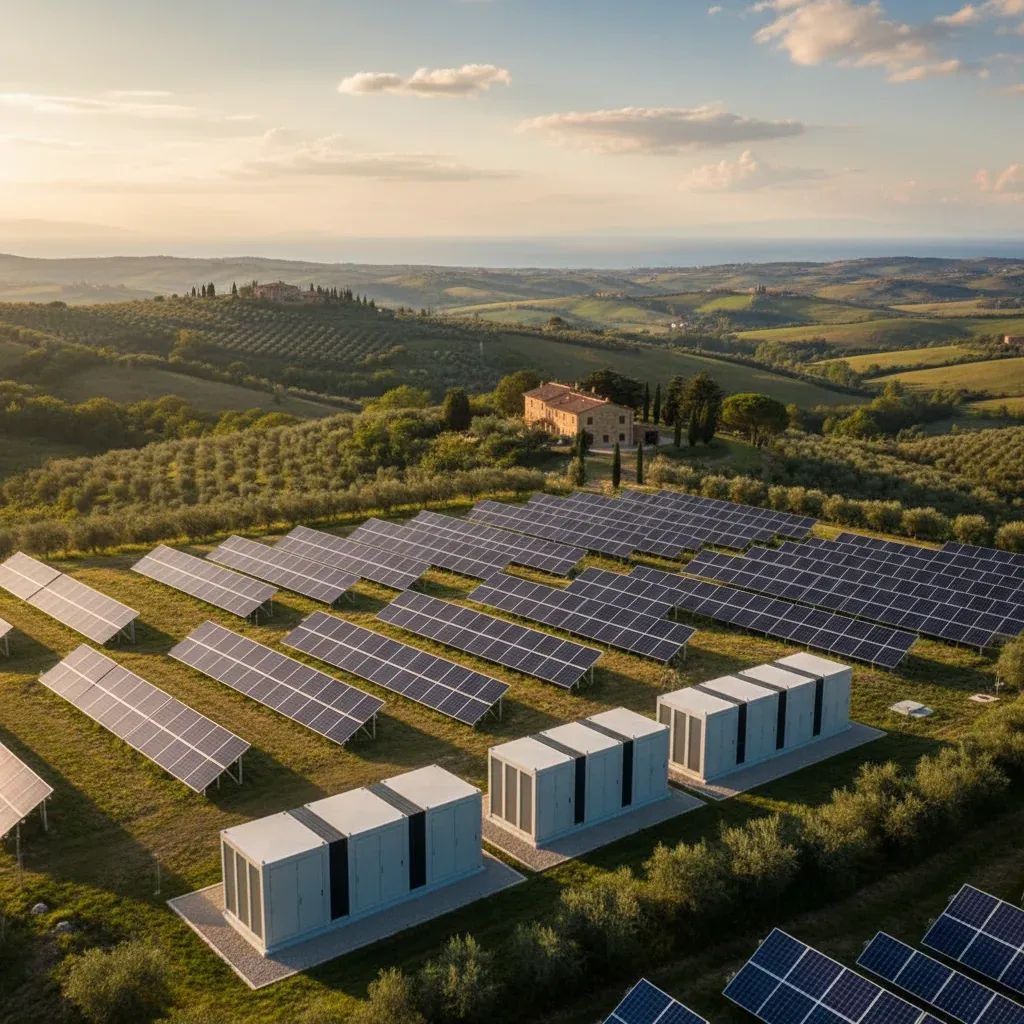
The Italy-China Business Association has formalized a strategic bridge to China's battery manufacturing colossus, establishing the Battery Business Hub Italy on March 3 in partnership with the Shenzhen Battery Industry Association (Sbia). The move positions Italy as a gateway for Chinese battery firms eyeing European expansion while giving Italian companies structured access to the world's dominant battery supply chain—a sector where China controls over 80% of global production.
Why This Matters
• Market timing: Italy's battery storage capacity jumped from under 100 MW in 2023 to 1.9 GW by late 2025, with projections to hit 15 GW by 2030.
• Investment incentives: Government schemes like the MACSE (Energy Storage Capacity Auction Mechanism) and Capacity Market have made Italy the third most attractive European market for battery projects, behind Germany and the UK.
• Cost advantage: Stationary storage battery prices dropped 45% in 2025 to $70/kWh, making large-scale grid projects increasingly viable.
• Industrial access: The Hub offers Italian manufacturers direct channels to negotiate with Chinese suppliers who produce cells up to 90% cheaper than European alternatives.
Strategic Context for Italy's Energy Transition
Italy's electricity grid is racing to accommodate a surge in solar and wind installations, which require massive storage buffers to balance intermittent generation. By the end of 2025, the country had operational battery capacity of 7.3 GWh, with energy giant Enel controlling over 85% of deployed assets, predominantly in Sardinia. The island hosts nearly half of Italy's operational battery fleet, serving as a testing ground for grid-scale storage before mainland rollout.
The Italy Ministry of Environment and Energy Security has certified over 6 GW of shovel-ready battery projects in the development pipeline, reflecting confidence in subsidy programs that guarantee 15-year revenue contracts for storage operators. Analysts project Italy could reach 9 GW of cumulative storage by decade's end if current growth trajectories hold, effectively displacing natural gas demand during evening peak hours when solar output vanishes.
What the Battery Business Hub Italy Will Do
The new platform functions as a two-way industrial matchmaker. For Italian firms, research institutes, and regional development agencies, it provides structured engagement with Sbia's member companies—a network that spans the entire battery value chain from lithium refining to pack assembly. Activities include:
• Technology scouting missions to Shenzhen, the global epicenter of battery innovation, where firms like CATL and BYD dominate manufacturing.
• Joint pilot programs targeting high-investment sectors: utility-scale storage, electric vehicle fleets, logistics hubs, and residential backup systems.
• Commercial partnership brokerage for Italian automakers, energy utilities, and industrial consumers seeking long-term supply agreements.
For Chinese battery manufacturers, the Hub offers qualified entry points into Italy and broader European markets, including feasibility studies for local production facilities and compliance support for the EU's evolving battery regulations. One precedent: In January 2024, Energy announced a joint venture with Chinese firm Pylon to produce lithium-iron-phosphate cells in Italy, with a new manufacturing plant slated for 2026.
Europe's Battery Dilemma and China's Dominance
The accord arrives as Europe grapples with a stark industrial reality: despite billions in subsidies, European battery cell production remains uncompetitive on cost and scale. Sweden's Northvolt, once heralded as the flagship of European battery sovereignty, filed for bankruptcy in 2024 before its Swedish assets were acquired by U.S. firm Lyten, which plans to restart cell sales by mid-2026.
Automotive Cells Company (ACC), a consortium backed by Stellantis and Mercedes-Benz, suspended factory construction in Germany and Italy, citing weaker-than-expected electric vehicle demand. Even Volkswagen's PowerCo subsidiary, which operates a 20-GWh plant in Salzgitter, sources much of its production equipment from Asia.
European cells can cost up to 90% more than Chinese equivalents, a gap driven by China's vertical integration of raw material processing, electrode manufacturing, and cell assembly. The European Commission's Industrial Accelerator Act seeks to attract foreign investment in strategic sectors—including batteries—by imposing conditions on deals exceeding €100 M and offering streamlined permitting. Yet the policy walks a tightrope: Europe needs Chinese capital and expertise while attempting to reduce supply chain dependence.
Impact on Residents, Businesses, and Investors in Italy
For homeowners and building managers, cheaper battery storage translates to more affordable residential solar-plus-storage systems, reducing reliance on grid electricity during high-tariff evening hours. The price drop to $70/kWh makes rooftop systems viable for middle-income households, particularly in sun-rich southern regions.
Industrial consumers—from ceramics factories in Sassuolo to food processors in Emilia-Romagna—can leverage the Hub to negotiate bulk purchases of energy storage solutions, cutting peak-demand charges and buffering against grid instability. Logistics firms operating electric delivery fleets gain access to Chinese fast-charging infrastructure technology and battery swap systems already proven in Shenzhen's massive e-mobility ecosystem.
Investors and developers eyeing Italy's 6 GW project pipeline can use the Hub to source components at competitive prices, improving project economics for utility-scale storage farms. With MACSE auctions guaranteeing revenue streams, access to low-cost Chinese cells could be the difference between a bankable project and a shelved one.
Startups and research institutions—particularly in battery chemistry, recycling, and second-life applications—gain introductions to Chinese partners who can prototype, scale, and manufacture innovations faster than European counterparts. Italy's National Research Council (CNR) and university labs in Milan, Turin, and Bologna could fast-track commercialization of sodium-ion or solid-state battery research by tapping Sbia's network.
Regulatory and Geopolitical Considerations
The Hub's launch coincides with heightened European scrutiny of Chinese industrial policy. Brussels is weighing tariffs and local-content requirements to protect nascent European cell manufacturers, while also recognizing that an outright ban on Chinese components would cripple the continent's energy transition timeline.
Italy's geographic position as a Mediterranean crossroads makes it an attractive landing point for Chinese firms seeking EU market access without the higher labor costs of northern Europe. The Italy Ministry of Economic Development has signaled openness to foreign investment in green technologies, provided projects create local jobs and involve technology transfer.
However, concerns about over-reliance persist. If geopolitical tensions escalate—or if China restricts exports of critical battery materials like lithium hydroxide or graphite—Italy's energy storage ambitions could stall. The Hub's architects argue that diversification through engagement is less risky than isolation, pointing to Italy's historical role as a bridge between Europe and global supply chains.
The Broader European Battery Landscape
Beyond Italy, PowerCo is building a twin facility in Valencia, Spain, targeting production start by late 2026. Bavaria is developing a sodium-ion battery plant slated for commissioning by year-end, a technology China has already deployed in mass-market electric vehicles. Lyten's reopened Northvolt sites in Sweden aim to ship European-made cells by the second half of 2026, though initial volumes will be modest.
These fragmented efforts highlight Europe's challenge: no single European firm approaches the scale or cost structure of CATL, which alone supplies nearly 40% of global EV batteries. The Battery Business Hub Italy represents a pragmatic middle path—leveraging Chinese efficiency while building Italian industrial capacity and expertise.
What Comes Next
The Hub's first deliverable is a joint delegation visit scheduled for later in 2026, bringing Italian manufacturers and policymakers to Shenzhen for facility tours and matchmaking sessions. Sviluppo Cina will also host quarterly webinars on Chinese battery market trends, regulatory updates, and technology roadmaps.
For Italy, success will be measured not just in gigawatt-hours deployed, but in knowledge transfer and local value creation. If the Hub facilitates Italian firms moving up the battery value chain—from passive buyers to co-developers of next-generation storage systems—it could become a model for other European nations navigating the China dilemma.
For now, the arithmetic is straightforward: Italy needs tens of gigawatt-hours of storage to hit 2030 renewable targets, and Chinese manufacturers produce the cheapest, most proven batteries on the planet. The Battery Business Hub Italy formalizes that reality, turning a de facto dependence into a structured partnership with defined goals and mutual obligations.


