
Cellnex Italia, the telecommunications infrastructure giant led by Marco Patuano, has locked in a strategic alliance with Point One Navigation, a U.S.-based precision positioning specialist, to roll out centimeter-accurate location services across six European markets—a foundational shift that could finally make autonomous logistics, robotics, and agriculture economically viable on the continent.
Why This Matters:
• 100x accuracy boost: The network delivers centimeter-level positioning (versus the 5–15 meter margin of consumer GPS), enabling robots and drones to distinguish a roadway from a ditch.
• Italy deployment confirmed: Cellnex's roughly 25,000 Italian tower sites will host Point One's RTK correction stations, accelerating coverage for farms, construction zones, and urban logistics corridors.
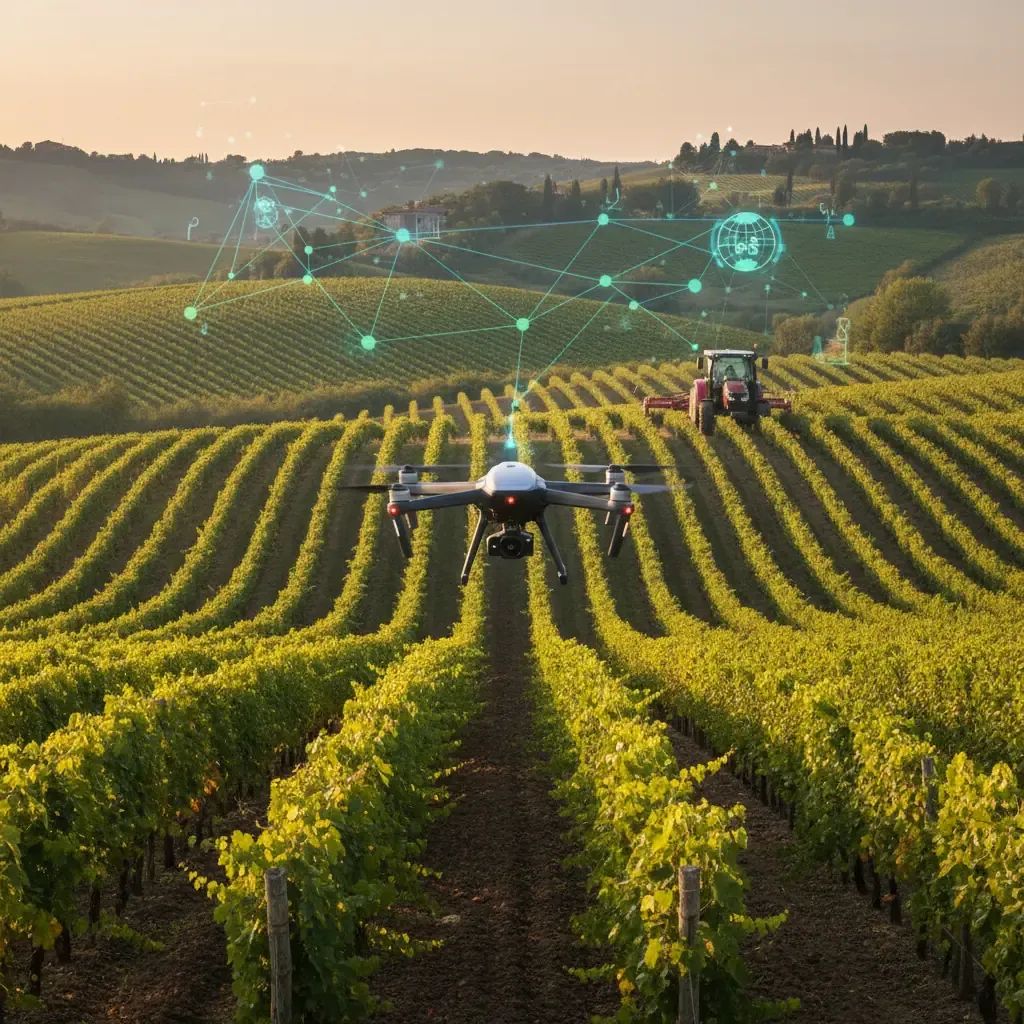
• Physical AI unlock: From autonomous tractors in Lombardy vineyards to last-mile delivery bots in Milan, the infrastructure enables "Physical AI"—machines that interact safely with the real world at scale.
The partnership, unveiled ahead of Mobile World Congress 2025 in Barcelona, marks a rare convergence: a European tower operator providing the physical backbone for a precision positioning technology, with immediate commercial applications from Poland to Switzerland.
The Positioning Gap Europe Needs to Close
Standard consumer GPS suffers from a structural flaw: atmospheric distortion, orbital drift, and weak urban signal reception conspire to produce location errors of 5 to 15 meters. In most consumer contexts—navigation apps, fitness trackers—that's tolerable. For a €150,000 autonomous harvester threading between rows of vines spaced 1.5 meters apart, or a delivery robot navigating a pedestrian crossing, it's catastrophic.
Point One Navigation's Polaris RTK network solves this by deploying ground-based correction stations with known fixed positions. These stations compare their calculated location against satellite signals, compute the error in real time, and broadcast corrections to nearby receivers—100 times more accurate than raw GNSS data. The result: positioning accurate to 1–2 centimeters, updated in real time, even in challenging environments like urban canyons or beneath overpasses where traditional GPS fails.
Under the new agreement, Point One will leverage Cellnex's neutral-host telecommunications sites in Italy, Poland, Denmark, Sweden, the Netherlands, and Switzerland to densify its correction network. For Italy, where Cellnex operates approximately 25,000 tower sites, this translates into rapid, cost-efficient deployment without the need to secure new real estate or permitting.
Lucas McKenna, Point One's Europe Director, framed the challenge bluntly: "Traditional GPS gives you 5-meter accuracy—the difference between being on a road and in a lake. Our RTK network delivers centimeter precision at continental scale. Europe needs a step change in critical infrastructure, and with Cellnex, we're building the foundational layer so Physical AI can operate safely in the real world."
What This Means for Residents and Businesses
For Italian farmers, particularly those in high-value crops like vineyards, olive groves, and vegetable production, the immediate impact is economic. Autonomous tractors guided by centimeter-accurate positioning can follow planting rows with surgical precision, reducing waste and increasing yields by optimizing seed spacing and chemical application. Small and mid-sized farms—historically priced out of precision agriculture by the cost of proprietary systems—gain access to affordable, subscription-based positioning that integrates with third-party machinery.
Construction and infrastructure projects stand to benefit from automated leveling and grading systems. Foundation work, historically dependent on manual surveying crews, can now proceed with autonomous machinery that adjusts blade angles and compaction patterns in real time, cutting labor costs and improving precision on job sites from highway expansions to industrial parks.
Urban logistics in congested Italian cities—Rome, Milan, Turin—faces a structural bottleneck: narrow streets, restricted delivery windows, and rising labor costs. Autonomous delivery robots, already piloted in limited zones, require centimeter positioning to navigate sidewalks, cross intersections, and avoid pedestrians. Point One's technology enables reliable operation even under arcades, bridges, and between tall buildings, where satellite visibility is compromised. The company's Positioning Engine fuses GNSS data with inertial measurement units (IMU) and wheel odometry, maintaining accuracy when satellites are momentarily obscured.
Drones—whether for parcel delivery, agricultural monitoring, or infrastructure inspection—depend on precise localization for autonomous flight. The RTK network reduces positioning drift, improves flight stability, and accelerates the shift from prototype to commercial-scale deployment by ensuring regulatory compliance with strict operational safety margins.
Jamie Hayes, Cellnex Global Sales Director, emphasized the industrial breadth: "We're giving momentum to Europe's robotics industry across automotive, transport, logistics, and public safety sectors. This is infrastructure that enables an entire ecosystem."
How the Technology Works in Practice
Real-Time Kinematic (RTK) positioning relies on a simple but powerful concept: measuring carrier-phase signals from GNSS satellites (GPS, Galileo, GLONASS, BeiDou), rather than the coarser pseudorange codes used by consumer devices. Carrier-phase measurements are inherently more precise but ambiguous—receivers must resolve an unknown integer number of signal wavelengths.
Point One's network operates over 1,440 correction stations globally, with European expansion now underway. When a rover (mobile receiver) powers on, it connects via cellular or internet link to Point One's cloud platform, which automatically assigns the nearest correction station and streams differential corrections in real time. Advanced algorithms resolve carrier-phase ambiguities within seconds, delivering centimeter accuracy without post-processing delays.
For challenging environments—urban centers, forested areas, or mountain valleys—Point One's Positioning Engine integrates sensor fusion: combining GNSS with IMU accelerometers, gyroscopes, and wheel encoders to maintain positioning continuity even during brief signal dropouts. This multi-sensor approach is critical for autonomous vehicles that cannot tolerate navigation interruptions.
The partnership with Cellnex accelerates deployment by piggy-backing on existing telecom tower infrastructure, reducing capital expenditure and shortening time-to-market. Cellnex's neutral-host model—tower sites shared by multiple telecom carriers—offers geographic reach, power redundancy, and secure physical locations ideal for hosting sensitive positioning equipment.
Europe's Autonomous Economy and the Competitive Landscape
The Cellnex–Point One partnership reflects the broader shift among European telecom operators to redefine their role beyond basic connectivity. 5G expansion, edge computing, and emerging autonomous technologies are converging into a new infrastructure model where telecoms serve as foundational providers for robotics, autonomous vehicles, and smart systems. This shift requires investment in precision technologies that go beyond traditional network services.
European telecoms are positioning themselves as critical infrastructure providers for the autonomous economy. Edge computing architectures—processing data closer to end-users—reduce network congestion and cut latency to sub-10 millisecond ranges, essential requirements for real-time control of autonomous systems.
Telecom Italia (TIM), Orange, and other major operators across Europe are increasingly partnering with technology and cloud providers to build the computational and connectivity backbone needed for autonomous deployment. The European Commission's "Connecting Europe Facility – Digital" program is co-funding large-scale 5G pilot corridors and smart communities, recognizing telecom infrastructure as critical to security, technological independence, and social cohesion.
Yet fragmentation persists. Regulatory complexity across member states, cautious capital allocation, and the legacy burden of LTE networks slow the transition to fully cloud-native, AI-driven architectures. The Cellnex–Point One deal offers a shortcut: leveraging existing physical assets to deploy a new service layer without a decade-long build cycle.
Regulatory and Privacy Considerations
Centimeter-accurate positioning raises questions around data sovereignty, privacy, and security. Unlike consumer GPS—which operates passively, with no uplink—RTK services require real-time data transmission between rovers and correction stations. Point One's cloud platform processes location streams, raising concerns about who owns movement data, how long it's retained, and whether it could be accessed by third parties.
Italy's Data Protection Authority (Garante per la protezione dei dati personali) has historically taken a strict stance on location tracking. Autonomous vehicle operators and robotics firms deploying Point One–enabled systems will need to ensure compliance with GDPR Article 6 (lawful basis for processing), Article 25 (data protection by design), and sector-specific rules under Italy's Legislative Decree 196/2003 (Privacy Code).
The partnership announcement does not detail data residency commitments—whether correction data and positioning logs will be stored on European soil or routed through external servers. Given the sensitive nature of infrastructure positioning, this will likely become a negotiation point with Italian and EU regulators.
What Comes Next
The rollout timeline and pricing structure remain unannounced. Cellnex has confirmed that deployment will begin across the six initial markets, with Italy among the first. Interested parties—agricultural cooperatives, construction firms, logistics operators, drone service providers—should monitor announcements from Point One Navigation and Cellnex Italia regarding commercial availability, subscription tiers, and integration support.
For Italian municipalities exploring autonomous public transport or last-mile delivery pilots, the infrastructure could remove a critical technical barrier, shifting the conversation from "can it work?" to "how do we regulate it?" Urban planners in cities like Bologna, Florence, and Naples will need to update zoning, permitting, and safety protocols to accommodate autonomous systems that rely on this new positioning layer.
The partnership underscores a broader reality: Europe's industrial autonomy—whether in agriculture, manufacturing, or logistics—depends not just on software and robotics, but on the invisible infrastructure that makes precision possible. The convergence of telecom towers and satellite correction networks is unglamorous but foundational, the kind of infrastructure investment that separates pilot projects from industrial-scale deployment.


